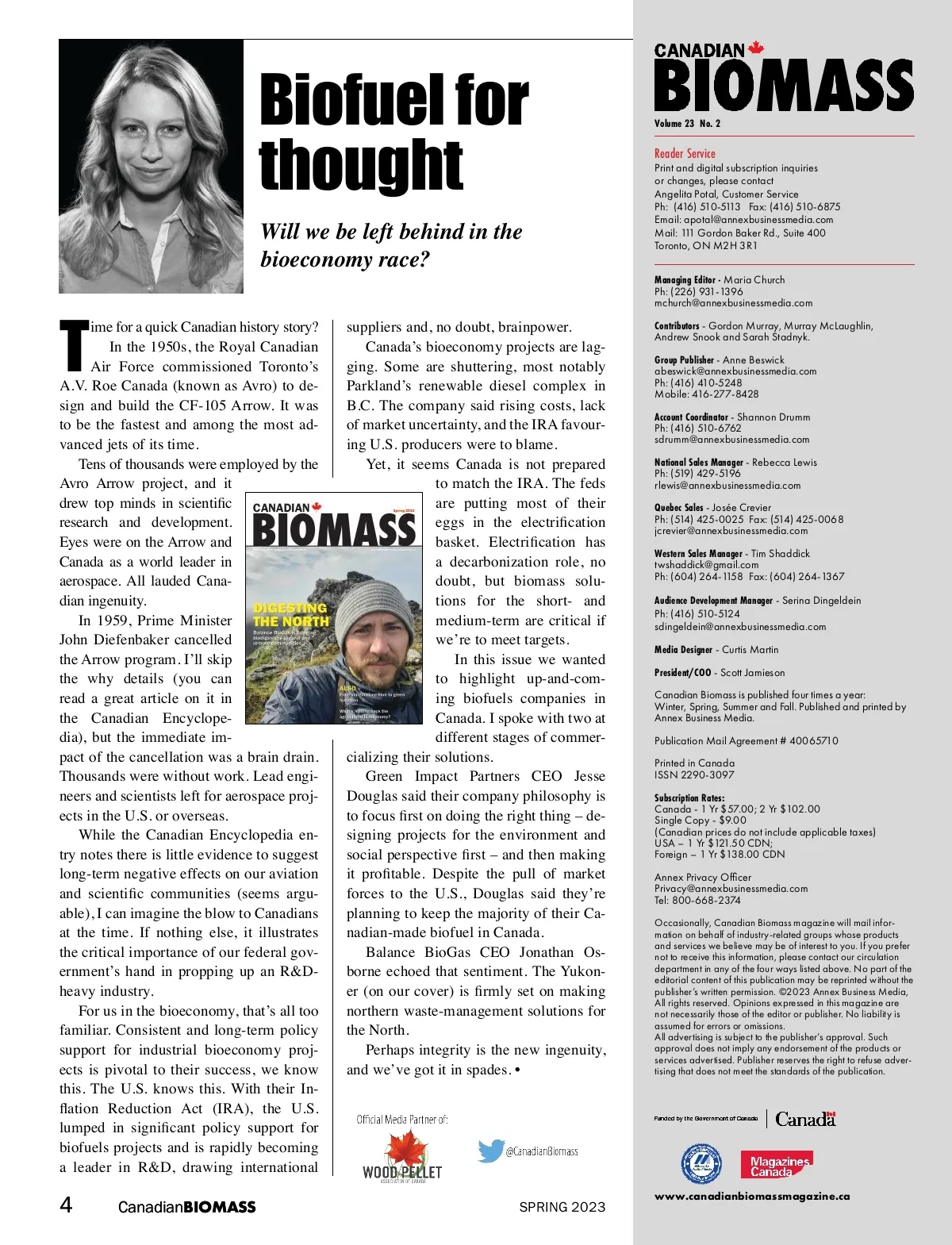
BIOMASS BOILERS AMONG FUNDED PROJECTS TO IMPROVE GRAIN DRYING STEEPER’S ALBERTA FORESTRY BIOCRUDE PLANT MOVES FORWARD Steeper Energy and Invest Alberta have signed a memoran-dum of understanding to commercialize Steeper’s proprietary Hydrofaction technology within Alberta. Steeper’s technology is a proprietary form of hydrother-mal liquefaction (HTL) capable of converting a wide range of biowaste feedstocks to flexible renewable biocrude. The biocrude can be used directly or upgraded for use as a re-newable marine, diesel, or aviation fuel. Focused on use of third-generation biomass, Steeper’s first commercial plant in Alberta aims to use large volumes of forestry residue. The company said in an April news release it is actively identi-fying potential commercial partners and evaluating project sites. Emissions Reduction Alberta awarded Steeper $5 million in funding in 2021 to help establish their first commercial scale plant in Alberta. Canada’s Ministry of Agriculture and Agri-Food is funding 45 projects that will allow grain farmers to adopt more efficient drying technology, such as biomass boilers. More than $22.2 million is being provided for the equipment upgrades and fuel switching initiatives through the Agricultural Clean Technology Program – Adoption Stream. To date the pro -gram has supported 99 dryer projects across the country. Geerts Farms Ltd., in Kamsack, Sask., is among the program recipients. The 26,000-acre family-operated producer of canola, wheat and oats is receiving up to $2 million to purchase and in-stall a new grain dryer and biomass boiler. The boiler is powered by locally sourced wood waste and will eliminate the farm’s cur-rent use of propane. WPAC WELCOMES ‘NOT PERFECT’ REDIII DEAL BIOINDUSTRIAL INNOVATION CANADA, BIOENTERPRISE CANADA JOIN FORCES ON CLEANTECH Canada’s clean, green, sustainable chemistry business accel-erator and Canada’s Food & Agri-Tech Engine are collabo-rating to enhance support for cleantech innovators. Bioindustrial Innovation Canada (BIC) has joined Bioen-terprise Canada as a Knowledge & Development Partner. The two organizations have signed a memorandum of understanding to help entrepreneurs and growth-oriented businesses with sustainable green technologies access more resources to support development and commercialization of their innovations. BIC’s portfolio companies gain access to Bioenterprise’s national network of mentors, resources and funding while Bio-enterprise members and partners across Canada can explore opportunities in the sustainable chemistry space through BIC’s national and international network. The Wood Pellet Association of Canada (WPAC) is welcoming news of the European Parliament’s deal on the EU Renewable Energy Directive (REDIII). In a message to members, WPAC executive director Gordon Murray said, while not perfect, there is a lot to be appreciated in the deal. “Many of the points that were better for our sector and sup-ported by the European Council were adopted in the final agree -ment and the most damaging points proposed by the European Parliament were rejected,” Murray noted. Original proposals in the deal that were rejected include pro-hibition on the use of primary biomass and the enforcement of “no go” areas, he said. LOAN FOR QUEBEC BIOREFINERY The Canada Infrastructure Bank is providing a loan of $277 mil-lion to a joint-venture partnership between Shell, Suncor, Pro-man and the government of Québec that will enable construction of Canada’s largest biorefinery, based on Enerkem technology. The $1.2 billion facility – Varennes Carbon Recycling – will include an electrolyzer which will supply clean hydrogen and oxygen to convert more than 200,000 tonnes of non-recyclable waste and residual biomass into biofuels with a capacity of up to 130 million litres annually. Canadian BIOMASS 5
Canadian Biomass Spring 2023: Page 5