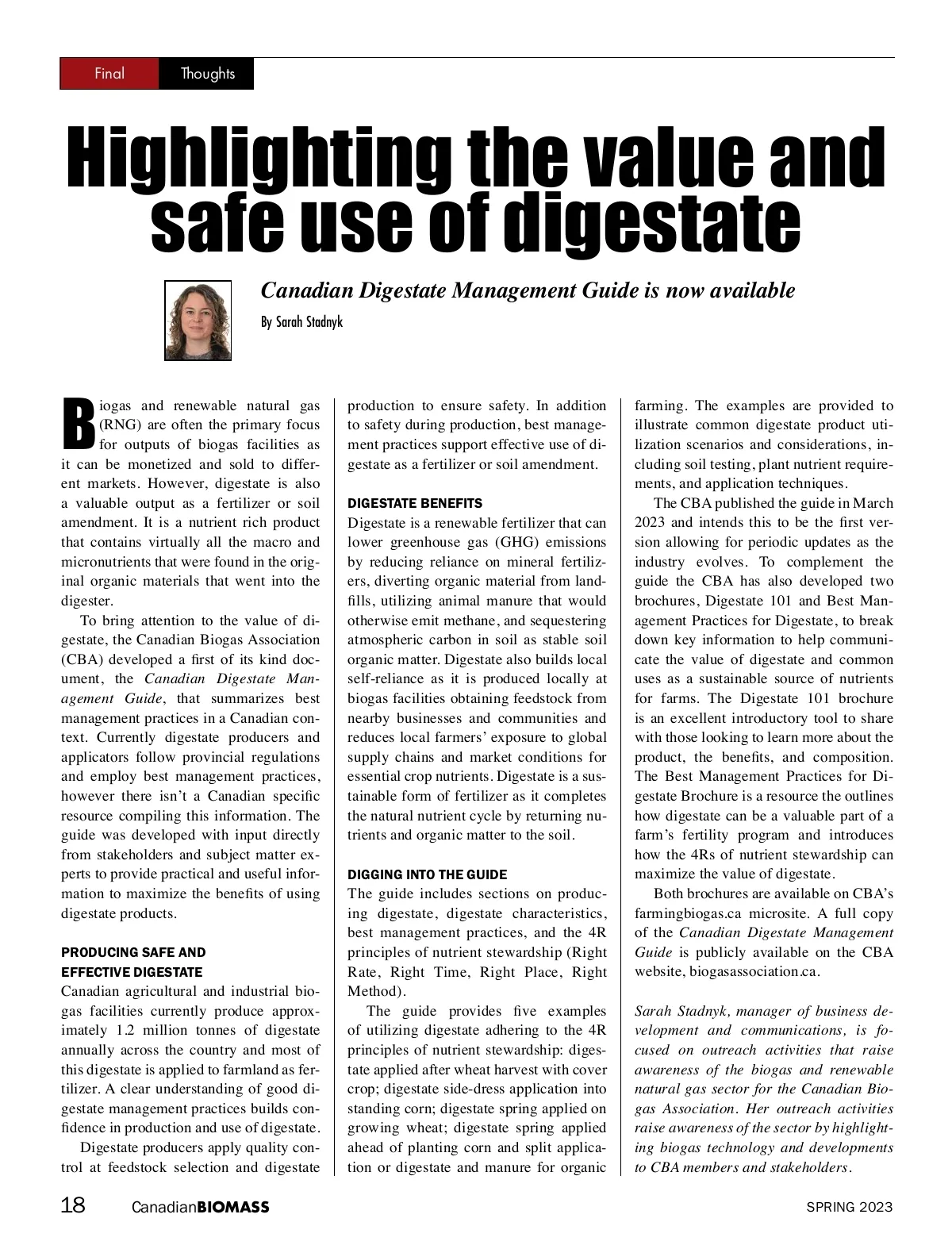
Final Thoughts Highlighting the value and safe use of digestate Canadian Digestate Management Guide is now available By Sarah Stadnyk iogas and renewable natural gas (RNG) are often the primary focus for outputs of biogas facilities as it can be monetized and sold to differ-ent markets. However, digestate is also a valuable output as a fertilizer or soil amendment. It is a nutrient rich product that contains virtually all the macro and micronutrients that were found in the orig-inal organic materials that went into the digester. To bring attention to the value of di-gestate, the Canadian Biogas Association (CBA) developed a first of its kind doc -ument, the Canadian Digestate Man-agement Guide , that summarizes best management practices in a Canadian con-text. Currently digestate producers and applicators follow provincial regulations and employ best management practices, however there isn’t a Canadian specific resource compiling this information. The guide was developed with input directly from stakeholders and subject matter ex-perts to provide practical and useful infor-mation to maximize the benefits of using digestate products. PRODUCING SAFE AND EFFECTIVE DIGESTATE B production to ensure safety. In addition to safety during production, best manage-ment practices support effective use of di-gestate as a fertilizer or soil amendment. DIGESTATE BENEFITS Digestate is a renewable fertilizer that can lower greenhouse gas (GHG) emissions by reducing reliance on mineral fertiliz-ers, diverting organic material from land-fills, utilizing animal manure that would otherwise emit methane, and sequestering atmospheric carbon in soil as stable soil organic matter. Digestate also builds local self-reliance as it is produced locally at biogas facilities obtaining feedstock from nearby businesses and communities and reduces local farmers’ exposure to global supply chains and market conditions for essential crop nutrients. Digestate is a sus-tainable form of fertilizer as it completes the natural nutrient cycle by returning nu-trients and organic matter to the soil. DIGGING INTO THE GUIDE Canadian agricultural and industrial bio-gas facilities currently produce approx-imately 1.2 million tonnes of digestate annually across the country and most of this digestate is applied to farmland as fer-tilizer. A clear understanding of good di-gestate management practices builds con-fidence in production and use of digestate. Digestate producers apply quality con-trol at feedstock selection and digestate The guide includes sections on produc-ing digestate, digestate characteristics, best management practices, and the 4R principles of nutrient stewardship (Right Rate, Right Time, Right Place, Right Method). The guide provides five examples of utilizing digestate adhering to the 4R principles of nutrient stewardship: diges-tate applied after wheat harvest with cover crop; digestate side-dress application into standing corn; digestate spring applied on growing wheat; digestate spring applied ahead of planting corn and split applica-tion or digestate and manure for organic farming. The examples are provided to illustrate common digestate product uti-lization scenarios and considerations, in-cluding soil testing, plant nutrient require-ments, and application techniques. The CBA published the guide in March 2023 and intends this to be the first ver -sion allowing for periodic updates as the industry evolves. To complement the guide the CBA has also developed two brochures, Digestate 101 and Best Man-agement Practices for Digestate, to break down key information to help communi-cate the value of digestate and common uses as a sustainable source of nutrients for farms. The Digestate 101 brochure is an excellent introductory tool to share with those looking to learn more about the product, the benefits, and composition. The Best Management Practices for Di-gestate Brochure is a resource the outlines how digestate can be a valuable part of a farm’s fertility program and introduces how the 4Rs of nutrient stewardship can maximize the value of digestate. Both brochures are available on CBA’s farmingbiogas.ca microsite. A full copy of the Canadian Digestate Management Guide is publicly available on the CBA website, biogasassociation.ca. Sarah Stadnyk, manager of business de-velopment and communications, is fo-cused on outreach activities that raise awareness of the biogas and renewable natural gas sector for the Canadian Bio-gas Association. Her outreach activities raise awareness of the sector by highlight-ing biogas technology and developments to CBA members and stakeholders. SPRING 2023 18 Canadian BIOMASS
Canadian Biomass Spring 2023: Page 18