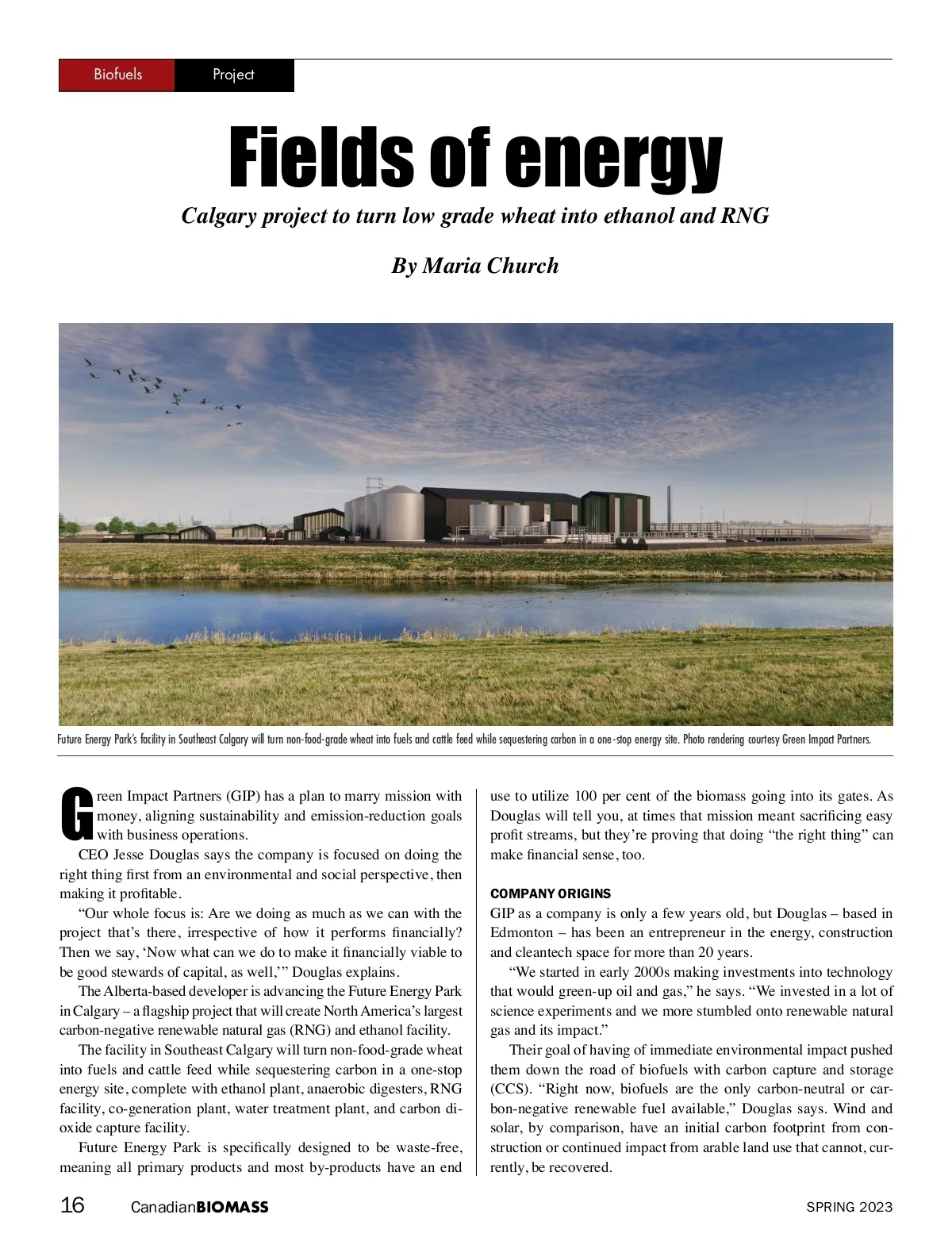
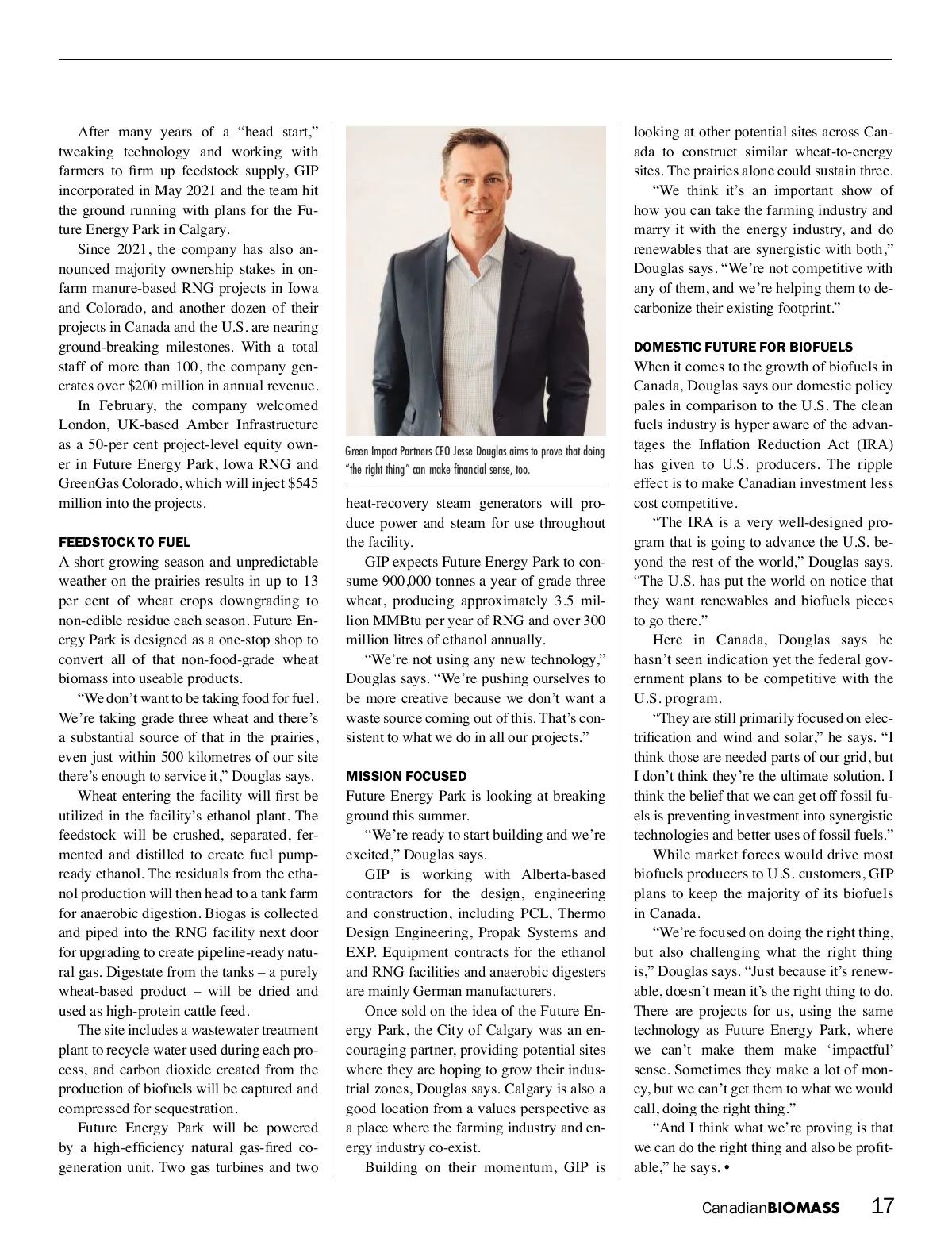
After many years of a “head start,” tweaking technology and working with farmers to firm up feedstock supply, GIP incorporated in May 2021 and the team hit the ground running with plans for the Fu-ture Energy Park in Calgary. Since 2021, the company has also an-nounced majority ownership stakes in on-farm manure-based RNG projects in Iowa and Colorado, and another dozen of their projects in Canada and the U.S. are nearing ground-breaking milestones. With a total staff of more than 100, the company gen-erates over $200 million in annual revenue. In February, the company welcomed London, UK-based Amber Infrastructure as a 50-per cent project-level equity own-er in Future Energy Park, Iowa RNG and GreenGas Colorado, which will inject $545 million into the projects. FEEDSTOCK TO FUEL looking at other potential sites across Can-ada to construct similar wheat-to-energy sites. The prairies alone could sustain three. “We think it’s an important show of how you can take the farming industry and marry it with the energy industry, and do renewables that are synergistic with both,” Douglas says. “We’re not competitive with any of them, and we’re helping them to de-carbonize their existing footprint.” DOMESTIC FUTURE FOR BIOFUELS Green Impact Partners CEO Jesse Douglas aims to prove that doing “the right thing” can make financial sense, too. A short growing season and unpredictable weather on the prairies results in up to 13 per cent of wheat crops downgrading to non-edible residue each season. Future En-ergy Park is designed as a one-stop shop to convert all of that non-food-grade wheat biomass into useable products. “We don’t want to be taking food for fuel. We’re taking grade three wheat and there’s a substantial source of that in the prairies, even just within 500 kilometres of our site there’s enough to service it,” Douglas says. Wheat entering the facility will first be utilized in the facility’s ethanol plant. The feedstock will be crushed, separated, fer-mented and distilled to create fuel pump-ready ethanol. The residuals from the etha-nol production will then head to a tank farm for anaerobic digestion. Biogas is collected and piped into the RNG facility next door for upgrading to create pipeline-ready natu-ral gas. Digestate from the tanks – a purely wheat-based product – will be dried and used as high-protein cattle feed. The site includes a wastewater treatment plant to recycle water used during each pro-cess, and carbon dioxide created from the production of biofuels will be captured and compressed for sequestration. Future Energy Park will be powered by a high-efficiency natural gas-fired co -generation unit. Two gas turbines and two heat-recovery steam generators will pro-duce power and steam for use throughout the facility. GIP expects Future Energy Park to con-sume 900,000 tonnes a year of grade three wheat, producing approximately 3.5 mil-lion MMBtu per year of RNG and over 300 million litres of ethanol annually. “We’re not using any new technology,” Douglas says. “We’re pushing ourselves to be more creative because we don’t want a waste source coming out of this. That’s con-sistent to what we do in all our projects.” MISSION FOCUSED Future Energy Park is looking at breaking ground this summer. “We’re ready to start building and we’re excited,” Douglas says. GIP is working with Alberta-based contractors for the design, engineering and construction, including PCL, Thermo Design Engineering, Propak Systems and EXP. Equipment contracts for the ethanol and RNG facilities and anaerobic digesters are mainly German manufacturers. Once sold on the idea of the Future En-ergy Park, the City of Calgary was an en-couraging partner, providing potential sites where they are hoping to grow their indus-trial zones, Douglas says. Calgary is also a good location from a values perspective as a place where the farming industry and en-ergy industry co-exist. Building on their momentum, GIP is When it comes to the growth of biofuels in Canada, Douglas says our domestic policy pales in comparison to the U.S. The clean fuels industry is hyper aware of the advan-tages the Inflation Reduction Act (IRA) has given to U.S. producers. The ripple effect is to make Canadian investment less cost competitive. “The IRA is a very well-designed pro-gram that is going to advance the U.S. be-yond the rest of the world,” Douglas says. “The U.S. has put the world on notice that they want renewables and biofuels pieces to go there.” Here in Canada, Douglas says he hasn’t seen indication yet the federal gov-ernment plans to be competitive with the U.S. program. “They are still primarily focused on elec-trification and wind and solar,” he says. “I think those are needed parts of our grid, but I don’t think they’re the ultimate solution. I think the belief that we can get off fossil fu-els is preventing investment into synergistic technologies and better uses of fossil fuels.” While market forces would drive most biofuels producers to U.S. customers, GIP plans to keep the majority of its biofuels in Canada. “We’re focused on doing the right thing, but also challenging what the right thing is,” Douglas says. “Just because it’s renew-able, doesn’t mean it’s the right thing to do. There are projects for us, using the same technology as Future Energy Park, where we can’t make them make ‘impactful’ sense. Sometimes they make a lot of mon-ey, but we can’t get them to what we would call, doing the right thing.” “And I think what we’re proving is that we can do the right thing and also be profit -able,” he says. • Canadian BIOMASS 17
Canadian Biomass Spring 2023: Page 17