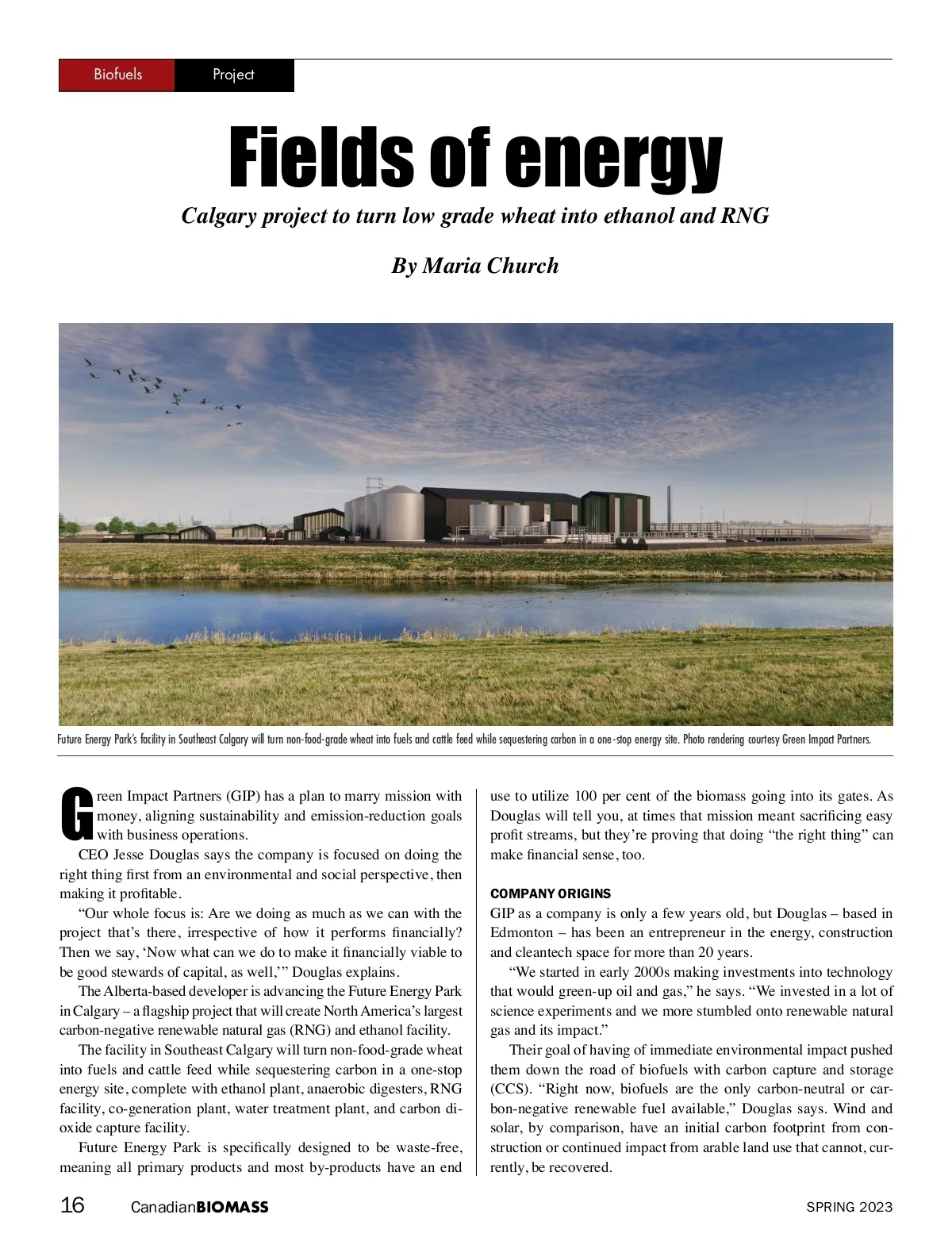
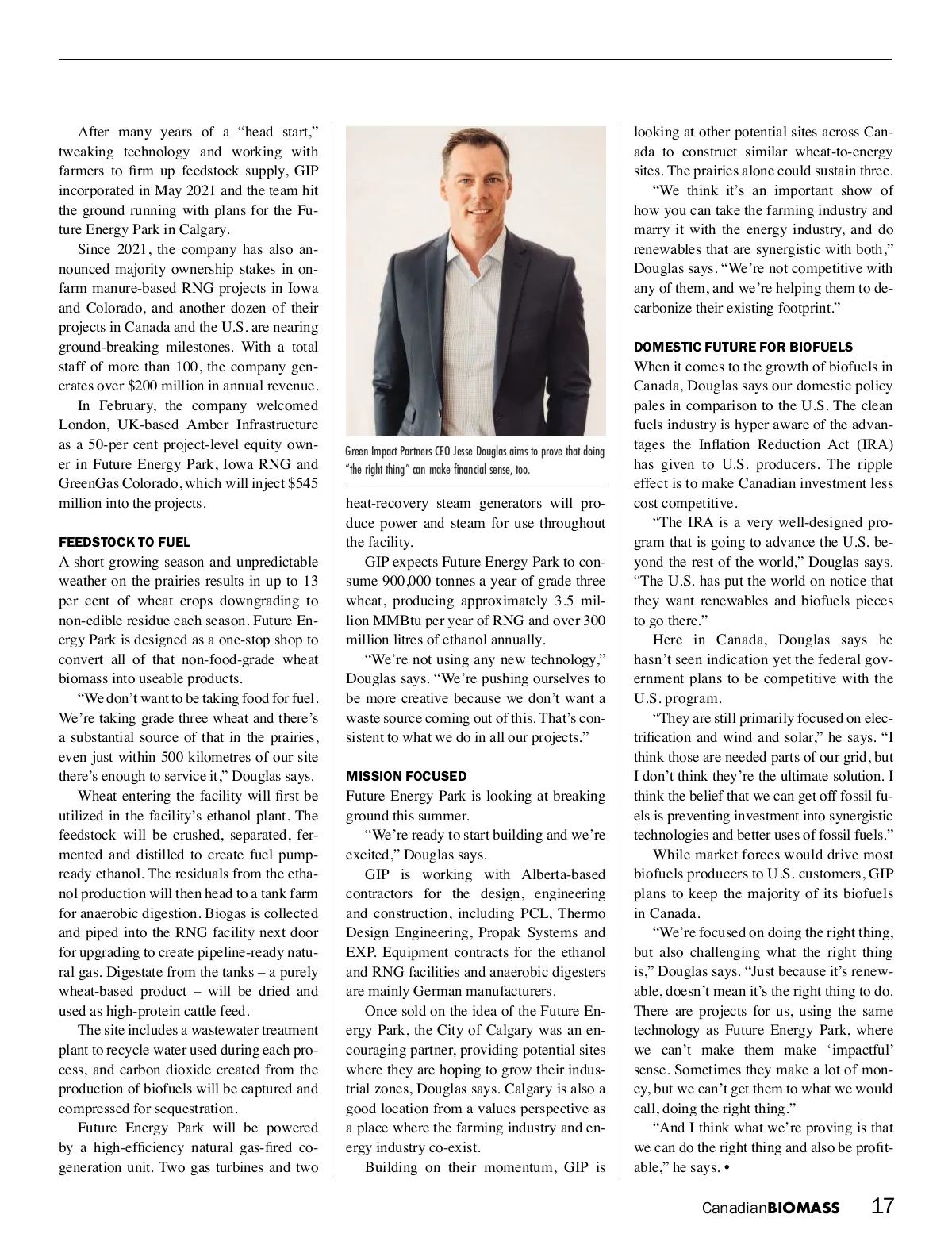
Biofuels Project Calgary project to turn low grade wheat into ethanol and RNG By Maria Church Fields of energy Future Energy Park’s facility in Southeast Calgary will turn non-food-grade wheat into fuels and cattle feed while sequestering carbon in a one-stop energy site. Photo rendering courtesy Green Impact Partners. reen Impact Partners (GIP) has a plan to marry mission with money, aligning sustainability and emission-reduction goals with business operations. CEO Jesse Douglas says the company is focused on doing the right thing first from an environmental and social perspective, then making it profitable. “Our whole focus is: Are we doing as much as we can with the project that’s there, irrespective of how it performs financially? Then we say, ‘Now what can we do to make it financially viable to be good stewards of capital, as well,’” Douglas explains. The Alberta-based developer is advancing the Future Energy Park in Calgary – a flagship project that will create North America’s largest carbon-negative renewable natural gas (RNG) and ethanol facility. The facility in Southeast Calgary will turn non-food-grade wheat into fuels and cattle feed while sequestering carbon in a one-stop energy site, complete with ethanol plant, anaerobic digesters, RNG facility, co-generation plant, water treatment plant, and carbon di-oxide capture facility. Future Energy Park is specifically designed to be waste-free, meaning all primary products and most by-products have an end G use to utilize 100 per cent of the biomass going into its gates. As Douglas will tell you, at times that mission meant sacrificing easy profit streams, but they’re proving that doing “the right thing” can make financial sense, too. COMPANY ORIGINS GIP as a company is only a few years old, but Douglas – based in Edmonton – has been an entrepreneur in the energy, construction and cleantech space for more than 20 years. “We started in early 2000s making investments into technology that would green-up oil and gas,” he says. “We invested in a lot of science experiments and we more stumbled onto renewable natural gas and its impact.” Their goal of having of immediate environmental impact pushed them down the road of biofuels with carbon capture and storage (CCS). “Right now, biofuels are the only carbon-neutral or car-bon-negative renewable fuel available,” Douglas says. Wind and solar, by comparison, have an initial carbon footprint from con-struction or continued impact from arable land use that cannot, cur-rently, be recovered. SPRING 2023 16 Canadian BIOMASS
Canadian Biomass Spring 2023: Page 16