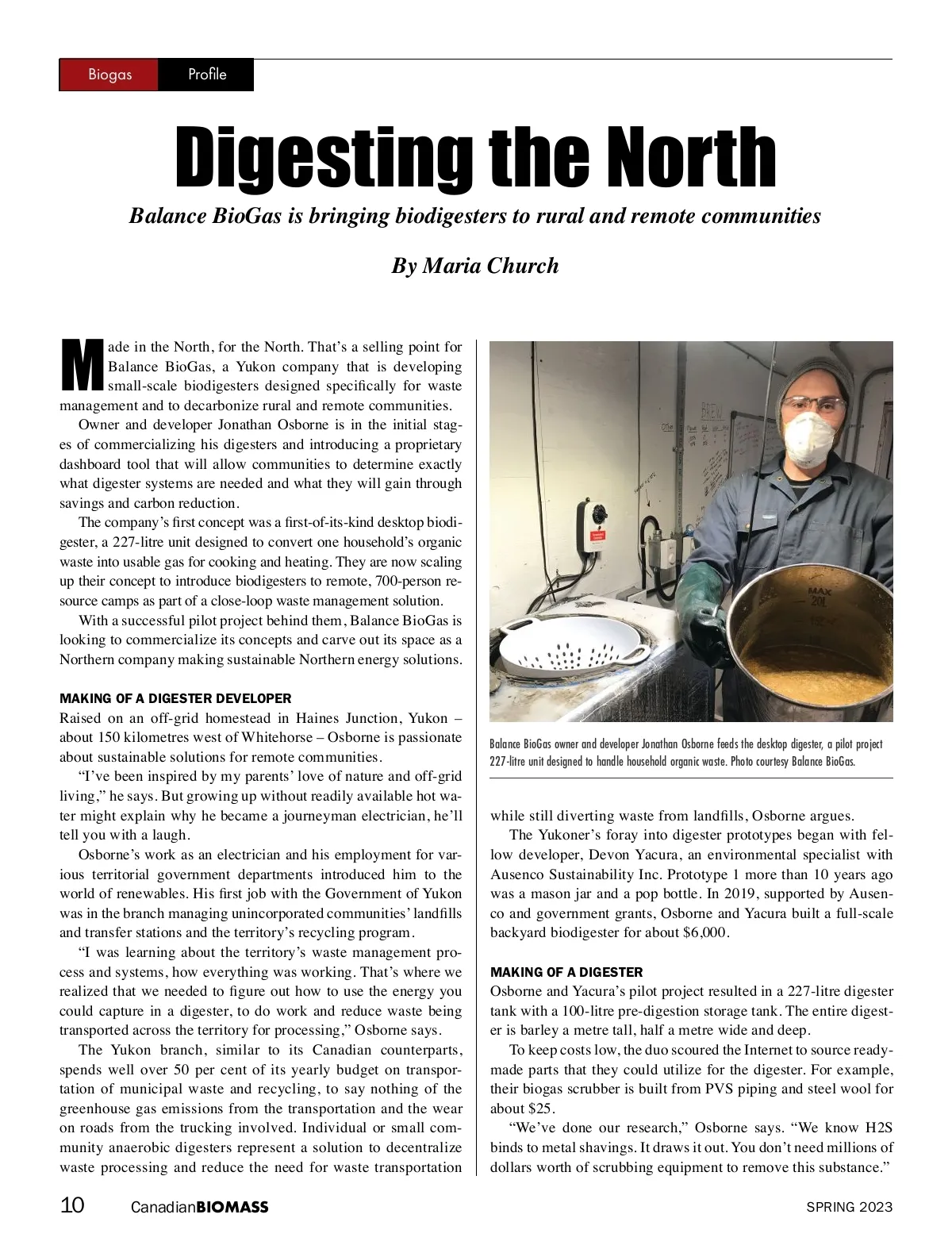
Biogas Profile Balance BioGas is bringing biodigesters to rural and remote communities By Maria Church Digesting the North M ade in the North, for the North. That’s a selling point for Balance BioGas, a Yukon company that is developing small-scale biodigesters designed specifically for waste management and to decarbonize rural and remote communities. Owner and developer Jonathan Osborne is in the initial stag-es of commercializing his digesters and introducing a proprietary dashboard tool that will allow communities to determine exactly what digester systems are needed and what they will gain through savings and carbon reduction. The company’s first concept was a first-of-its-kind desktop biodi -gester, a 227-litre unit designed to convert one household’s organic waste into usable gas for cooking and heating. They are now scaling up their concept to introduce biodigesters to remote, 700-person re-source camps as part of a close-loop waste management solution. With a successful pilot project behind them, Balance BioGas is looking to commercialize its concepts and carve out its space as a Northern company making sustainable Northern energy solutions. MAKING OF A DIGESTER DEVELOPER Raised on an off-grid homestead in Haines Junction, Yukon – about 150 kilometres west of Whitehorse – Osborne is passionate about sustainable solutions for remote communities. “I’ve been inspired by my parents’ love of nature and off-grid living,” he says. But growing up without readily available hot wa-ter might explain why he became a journeyman electrician, he’ll tell you with a laugh. Osborne’s work as an electrician and his employment for var-ious territorial government departments introduced him to the world of renewables. His first job with the Government of Yukon was in the branch managing unincorporated communities’ landfills and transfer stations and the territory’s recycling program. “I was learning about the territory’s waste management pro-cess and systems, how everything was working. That’s where we realized that we needed to figure out how to use the energy you could capture in a digester, to do work and reduce waste being transported across the territory for processing,” Osborne says. The Yukon branch, similar to its Canadian counterparts, spends well over 50 per cent of its yearly budget on transpor-tation of municipal waste and recycling, to say nothing of the greenhouse gas emissions from the transportation and the wear on roads from the trucking involved. Individual or small com-munity anaerobic digesters represent a solution to decentralize waste processing and reduce the need for waste transportation Balance BioGas owner and developer Jonathan Osborne feeds the desktop digester, a pilot project 227-litre unit designed to handle household organic waste. Photo courtesy Balance BioGas. while still diverting waste from landfills, Osborne argues. The Yukoner’s foray into digester prototypes began with fel-low developer, Devon Yacura, an environmental specialist with Ausenco Sustainability Inc. Prototype 1 more than 10 years ago was a mason jar and a pop bottle. In 2019, supported by Ausen-co and government grants, Osborne and Yacura built a full-scale backyard biodigester for about $6,000. MAKING OF A DIGESTER Osborne and Yacura’s pilot project resulted in a 227-litre digester tank with a 100-litre pre-digestion storage tank. The entire digest-er is barley a metre tall, half a metre wide and deep. To keep costs low, the duo scoured the Internet to source ready-made parts that they could utilize for the digester. For example, their biogas scrubber is built from PVS piping and steel wool for about $25. “We’ve done our research,” Osborne says. “We know H2S binds to metal shavings. It draws it out. You don’t need millions of dollars worth of scrubbing equipment to remove this substance.” SPRING 2023 10 Canadian BIOMASS
Canadian Biomass Spring 2023: Page 10