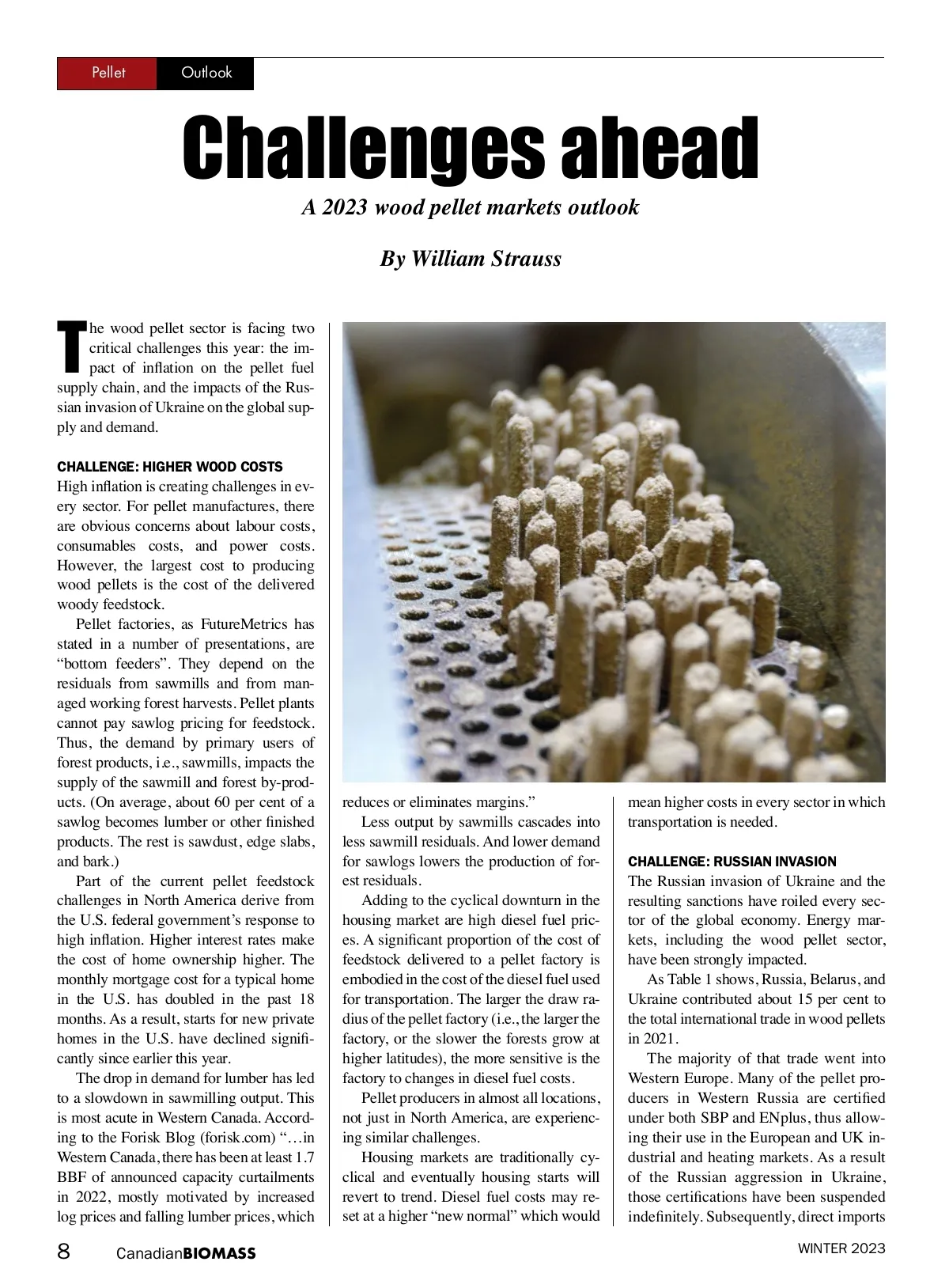
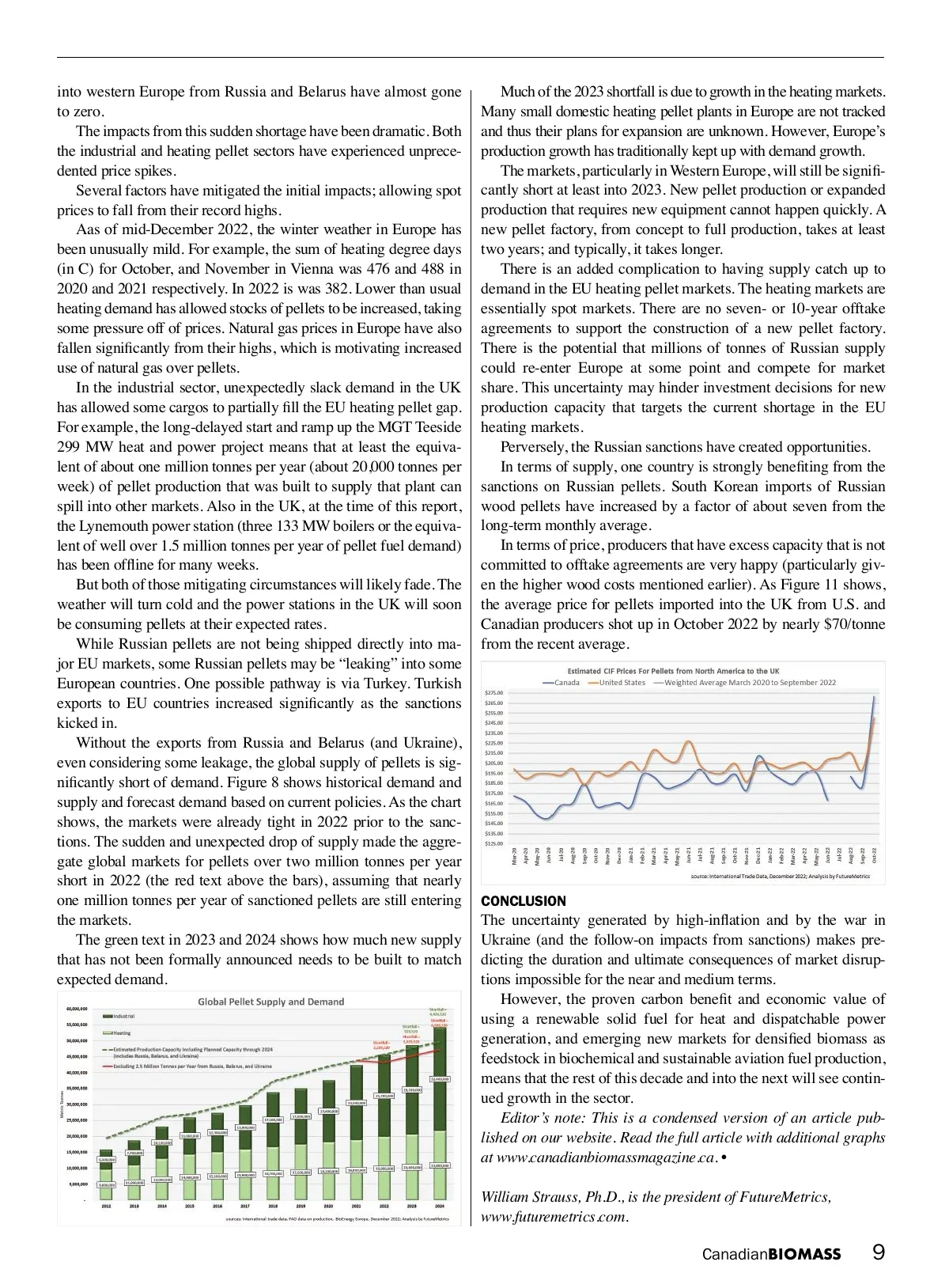
into western Europe from Russia and Belarus have almost gone to zero. The impacts from this sudden shortage have been dramatic. Both the industrial and heating pellet sectors have experienced unprece-dented price spikes. Several factors have mitigated the initial impacts; allowing spot prices to fall from their record highs. Aas of mid-December 2022, the winter weather in Europe has been unusually mild. For example, the sum of heating degree days (in C) for October, and November in Vienna was 476 and 488 in 2020 and 2021 respectively. In 2022 is was 382. Lower than usual heating demand has allowed stocks of pellets to be increased, taking some pressure off of prices. Natural gas prices in Europe have also fallen significantly from their highs, which is motivating increased use of natural gas over pellets. In the industrial sector, unexpectedly slack demand in the UK has allowed some cargos to partially fill the EU heating pellet gap. For example, the long-delayed start and ramp up the MGT Teeside 299 MW heat and power project means that at least the equiva -lent of about one million tonnes per year (about 20,000 tonnes per week) of pellet production that was built to supply that plant can spill into other markets. Also in the UK, at the time of this report, the Lynemouth power station (three 133 MW boilers or the equiva-lent of well over 1.5 million tonnes per year of pellet fuel demand) has been offline for many weeks. But both of those mitigating circumstances will likely fade. The weather will turn cold and the power stations in the UK will soon be consuming pellets at their expected rates. While Russian pellets are not being shipped directly into ma-jor EU markets, some Russian pellets may be “leaking” into some European countries. One possible pathway is via Turkey. Turkish exports to EU countries increased significantly as the sanctions kicked in. Without the exports from Russia and Belarus (and Ukraine), even considering some leakage, the global supply of pellets is sig-nificantly short of demand. Figure 8 shows historical demand and supply and forecast demand based on current policies. As the chart shows, the markets were already tight in 2022 prior to the sanc-tions. The sudden and unexpected drop of supply made the aggre-gate global markets for pellets over two million tonnes per year short in 2022 (the red text above the bars), assuming that nearly one million tonnes per year of sanctioned pellets are still entering the markets. The green text in 2023 and 2024 shows how much new supply that has not been formally announced needs to be built to match expected demand. Much of the 2023 shortfall is due to growth in the heating markets. Many small domestic heating pellet plants in Europe are not tracked and thus their plans for expansion are unknown. However, Europe’s production growth has traditionally kept up with demand growth. The markets, particularly in Western Europe, will still be signifi -cantly short at least into 2023. New pellet production or expanded production that requires new equipment cannot happen quickly. A new pellet factory, from concept to full production, takes at least two years; and typically, it takes longer. There is an added complication to having supply catch up to demand in the EU heating pellet markets. The heating markets are essentially spot markets. There are no seven-or 10-year offtake agreements to support the construction of a new pellet factory. There is the potential that millions of tonnes of Russian supply could re-enter Europe at some point and compete for market share. This uncertainty may hinder investment decisions for new production capacity that targets the current shortage in the EU heating markets. Perversely, the Russian sanctions have created opportunities. In terms of supply, one country is strongly benefiting from the sanctions on Russian pellets. South Korean imports of Russian wood pellets have increased by a factor of about seven from the long-term monthly average. In terms of price, producers that have excess capacity that is not committed to offtake agreements are very happy (particularly giv-en the higher wood costs mentioned earlier). As Figure 11 shows, the average price for pellets imported into the UK from U.S. and Canadian producers shot up in October 2022 by nearly $70/tonne from the recent average. CONCLUSION The uncertainty generated by high-inflation and by the war in Ukraine (and the follow-on impacts from sanctions) makes pre-dicting the duration and ultimate consequences of market disrup-tions impossible for the near and medium terms. However, the proven carbon benefit and economic value of using a renewable solid fuel for heat and dispatchable power generation, and emerging new markets for densified biomass as feedstock in biochemical and sustainable aviation fuel production, means that the rest of this decade and into the next will see contin-ued growth in the sector. Editor’s note: This is a condensed version of an article pub-lished on our website. Read the full article with additional graphs at www.canadianbiomassmagazine.ca. • William Strauss, Ph.D., is the president of FutureMetrics, www.futuremetrics.com. Canadian BIOMASS 9
Canadian Biomass Winter 2023: Page 9