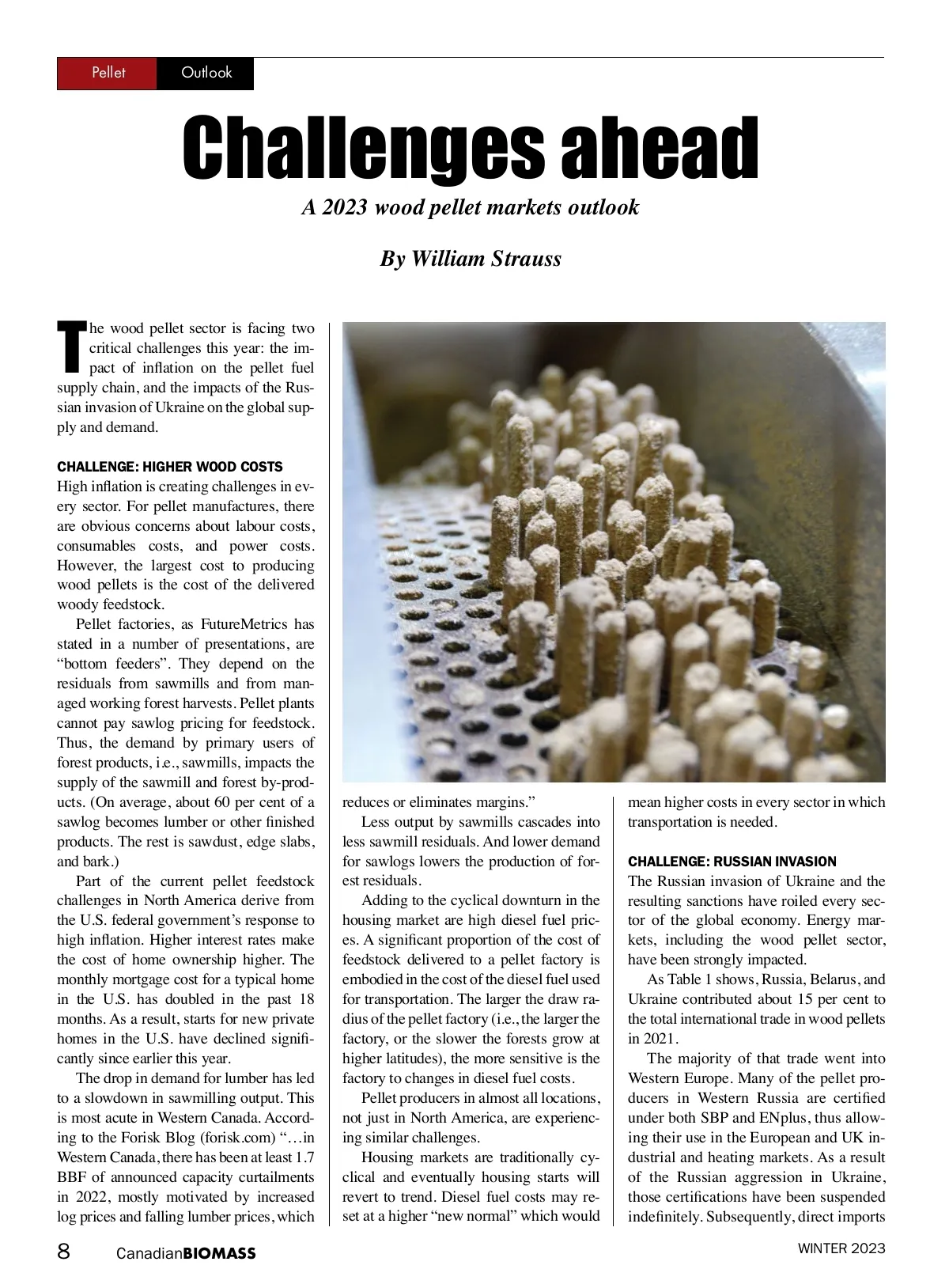
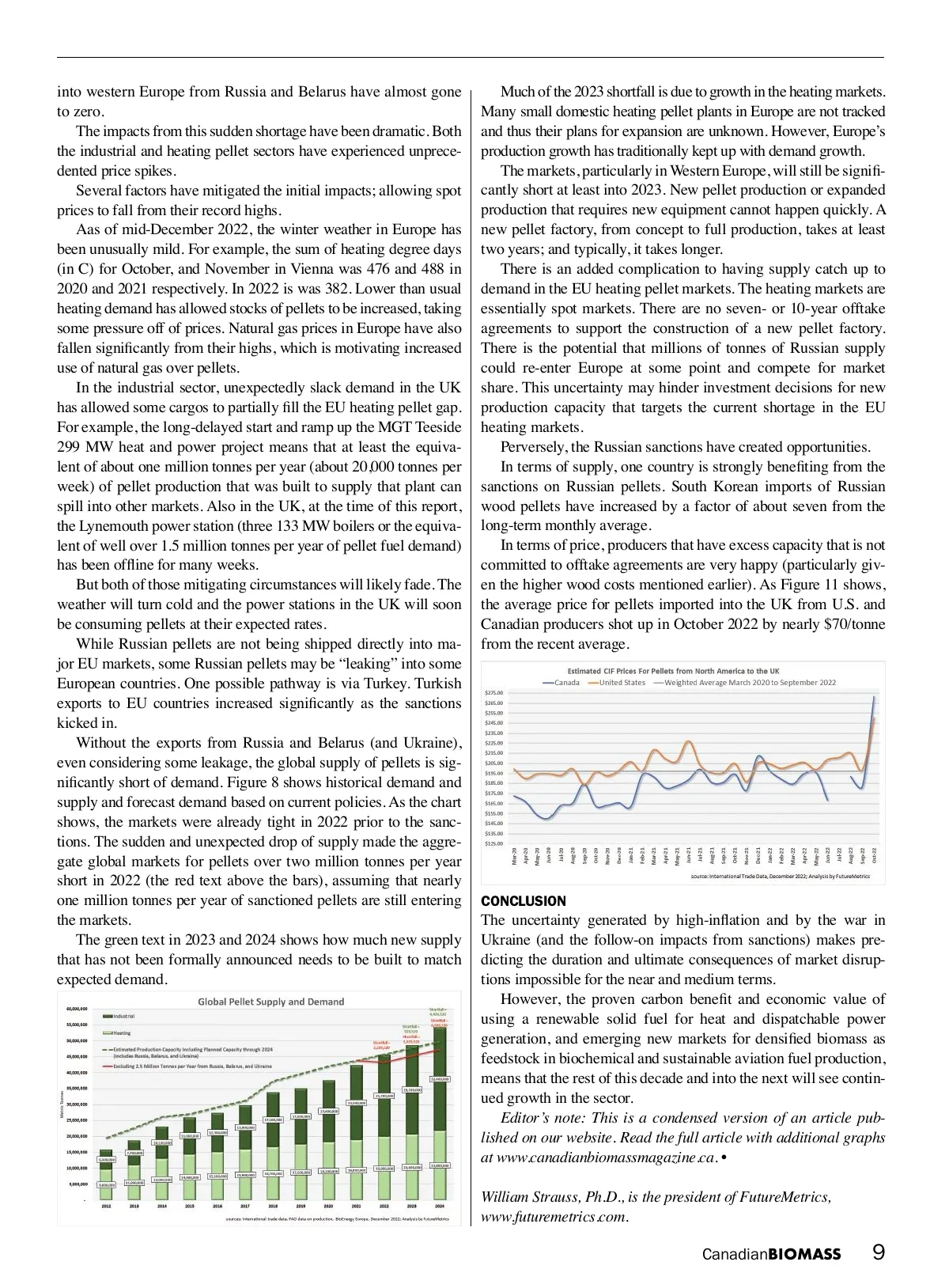
Pellet Outlook Challenges ahead A 2023 wood pellet markets outlook By William Strauss he wood pellet sector is facing two critical challenges this year: the im-pact of inflation on the pellet fuel supply chain, and the impacts of the Rus-sian invasion of Ukraine on the global sup-ply and demand. CHALLENGE: HIGHER WOOD COSTS T High inflation is creating challenges in ev -ery sector. For pellet manufactures, there are obvious concerns about labour costs, consumables costs, and power costs. However, the largest cost to producing wood pellets is the cost of the delivered woody feedstock. Pellet factories, as FutureMetrics has stated in a number of presentations, are “bottom feeders”. They depend on the residuals from sawmills and from man-aged working forest harvests. Pellet plants cannot pay sawlog pricing for feedstock. Thus, the demand by primary users of forest products, i.e., sawmills, impacts the supply of the sawmill and forest by-prod-ucts. (On average, about 60 per cent of a sawlog becomes lumber or other finished products. The rest is sawdust, edge slabs, and bark.) Part of the current pellet feedstock challenges in North America derive from the U.S. federal government’s response to high inflation. Higher interest rates make the cost of home ownership higher. The monthly mortgage cost for a typical home in the U.S. has doubled in the past 18 months. As a result, starts for new private homes in the U.S. have declined signifi -cantly since earlier this year. The drop in demand for lumber has led to a slowdown in sawmilling output. This is most acute in Western Canada. Accord-ing to the Forisk Blog (forisk.com) “…in Western Canada, there has been at least 1.7 BBF of announced capacity curtailments in 2022, mostly motivated by increased log prices and falling lumber prices, which reduces or eliminates margins.” Less output by sawmills cascades into less sawmill residuals. And lower demand for sawlogs lowers the production of for-est residuals. Adding to the cyclical downturn in the housing market are high diesel fuel pric-es. A significant proportion of the cost of feedstock delivered to a pellet factory is embodied in the cost of the diesel fuel used for transportation. The larger the draw ra-dius of the pellet factory (i.e., the larger the factory, or the slower the forests grow at higher latitudes), the more sensitive is the factory to changes in diesel fuel costs. Pellet producers in almost all locations, not just in North America, are experienc -ing similar challenges. Housing markets are traditionally cy-clical and eventually housing starts will revert to trend. Diesel fuel costs may re-set at a higher “new normal” which would mean higher costs in every sector in which transportation is needed. CHALLENGE: RUSSIAN INVASION The Russian invasion of Ukraine and the resulting sanctions have roiled every sec-tor of the global economy. Energy mar-kets, including the wood pellet sector, have been strongly impacted. As Table 1 shows, Russia, Belarus, and Ukraine contributed about 15 per cent to the total international trade in wood pellets in 2021. The majority of that trade went into Western Europe. Many of the pellet pro-ducers in Western Russia are certified under both SBP and ENplus, thus allow-ing their use in the European and UK in-dustrial and heating markets. As a result of the Russian aggression in Ukraine, those certifications have been suspended indefinitely. Subsequently, direct imports WINTER 2023 8 Canadian BIOMASS
Canadian Biomass Winter 2023: Page 8