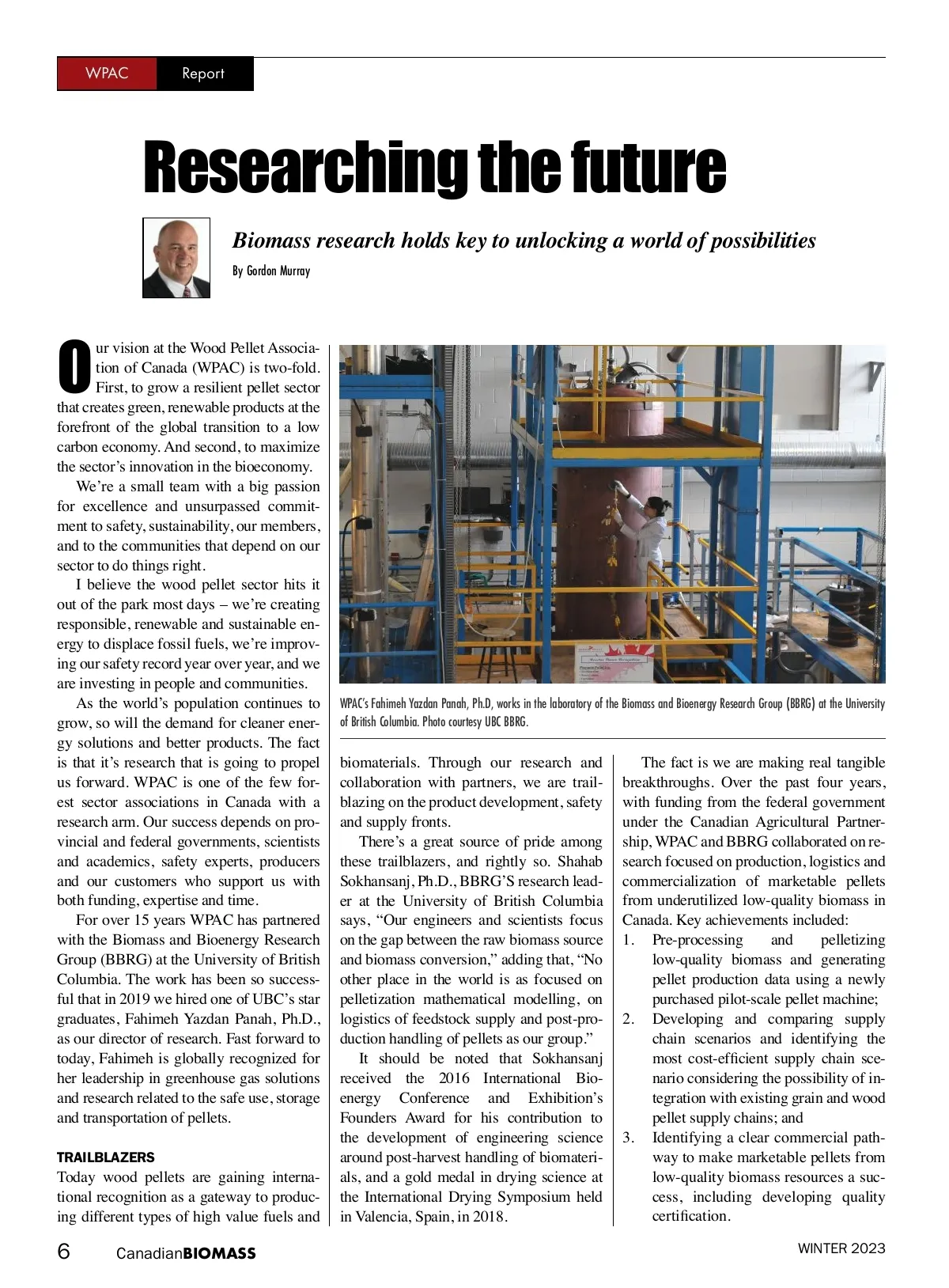
Research is also making our sector safer. Fifteen years ago, there were a se-ries of fatal accidents that involved ste-vedores going into ship holds carrying pellets and being overcome by carbon monoxide. No one really understood what was creating this dangerous situa-tion. We knew we had to dig into this is-sue to find out why it was happening and what steps we could take to prevent these tragedies. We installed a pilot-scale pellet silo in the lab to study the effects off-gas-sing. The collection of that data set the foundation of international standards and practical procedures that are being used globally for the storage, handling and transportation of wood pellets. Federal funding has also enabled further research into fibre pile manage -ment. Our group has studied the effects of fibre stored in piles, and the self-heat -ing and combustion that can occur over time. The risk of spontaneous ignition increases if the raw material or biofu-el becomes moist, the stored volume is large, and the ambient temperature is high. This research and resulting study have created new best practices for fibre pile management. NEW FRONTIERS THE SKY IS THE LIMIT We are currently taking proactive steps now to ensure a strong funding foundation for on-going research and product development by building on our positive relationship with the Government of Canada and on the success of our current research initiatives to further mobilize new biomass feedstock sources. BBRG and WPAC have applied for a new five-year research funding agreement with the Government of Canada under the recently announced Sustainable Canadi-an Agricultural Partnership (SCAP) pro-gram for the period of April 1, 2023, to March 31, 2028. There are lots of synergies between wood and agri-pellets. Solving the logis-tical complexities associated with the dis-persed crop residues and reducing the high ash/chlorine contents in herbaceous crops would make agri-pellets another source of low carbon feedstock. We now know the answer to a lot of ques-tions that we didn’t know 10 years ago. Today, that data is the foundation of inter-national standards and practical procedures that are keeping people safer, contributing to the global fight against climate change, reducing energy poverty here in Canada, and unlocking the door to the new bioeco-nomy; one where pellets spark new path-ways, products and innovations. But we know we have new frontiers to cross and more opportunities to explore. We will only get there through collabora-tion and investment. As Gary Bull, Ph.D., professor and head of the University of British Columbia’s Department of Forest Resources Management, says, “Wood pel-lets have an incredibly important role to play in society, and we will see a huge evo-lution. The opportunities for using wood pellets right here at home and around the world are basically limitless.” • Gordon Murray is the executive director of the Wood Pellet Association of Canada. CB_BBI_Winter23_CSA.indd 1 Canadian BIOMASS 2023-01-31 1:20 PM 7
Canadian Biomass Winter 2023: Page 7