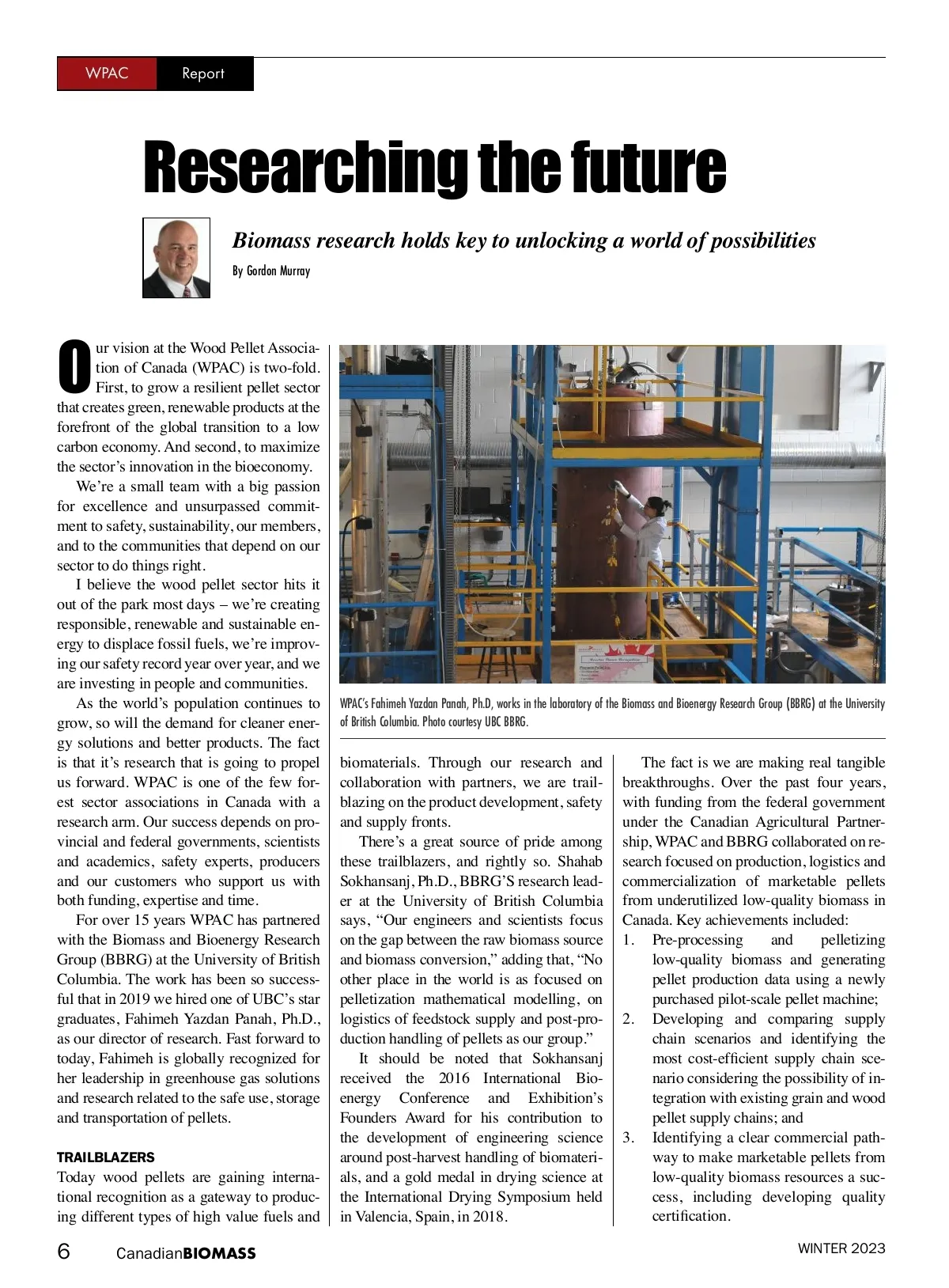
WPAC Report Researching the future Biomass research holds key to unlocking a world of possibilities By Gordon Murray O ur vision at the Wood Pellet Associa-tion of Canada (WPAC) is two-fold. First, to grow a resilient pellet sector that creates green, renewable products at the forefront of the global transition to a low carbon economy. And second, to maximize the sector’s innovation in the bioeconomy. We’re a small team with a big passion for excellence and unsurpassed commit-ment to safety, sustainability, our members, and to the communities that depend on our sector to do things right. I believe the wood pellet sector hits it out of the park most days – we’re creating responsible, renewable and sustainable en-ergy to displace fossil fuels, we’re improv-ing our safety record year over year, and we are investing in people and communities. As the world’s population continues to grow, so will the demand for cleaner ener-gy solutions and better products. The fact is that it’s research that is going to propel us forward. WPAC is one of the few for-est sector associations in Canada with a research arm. Our success depends on pro-vincial and federal governments, scientists and academics, safety experts, producers and our customers who support us with both funding, expertise and time. For over 15 years WPAC has partnered with the Biomass and Bioenergy Research Group (BBRG) at the University of British Columbia. The work has been so success-ful that in 2019 we hired one of UBC’s star graduates, Fahimeh Yazdan Panah, Ph.D., as our director of research. Fast forward to today, Fahimeh is globally recognized for her leadership in greenhouse gas solutions and research related to the safe use, storage and transportation of pellets. WPAC’s Fahimeh Yazdan Panah, Ph.D, works in the laboratory of the Biomass and Bioenergy Research Group (BBRG) at the University of British Columbia. Photo courtesy UBC BBRG. TRAILBLAZERS Today wood pellets are gaining interna-tional recognition as a gateway to produc-ing different types of high value fuels and biomaterials. Through our research and collaboration with partners, we are trail-blazing on the product development, safety and supply fronts. There’s a great source of pride among these trailblazers, and rightly so. Shahab Sokhansanj, Ph.D., BBRG’S research lead -er at the University of British Columbia says, “Our engineers and scientists focus on the gap between the raw biomass source and biomass conversion,” adding that, “No other place in the world is as focused on pelletization mathematical modelling, on logistics of feedstock supply and post-pro-duction handling of pellets as our group.” It should be noted that Sokhansanj received the 2016 International Bio-energy Conference and Exhibition’s Founders Award for his contribution to the development of engineering science around post-harvest handling of biomateri-als, and a gold medal in drying science at the International Drying Symposium held in Valencia, Spain, in 2018. The fact is we are making real tangible breakthroughs. Over the past four years, with funding from the federal government under the Canadian Agricultural Partner-ship, WPAC and BBRG collaborated on re-search focused on production, logistics and commercialization of marketable pellets from underutilized low-quality biomass in Canada. Key achievements included: 1. Pre-processing and pelletizing low-quality biomass and generating pellet production data using a newly purchased pilot-scale pellet machine; 2. Developing and comparing supply chain scenarios and identifying the most cost-efficient supply chain sce -nario considering the possibility of in-tegration with existing grain and wood pellet supply chains; and 3. Identifying a clear commercial path-way to make marketable pellets from low-quality biomass resources a suc-cess, including developing quality certification. WINTER 2023 6 Canadian BIOMASS
Canadian Biomass Winter 2023: Page 6