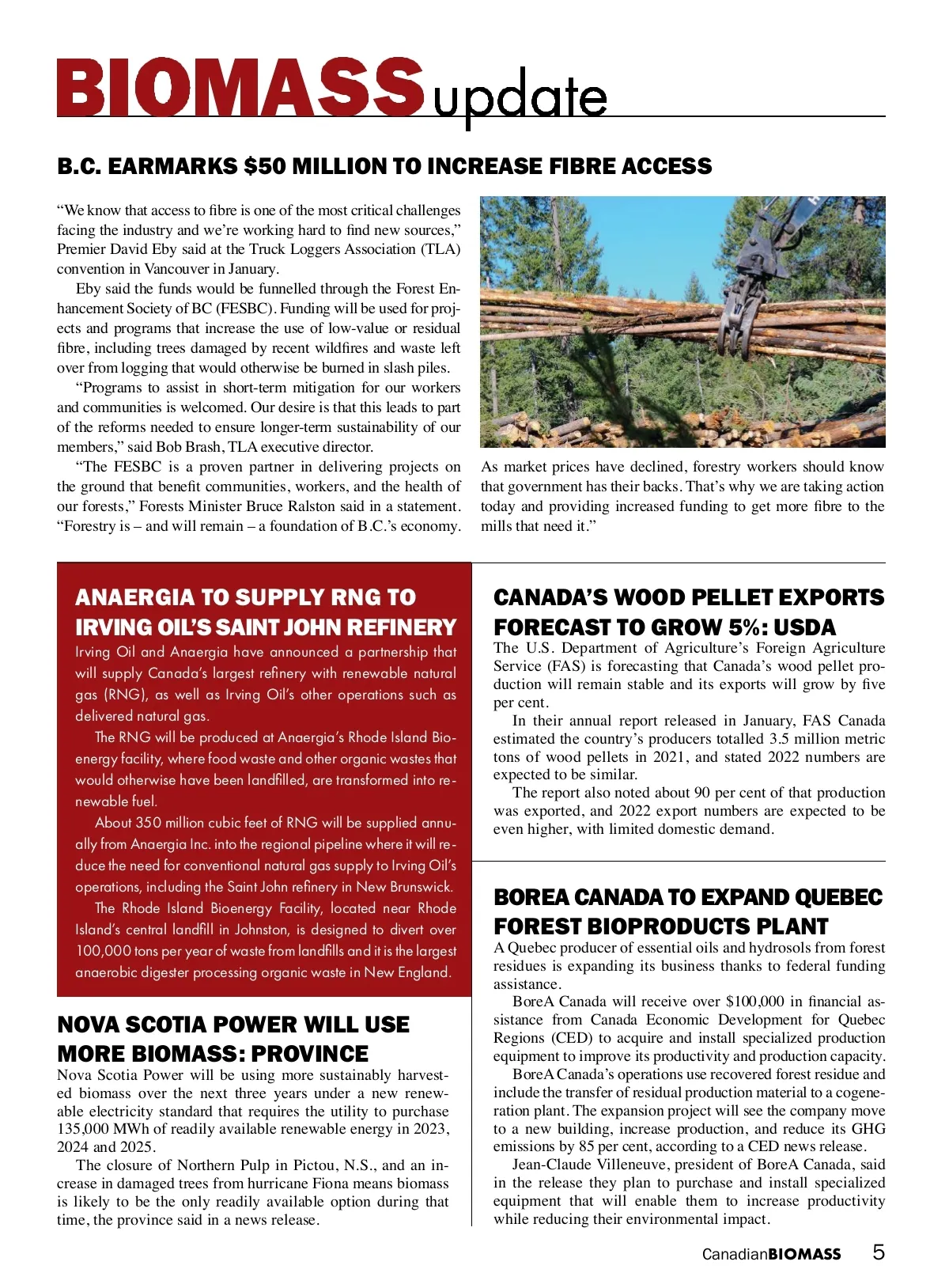
B.C. EARMARKS $50 MILLION TO INCREASE FIBRE ACCESS “We know that access to fibre is one of the most critical challenges facing the industry and we’re working hard to find new sources,” Premier David Eby said at the Truck Loggers Association (TLA) convention in Vancouver in January. Eby said the funds would be funnelled through the Forest En-hancement Society of BC (FESBC). Funding will be used for proj -ects and programs that increase the use of low-value or residual fibre, including trees damaged by recent wildfires and waste left over from logging that would otherwise be burned in slash piles. “Programs to assist in short-term mitigation for our workers and communities is welcomed. Our desire is that this leads to part of the reforms needed to ensure longer-term sustainability of our members,” said Bob Brash, TLA executive director. “The FESBC is a proven partner in delivering projects on the ground that benefit communities, workers, and the health of our forests,” Forests Minister Bruce Ralston said in a statement. “Forestry is – and will remain – a foundation of B.C.’s economy. As market prices have declined, forestry workers should know that government has their backs. That’s why we are taking action today and providing increased funding to get more fibre to the mills that need it.” ANAERGIA TO SUPPLY RNG TO IRVING OIL’S SAINT JOHN REFINERY Irving Oil and Anaergia have announced a partnership that will supply Canada’s largest refinery with renewable natural gas (RNG), as well as Irving Oil’s other operations such as delivered natural gas. The RNG will be produced at Anaergia’s Rhode Island Bio-energy facility, where food waste and other organic wastes that would otherwise have been landfilled, are transformed into re-newable fuel. About 350 million cubic feet of RNG will be supplied annu-ally from Anaergia Inc. into the regional pipeline where it will re-duce the need for conventional natural gas supply to Irving Oil’s operations, including the Saint John refinery in New Brunswick. The Rhode Island Bioenergy Facility, located near Rhode Island’s central landfill in Johnston, is designed to divert over 100,000 tons per year of waste from landfills and it is the largest anaerobic digester processing organic waste in New England. CANADA’S WOOD PELLET EXPORTS FORECAST TO GROW 5%: USDA The U.S. Department of Agriculture’s Foreign Agriculture Service (FAS) is forecasting that Canada’s wood pellet pro-duction will remain stable and its exports will grow by five per cent. In their annual report released in January, FAS Canada estimated the country’s producers totalled 3.5 million metric tons of wood pellets in 2021, and stated 2022 numbers are expected to be similar. The report also noted about 90 per cent of that production was exported, and 2022 export numbers are expected to be even higher, with limited domestic demand. BOREA CANADA TO EXPAND QUEBEC FOREST BIOPRODUCTS PLANT NOVA SCOTIA POWER WILL USE MORE BIOMASS: PROVINCE Nova Scotia Power will be using more sustainably harvest-ed biomass over the next three years under a new renew-able electricity standard that requires the utility to purchase 135,000 MWh of readily available renewable energy in 2023, 2024 and 2025. The closure of Northern Pulp in Pictou, N.S., and an in-crease in damaged trees from hurricane Fiona means biomass is likely to be the only readily available option during that time, the province said in a news release. A Quebec producer of essential oils and hydrosols from forest residues is expanding its business thanks to federal funding assistance. BoreA Canada will receive over $100,000 in financial as -sistance from Canada Economic Development for Quebec Regions (CED) to acquire and install specialized production equipment to improve its productivity and production capacity. BoreA Canada’s operations use recovered forest residue and include the transfer of residual production material to a cogene-ration plant. The expansion project will see the company move to a new building, increase production, and reduce its GHG emissions by 85 per cent, according to a CED news release. Jean-Claude Villeneuve, president of BoreA Canada, said in the release they plan to purchase and install specialized equipment that will enable them to increase productivity while reducing their environmental impact. Canadian BIOMASS 5
Canadian Biomass Winter 2023: Page 5