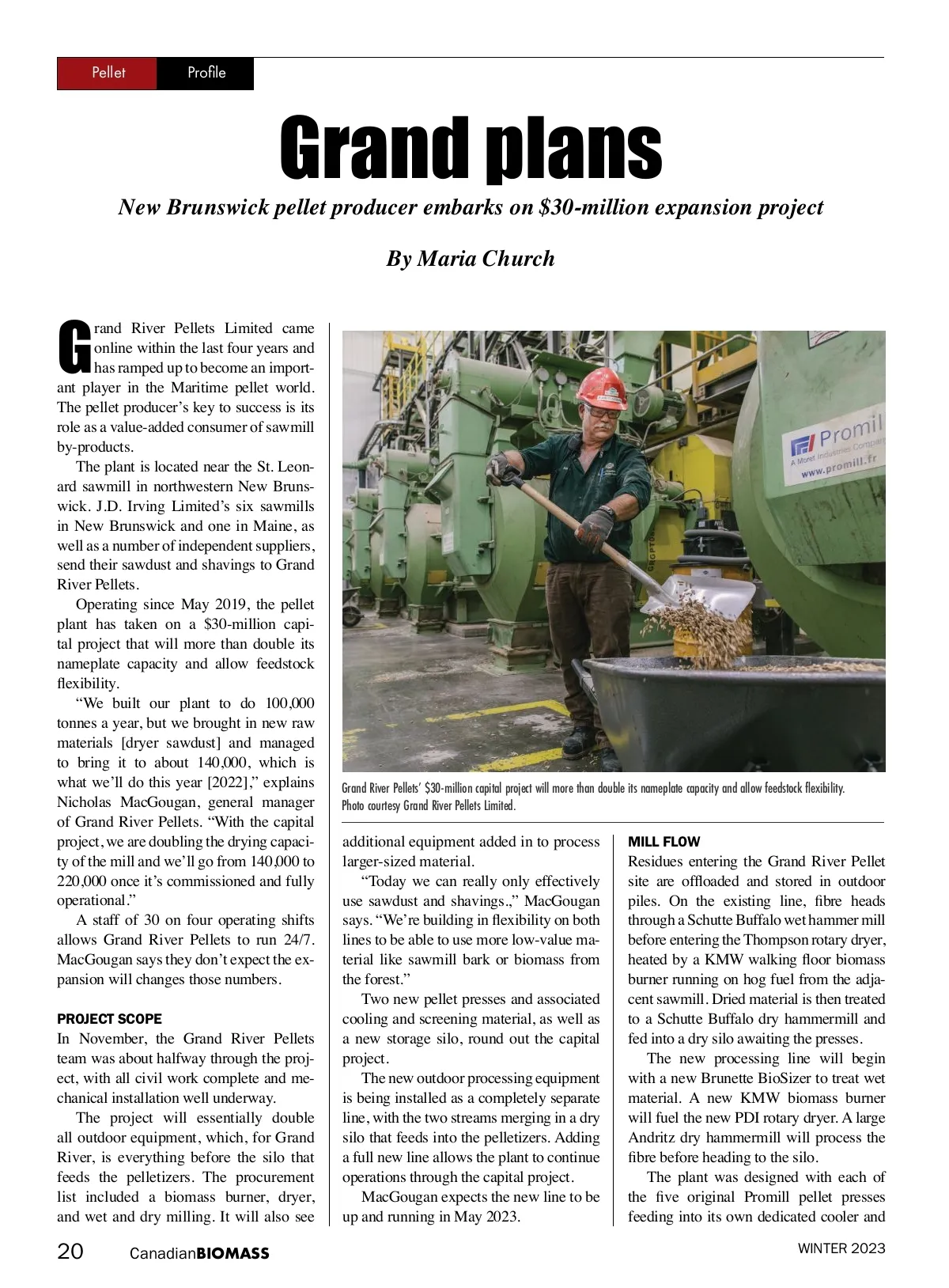
OF YOUR TAKE CONTROL SUPPLY The expansion project is adding an entirely new line to the plant, allowing the existing line to continue to run during construction. Photo courtesy Grand River Pellets Limited. screen. The two new ProGranul Toro pellet mills will keep with this configuration and have their own cooling and screening. “It’s a higher cost way of doing it, but in terms of the quality, we’re very happy with it. It makes sure the pellets are cooled rap-idly with very high durability and gets rid of the moisture so there are less corrosion issues,” MacGougan says. A new Mecafa bucket elevator will bring finished pellets to the two new Syma -ga silos being built next to the current two Scafco silos, bringing total storage capacity up to 1,800 tonnes. For dust safety measures, MacGougan says they’ve benefited from participation in the Wood Pellet Association of Cana-da’s Safety Committee, which gives them access to best practices and lessons learned across the pellet industry. “Being exposed to that brought the level of understanding for our folks up big time. We were able to have those learnings [such as bow-tie analysis and inherently safer design] all up front in the design engineer-ing,” he says. OPTIMISM FOR PELLETS Grand River Pellets produces 100 per cent industrial pellets, all of which are transport-ed by truck to the Port of Belledune and shipped to utility customers in Europe. Despite this, MacGougan says they see a “huge opportunity” on the horizon for domestic wood pellet use in the Maritime provinces. “We’re quite optimistic on the long-term prospects of the domestic heating market for pellets,” he says. “The market is tiny today relative to the pellet production capacity. Ninety per cent of the maritime pellet production is exported. But we don’t see ourselves forever being solely in the ex-port market … that’s where we are at today and that’s really a function the historic push to electrify heating in New Brunswick.” Yet, residential bioheat is an attractive option as federal and provincial low-carbon policies take effect over the coming decade, MacGougan says. New Brunswick homes and businesses are highly reliant on electric heating and much of that load is supplied by fossil fu-el-fired power stations. With the federal government’s pledge to phase out coal by 2030 and carbon taxes coming into play to disincentivize fossil fuels – the prov-inces will need to find alternative, higher cost sources of dispatchable electricity. Residential bioheat could take some of the peak electrical load off during the winter months. “We could then use the electricity for more high-value end uses, like electrify-ing transport, which is already going to require huge investment on the electrical grid to move transportation away from gasoline,” MacGougan says. “We think pellets have a real place to play to take heating loads away from oil, electricity, directly where the heat is need-ed,” he says. • Brunette BioSizer – – – – Consistent, Uniform Product Extreme-Duty Swing-Away Anvil Fixed Strikers for Maximum Bite Single Bolt Reversible Strikers ® HIGH-SPEED GRINDER VERSATILE GRINDING Green Green Hog Fuel Results Pulp Chip Results Process a Variety of Materials: -Oversized “Bush-Grind” Hog Fuel -Trim Blocks,Wood Chips & Overs -Pre-Ground Demolition Materials -Typical Urban Wood Waste 1-800-686-6679 www.brunettemc.com [email protected] Canadian BIOMASS 21 2023-01-26 3:20 PM CB_Brunette_Winter23_CSA.indd 1
Canadian Biomass Winter 2023: Page 21