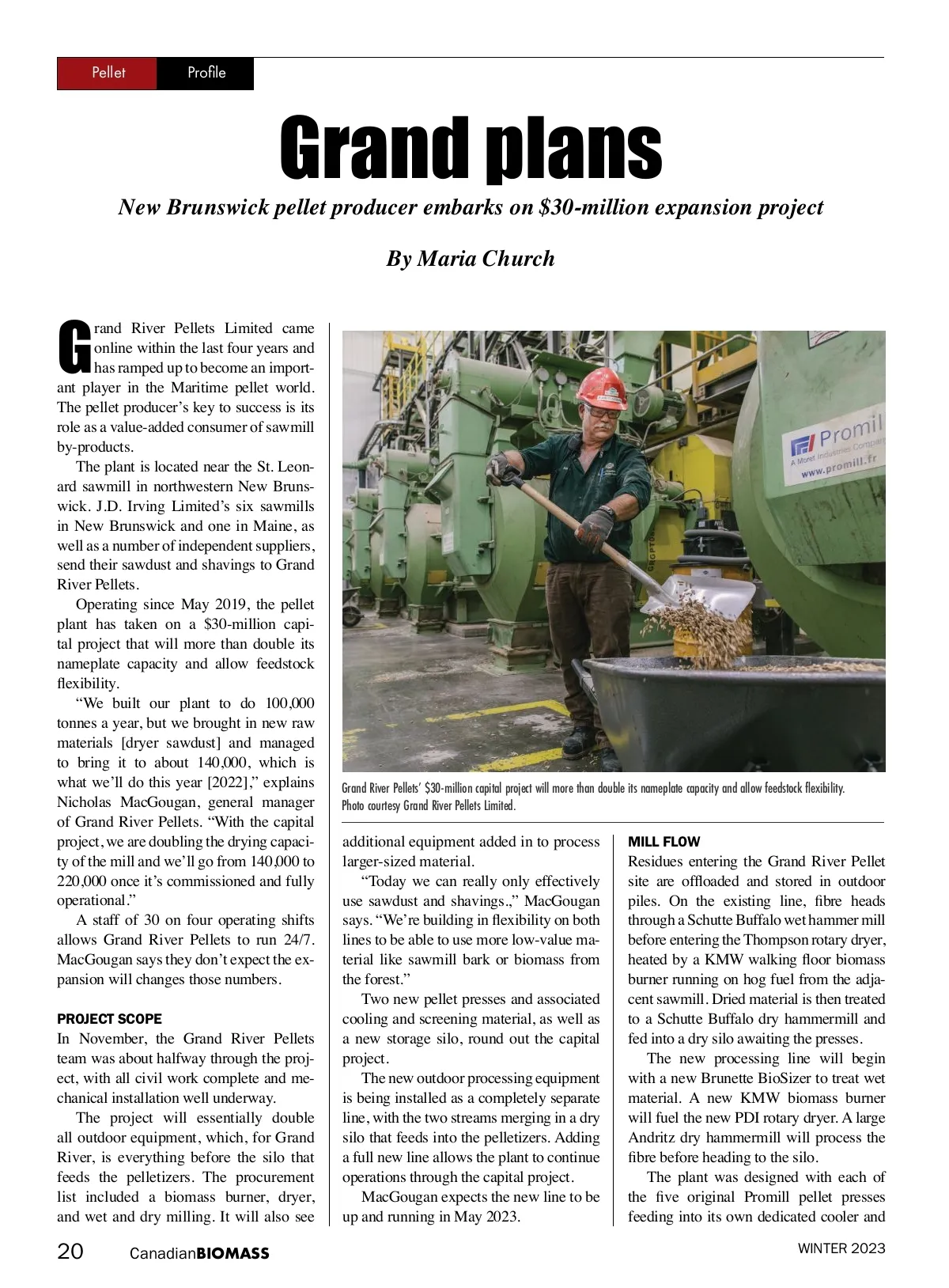
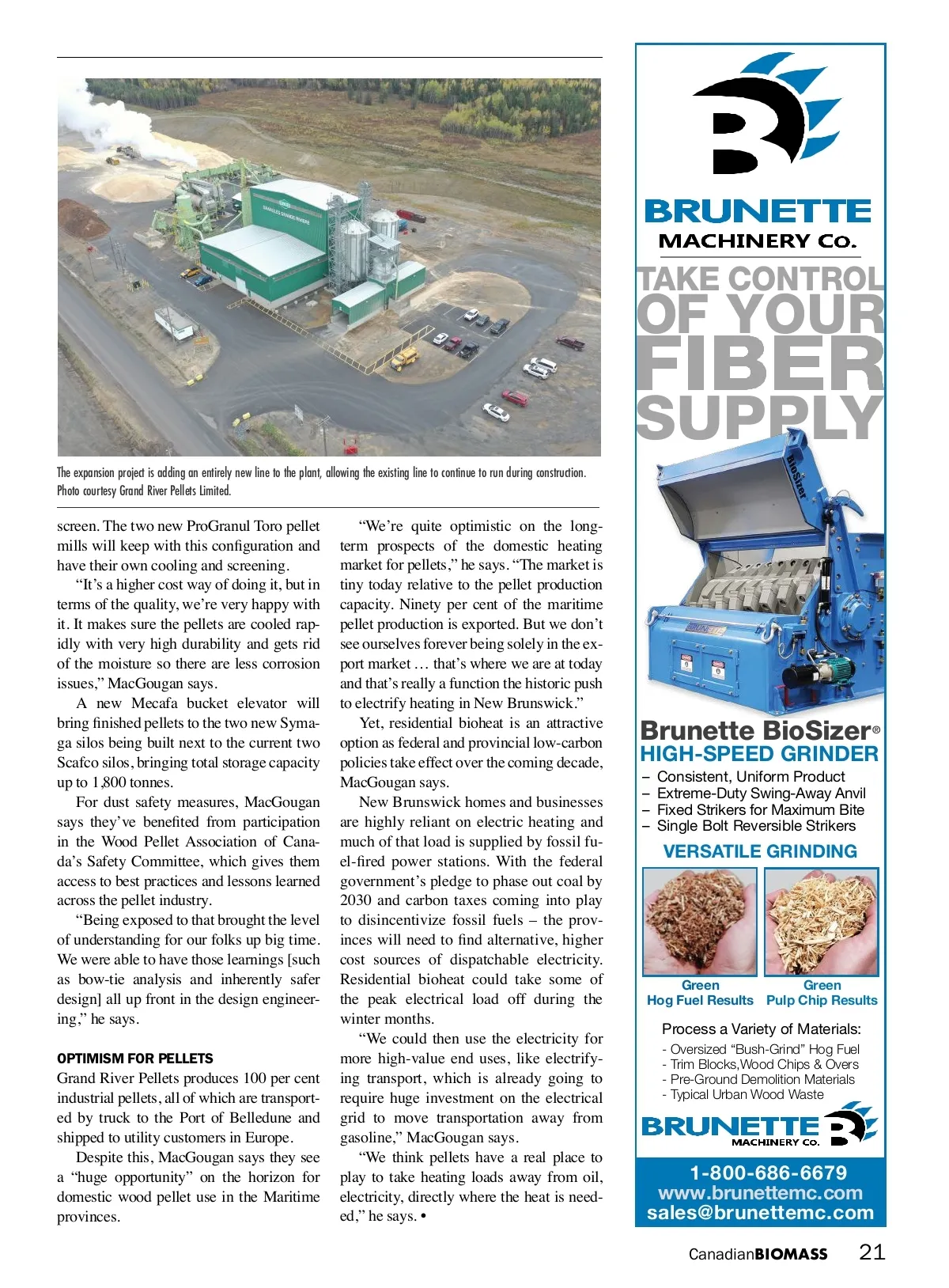
Pellet Profile New Brunswick pellet producer embarks on $30-million expansion project By Maria Church rand River Pellets Limited came online within the last four years and has ramped up to become an import-ant player in the Maritime pellet world. The pellet producer’s key to success is its role as a value-added consumer of sawmill by-products. The plant is located near the St. Leon-ard sawmill in northwestern New Bruns-wick. J.D. Irving Limited’s six sawmills in New Brunswick and one in Maine, as well as a number of independent suppliers, send their sawdust and shavings to Grand River Pellets. Operating since May 2019, the pellet plant has taken on a $30-million capi-tal project that will more than double its nameplate capacity and allow feedstock flexibility. “We built our plant to do 100,000 tonnes a year, but we brought in new raw materials [dryer sawdust] and managed to bring it to about 140,000, which is what we’ll do this year [2022],” explains Nicholas MacGougan, general manager of Grand River Pellets. “With the capital project, we are doubling the drying capaci -ty of the mill and we’ll go from 140,000 to 220,000 once it’s commissioned and fully operational.” A staff of 30 on four operating shifts allows Grand River Pellets to run 24/7. MacGougan says they don’t expect the ex-pansion will changes those numbers. PROJECT SCOPE Grand plans G Grand River Pellets’ $30-million capital project will more than double its nameplate capacity and allow feedstock flexibility. Photo courtesy Grand River Pellets Limited. In November, the Grand River Pellets team was about halfway through the proj -ect, with all civil work complete and me-chanical installation well underway. The project will essentially double all outdoor equipment, which, for Grand River, is everything before the silo that feeds the pelletizers. The procurement list included a biomass burner, dryer, and wet and dry milling. It will also see additional equipment added in to process larger-sized material. “Today we can really only effectively use sawdust and shavings.,” MacGougan says. “We’re building in flexibility on both lines to be able to use more low-value ma-terial like sawmill bark or biomass from the forest.” Two new pellet presses and associated cooling and screening material, as well as a new storage silo, round out the capital project. The new outdoor processing equipment is being installed as a completely separate line, with the two streams merging in a dry silo that feeds into the pelletizers. Adding a full new line allows the plant to continue operations through the capital project. MacGougan expects the new line to be up and running in May 2023. MILL FLOW Residues entering the Grand River Pellet site are offloaded and stored in outdoor piles. On the existing line, fibre heads through a Schutte Buffalo wet hammer mill before entering the Thompson rotary dryer, heated by a KMW walking floor biomass burner running on hog fuel from the adja -cent sawmill. Dried material is then treated to a Schutte Buffalo dry hammermill and fed into a dry silo awaiting the presses. The new processing line will begin with a new Brunette BioSizer to treat wet material. A new KMW biomass burner will fuel the new PDI rotary dryer. A large Andritz dry hammermill will process the fibre before heading to the silo. The plant was designed with each of the five original Promill pellet presses feeding into its own dedicated cooler and WINTER 2023 20 Canadian BIOMASS
Canadian Biomass Winter 2023: Page 20