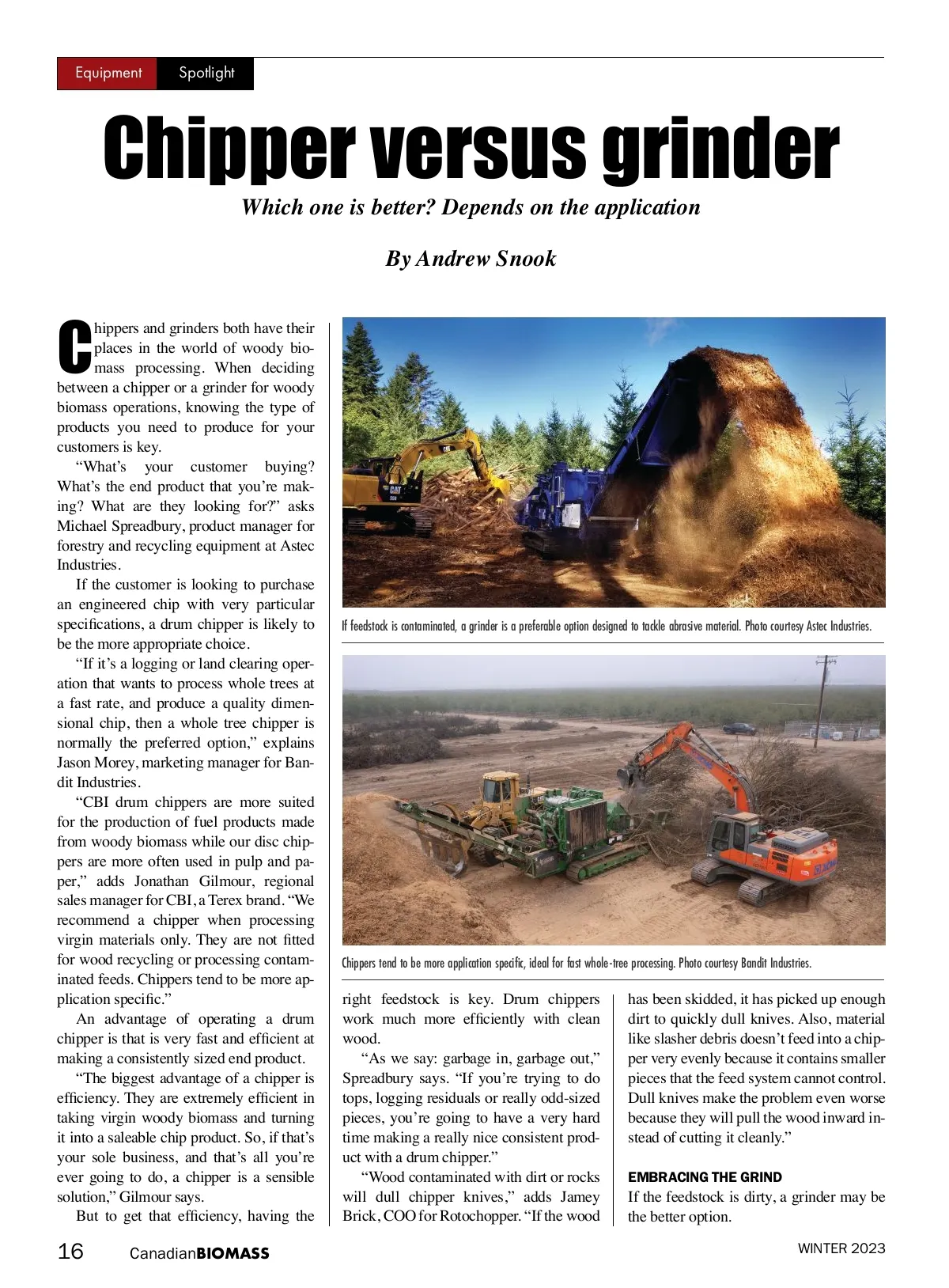
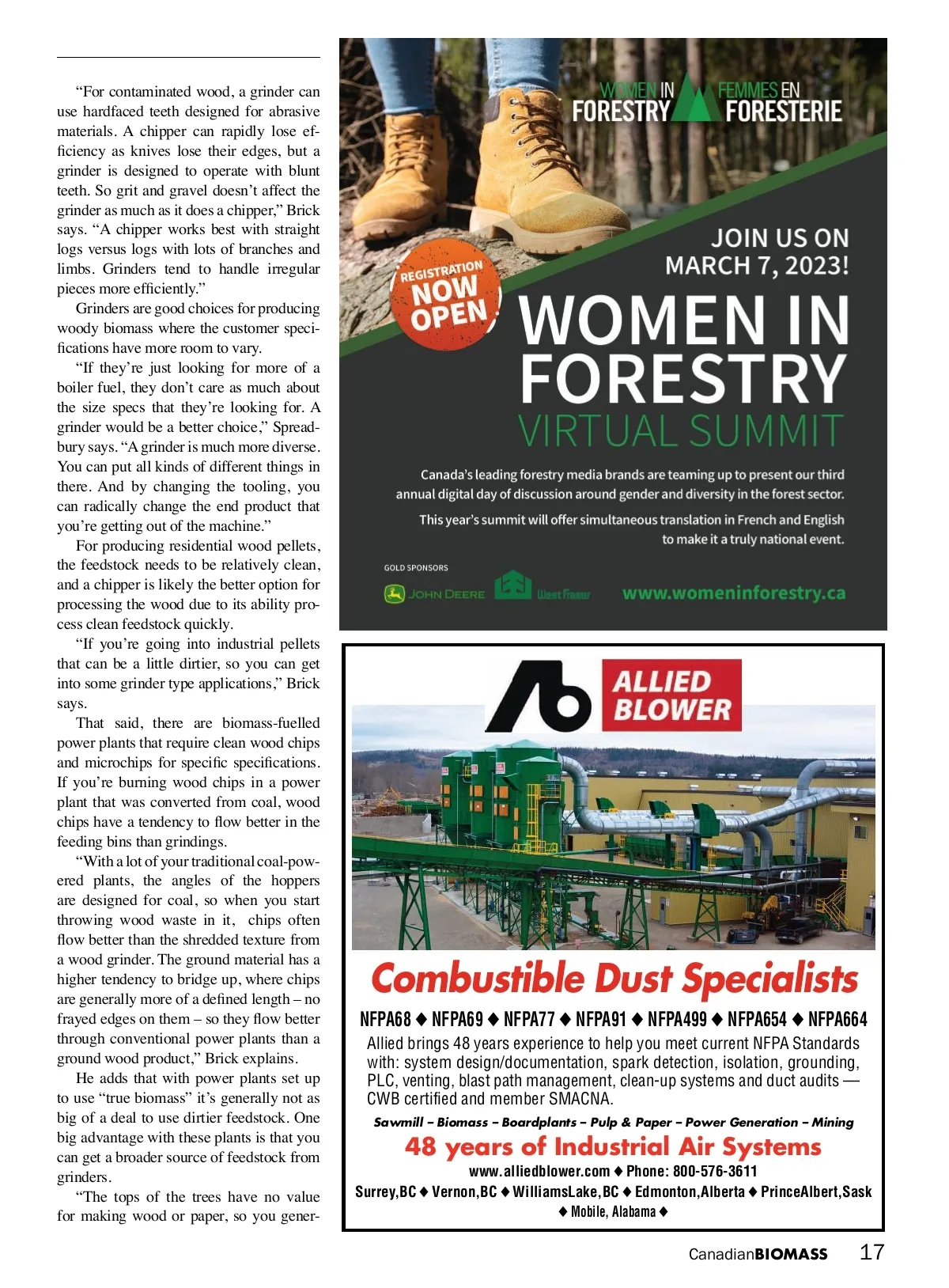
Equipment Spotlight Chipper versus grinder Which one is better? Depends on the application By Andrew Snook C hippers and grinders both have their places in the world of woody bio-mass processing. When deciding between a chipper or a grinder for woody biomass operations, knowing the type of products you need to produce for your customers is key. “What’s your customer buying? What’s the end product that you’re mak-ing? What are they looking for?” asks Michael Spreadbury, product manager for forestry and recycling equipment at Astec Industries. If the customer is looking to purchase an engineered chip with very particular specifications, a drum chipper is likely to be the more appropriate choice. “If it’s a logging or land clearing oper-ation that wants to process whole trees at a fast rate, and produce a quality dimen-sional chip, then a whole tree chipper is normally the preferred option,” explains Jason Morey, marketing manager for Ban-dit Industries. “CBI drum chippers are more suited for the production of fuel products made from woody biomass while our disc chip-pers are more often used in pulp and pa-per,” adds Jonathan Gilmour, regional sales manager for CBI, a Terex brand. “We recommend a chipper when processing virgin materials only. They are not fitted for wood recycling or processing contam-inated feeds. Chippers tend to be more ap-plication specific.” An advantage of operating a drum chipper is that is very fast and efficient at making a consistently sized end product. “The biggest advantage of a chipper is efficiency. They are extremely efficient in taking virgin woody biomass and turning it into a saleable chip product. So, if that’s your sole business, and that’s all you’re ever going to do, a chipper is a sensible solution,” Gilmour says. But to get that efficiency, having the If feedstock is contaminated, a grinder is a preferable option designed to tackle abrasive material. Photo courtesy Astec Industries. Chippers tend to be more application specific, ideal for fast whole-tree processing. Photo courtesy Bandit Industries. right feedstock is key. Drum chippers work much more efficiently with clean wood. “As we say: garbage in, garbage out,” Spreadbury says. “If you’re trying to do tops, logging residuals or really odd-sized pieces, you’re going to have a very hard time making a really nice consistent prod-uct with a drum chipper.” “Wood contaminated with dirt or rocks will dull chipper knives,” adds Jamey Brick, COO for Rotochopper. “If the wood has been skidded, it has picked up enough dirt to quickly dull knives. Also, material like slasher debris doesn’t feed into a chip-per very evenly because it contains smaller pieces that the feed system cannot control. Dull knives make the problem even worse because they will pull the wood inward in-stead of cutting it cleanly.” EMBRACING THE GRIND If the feedstock is dirty, a grinder may be the better option. WINTER 2023 16 Canadian BIOMASS
Canadian Biomass Winter 2023: Page 16