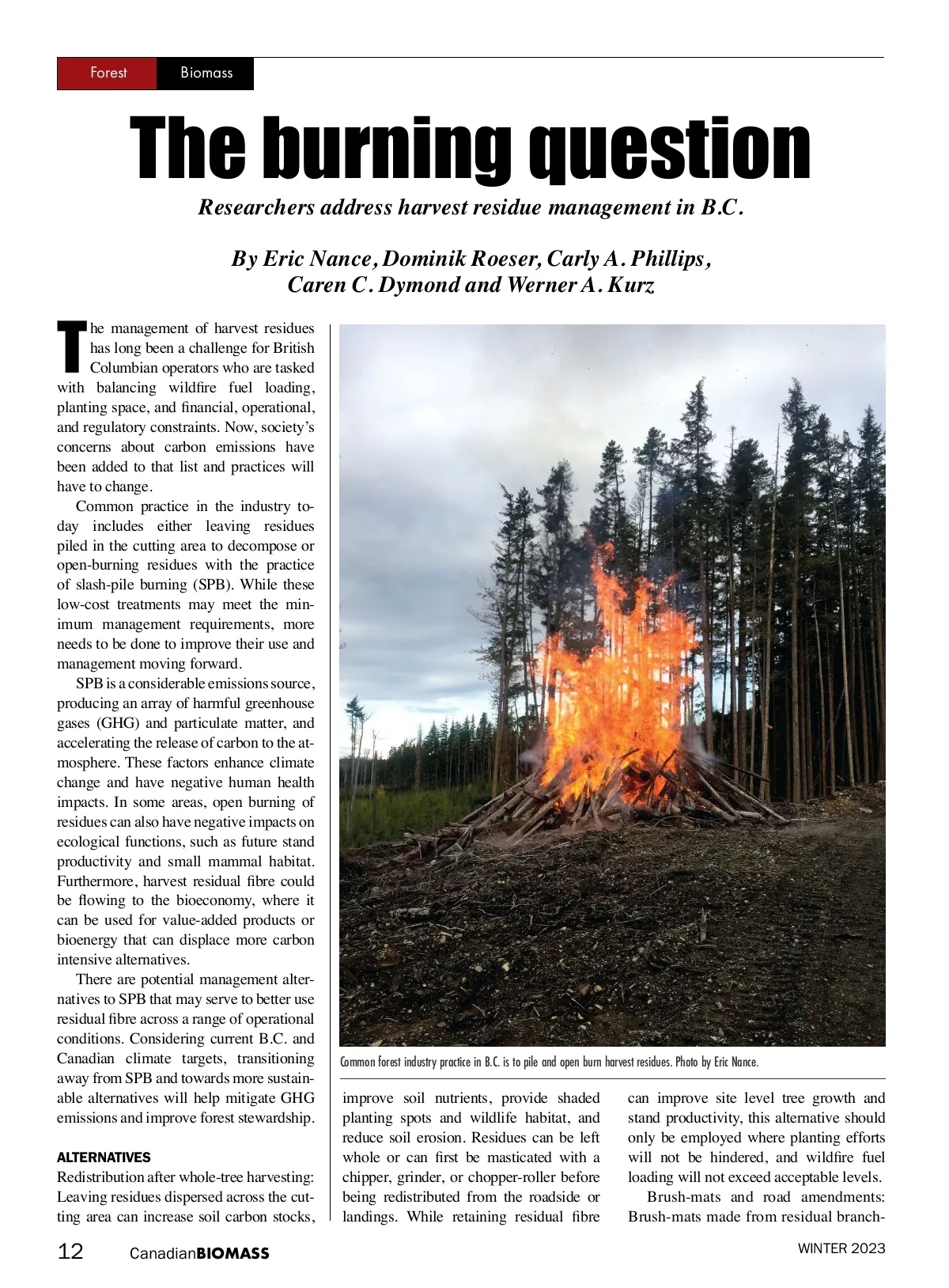
Forest Biomass The burning question Researchers address harvest residue management in B.C. By Eric Nance, Dominik Roeser, Carly A. Phillips, Caren C. Dymond and Werner A. Kurz he management of harvest residues has long been a challenge for British Columbian operators who are tasked with balancing wildfire fuel loading, planting space, and financial, operational, and regulatory constraints. Now, society’s concerns about carbon emissions have been added to that list and practices will have to change. Common practice in the industry to-day includes either leaving residues piled in the cutting area to decompose or open-burning residues with the practice of slash-pile burning (SPB). While these low-cost treatments may meet the min-imum management requirements, more needs to be done to improve their use and management moving forward. SPB is a considerable emissions source, producing an array of harmful greenhouse gases (GHG) and particulate matter, and accelerating the release of carbon to the at-mosphere. These factors enhance climate change and have negative human health impacts. In some areas, open burning of residues can also have negative impacts on ecological functions, such as future stand productivity and small mammal habitat. Furthermore, harvest residual fibre could be flowing to the bioeconomy, where it can be used for value-added products or bioenergy that can displace more carbon intensive alternatives. There are potential management alter-natives to SPB that may serve to better use residual fibre across a range of operational conditions. Considering current B.C. and Canadian climate targets, transitioning away from SPB and towards more sustain-able alternatives will help mitigate GHG emissions and improve forest stewardship. ALTERNATIVES T Common forest industry practice in B.C. is to pile and open burn harvest residues. Photo by Eric Nance. Redistribution after whole-tree harvesting: Leaving residues dispersed across the cut-ting area can increase soil carbon stocks, improve soil nutrients, provide shaded planting spots and wildlife habitat, and reduce soil erosion. Residues can be left whole or can first be masticated with a chipper, grinder, or chopper-roller before being redistributed from the roadside or landings. While retaining residual fibre can improve site level tree growth and stand productivity, this alternative should only be employed where planting efforts will not be hindered, and wildfire fuel loading will not exceed acceptable levels. Brush-mats and road amendments: Brush-mats made from residual branch-WINTER 2023 12 Canadian BIOMASS
Canadian Biomass Winter 2023: Page 12