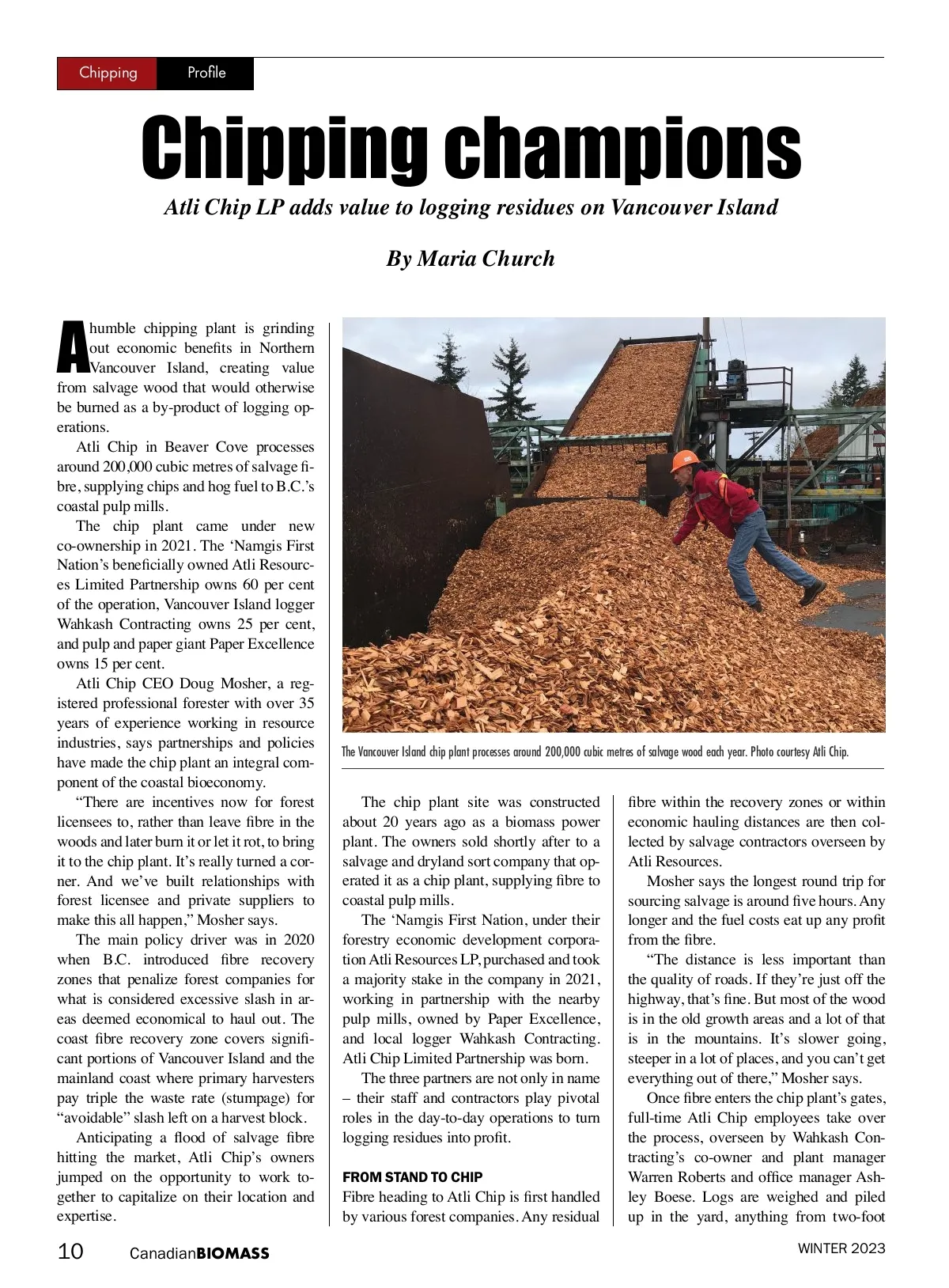
“chunks” up to 25 feet in length and 30 inches in diameter. A continuous flow of logs are fed into a hefty 25-foot DEAL processor – a cra-dle-style debarker top fed by mobile equip-ment, which includes a Komatsu front-end loader, Hitachi log loader and a Caterpillar grapple loader. The debarked fibre then runs via Belter -ra conveyor belts in the “big black hole,” Mosher says, that is the Carthage 12-knife, 2,800-hp chipper. “This chipper is quite a unique one from what we’ve been told by the experts be-cause it takes some of the most diversified fibre, at least in the province. It can handle the small chunks and not just round logs,” Mosher says. This sets Atli Chip out from your typical chipping plant. But with that uniqueness comes higher costs that need to be carefully managed and, ultimately, paid for by the customer. The chips are then sent through a USNR double deck 10x20-foot screen to filter out different sizes. A 2-inch round hole top overs screen and a ¼-inch round hold fines screen. A Columbia Machine Works grizzly re-chips oversize with the re-chipped mate-rial blow back to re-screen. Chip and hog product is then piled on the site’s concrete pad, ready for transport-ing via loaders and conveyors and a Pull-master Winch Corp. donkey that moves the waiting barges into position. Once loaded onto barges, the products are managed entirely by Paper Excellence, which ships them to their pulp mills for processing. PROGRESS WITH PARTNERS Like most businesses, industry partnerships are an essential cog to Atli Chip’s profit -ability. The chip plant has struck deals with the large licensees, private landowners, dry-land sort operators and forest management companies in the area, including Western Forest Products and Mosaic Forest Man-agement. Western has made significant volumes of harvest residue and pulp logs available to Atli Chip from two of their tree farm licenses and private land in the area. Mosaic and Wahkash Contracting have de-livered significant volumes of residue fibre and pulp logs directly from their field oper -ations. Mosaic has also allowed Atli Chip access to their dewatering property when needed to process fibre brought in on log barges from further away. The chip plant has also benefited from support from the Forest Enhancement Soci-ety of BC, and Natural Resources Canada’s Indigenous Forestry Initiative. FPInnovations is another partner. “They have been helping us out on various aspects of the operations, giving advice or making suggestions,” Mosher says. “Atli Chip is also grateful to Tale’Aw-txw Aboriginal Capital Corporation who provided initial financing assistance and on-going business expertise,” says Jim Bennett, Atli Resources’ director and trea-surer. “Many people came together to make this project happen and is a great example of interested partners working together for the common good.” EYE ON THE FUTURE In order to keep a chip plant running, it must have access to old-growth logging sites, Mosher says. Second-growth logging does not produce the volume of harvest res-idues needed to support a plant running full time. That volume also needs to be sourced locally enough to make economic sense. Atli Chip has its sights set on a few new sources of fibre as it navigates B.C.’s changing forest landscape. As the province continues to incentivize projects to reduce slash-pile burning and produce secondary products, there may be grant opportunities to ship fibre from further away, or to source historical fibre from blocks where slash is piled but not yet burned. “There are many moving parts with gov-ernment policy: dealing with old growth and working with First Nations reconcili-ation,” Mosher says. “We’re watching that right now very closely to see how we can adapt.” Atli Chip is eyeing a few on-site expan-sion projects as well, including increasing the size of their log yard and hog fuel stor-age areas, which would give them more flexibility in run times with more on-site storage. “For Atli Chip, our big push, is to adapt and be innovative, and to work with our partners – and that includes the major forest license holders, neighbouring First Nations and community landowners. If we’re all working together, it gives us a better chance of producing a good chip product and keep-ing employment going,” Mosher says. • IEM ROTARY DEBARKER The 30 foot long DEAL Processor manufactured under license using technology now owned by IEM. It is the first live floor open bottom rotary debarker (technology specific to IEM) that can accept logs up to 30 feet long and 40 inches in diameter; wood rich dry land sort debris; and residual wood fibre sources from logging activities. It maximizes recovery of fibre from the wood basket and is truly proven green technology. Located on the way to world famous Telegraph Cove (Canadian whale watching Mecca) it has been visited by people from all around the world. #109-19433 96th Avenue, Surrey, Bc, Canada, V4N 4C4 | Direct: 250.763-5008 | Office: 604.513.9930 | Web: www.iem.ca CB_IEM_Deal_Processor_Winter23_EJS.indd 1 Canadian BIOMASS 2023-01-12 1:37 PM 11
Canadian Biomass Winter 2023: Page 11