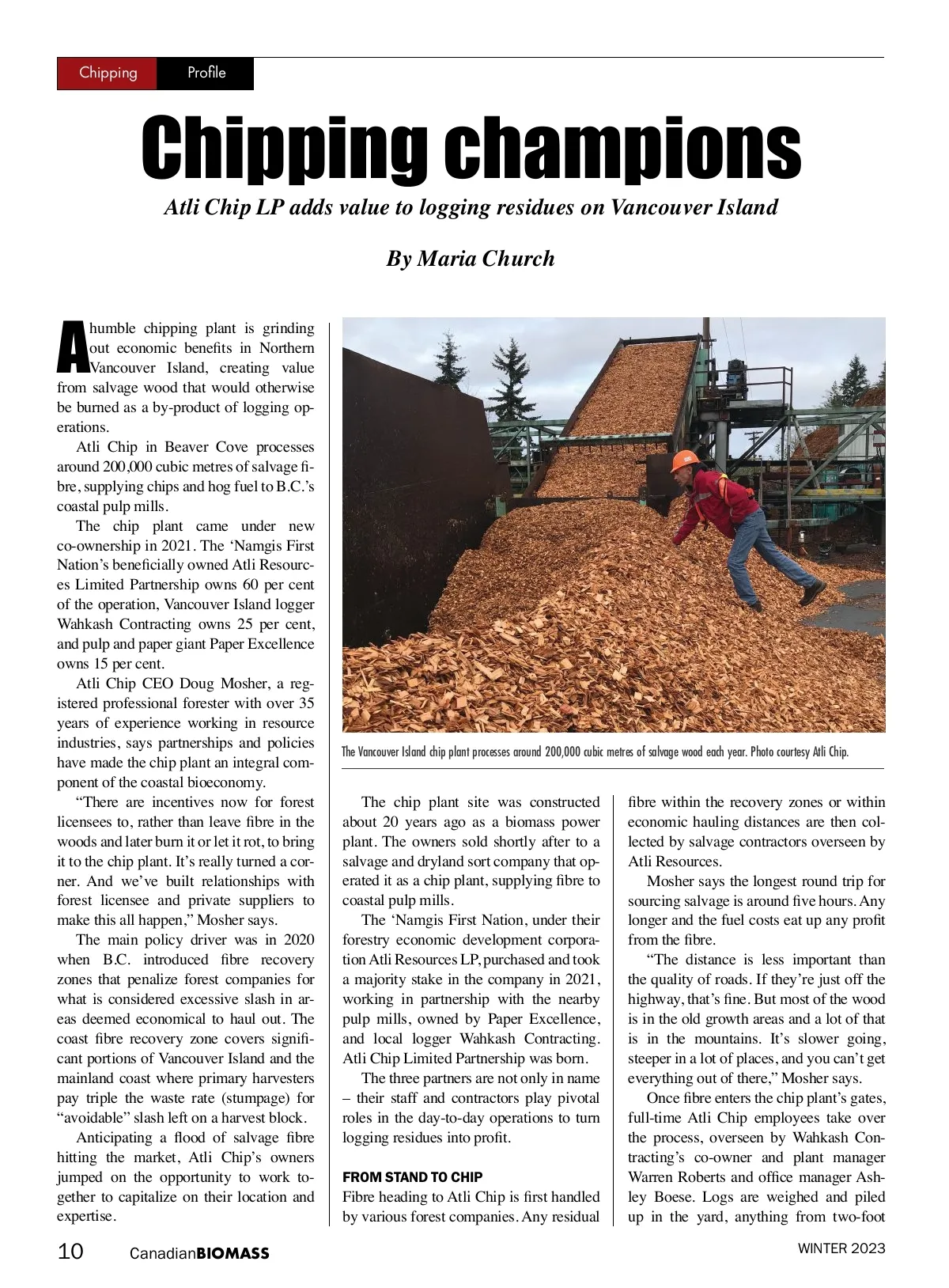
Chipping Profile Chipping champions Atli Chip LP adds value to logging residues on Vancouver Island By Maria Church humble chipping plant is grinding out economic benefits in Northern Vancouver Island, creating value from salvage wood that would otherwise be burned as a by-product of logging op-erations. Atli Chip in Beaver Cove processes around 200,000 cubic metres of salvage fi -bre, supplying chips and hog fuel to B.C.’s coastal pulp mills. The chip plant came under new co-ownership in 2021. The ‘Namgis First Nation’s beneficially owned Atli Resourc -es Limited Partnership owns 60 per cent of the operation, Vancouver Island logger Wahkash Contracting owns 25 per cent, and pulp and paper giant Paper Excellence owns 15 per cent. Atli Chip CEO Doug Mosher, a reg-istered professional forester with over 35 years of experience working in resource industries, says partnerships and policies have made the chip plant an integral com-ponent of the coastal bioeconomy. “There are incentives now for forest licensees to, rather than leave fibre in the woods and later burn it or let it rot, to bring it to the chip plant. It’s really turned a cor-ner. And we’ve built relationships with forest licensee and private suppliers to make this all happen,” Mosher says. The main policy driver was in 2020 when B.C. introduced fibre recovery zones that penalize forest companies for what is considered excessive slash in ar-eas deemed economical to haul out. The coast fibre recovery zone covers signifi -cant portions of Vancouver Island and the mainland coast where primary harvesters pay triple the waste rate (stumpage) for “avoidable” slash left on a harvest block. Anticipating a flood of salvage fibre hitting the market, Atli Chip’s owners jumped on the opportunity to work to -gether to capitalize on their location and expertise. A The Vancouver Island chip plant processes around 200,000 cubic metres of salvage wood each year. Photo courtesy Atli Chip. The chip plant site was constructed about 20 years ago as a biomass power plant. The owners sold shortly after to a salvage and dryland sort company that op-erated it as a chip plant, supplying fibre to coastal pulp mills. The ‘Namgis First Nation, under their forestry economic development corpora-tion Atli Resources LP, purchased and took a majority stake in the company in 2021, working in partnership with the nearby pulp mills, owned by Paper Excellence, and local logger Wahkash Contracting. Atli Chip Limited Partnership was born. The three partners are not only in name – their staff and contractors play pivotal roles in the day-to-day operations to turn logging residues into profit. FROM STAND TO CHIP Fibre heading to Atli Chip is first handled by various forest companies. Any residual fibre within the recovery zones or within economic hauling distances are then col-lected by salvage contractors overseen by Atli Resources. Mosher says the longest round trip for sourcing salvage is around five hours. Any longer and the fuel costs eat up any profit from the fibre. “The distance is less important than the quality of roads. If they’re just off the highway, that’s fine. But most of the wood is in the old growth areas and a lot of that is in the mountains. It’s slower going, steeper in a lot of places, and you can’t get everything out of there,” Mosher says. Once fibre enters the chip plant’s gates, full-time Atli Chip employees take over the process, overseen by Wahkash Con-tracting’s co-owner and plant manager Warren Roberts and office manager Ash -ley Boese. Logs are weighed and piled up in the yard, anything from two-foot WINTER 2023 10 Canadian BIOMASS
Canadian Biomass Winter 2023: Page 10