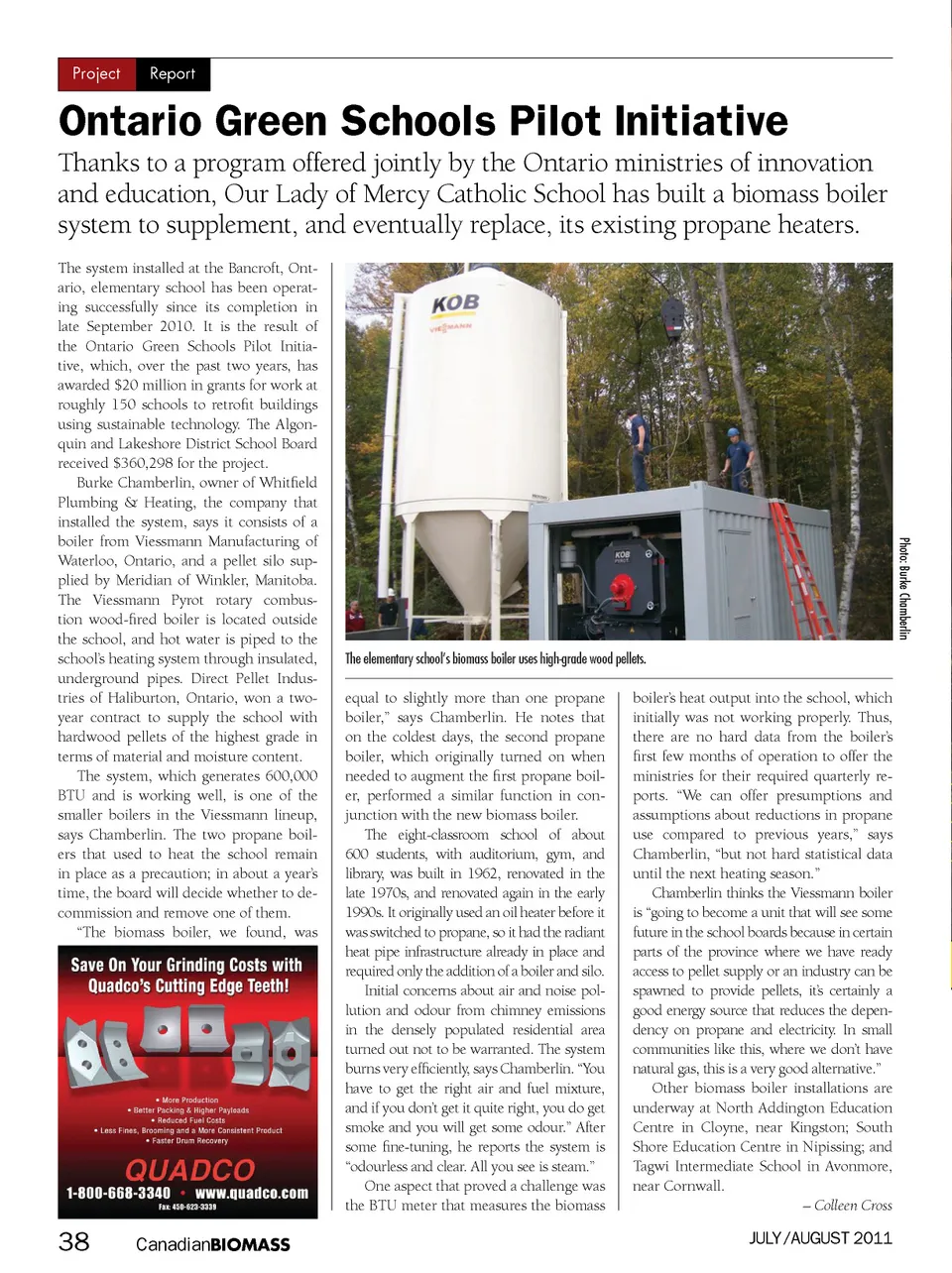
Project Report ontario green schools pilot initiative Thanks to a program offered jointly by the Ontario ministries of innovation and education, Our Lady of Mercy Catholic School has built a biomass boiler system to supplement, and eventually replace, its existing propane heaters. The system installed at the Bancroft, Ont-ario, elementary school has been operat-ing successfully since its completion in late September 2010. It is the result of the Ontario Green Schools Pilot Initia-tive, which, over the past two years, has awarded $20 million in grants for work at roughly 150 schools to retrofit buildings using sustainable technology. The Algon-quin and Lakeshore District School Board received $360,298 for the project. Burke Chamberlin, owner of Whitfield Plumbing & Heating, the company that installed the system, says it consists of a boiler from Viessmann Manufacturing of Waterloo, Ontario, and a pellet silo sup-plied by Meridian of Winkler, Manitoba. The Viessmann Pyrot rotary combus-tion wood-fired boiler is located outside the school, and hot water is piped to the school’s heating system through insulated, underground pipes. Direct Pellet Indus-tries of Haliburton, Ontario, won a two-year contract to supply the school with hardwood pellets of the highest grade in terms of material and moisture content. The system, which generates 600,000 BTU and is working well, is one of the smaller boilers in the Viessmann lineup, says Chamberlin. The two propane boil-ers that used to heat the school remain in place as a precaution; in about a year’s time, the board will decide whether to de-commission and remove one of them. “The biomass boiler, we found, was Photo: Burke Chamberlin The elementary school’s biomass boiler uses high-grade wood pellets. equal to slightly more than one propane boiler,” says Chamberlin. He notes that on the coldest days, the second propane boiler, which originally turned on when needed to augment the first propane boil-er, performed a similar function in con-junction with the new biomass boiler. The eight-classroom school of about 600 students, with auditorium, gym, and library, was built in 1962, renovated in the late 1970s, and renovated again in the early 1990s. It originally used an oil heater before it was switched to propane, so it had the radiant heat pipe infrastructure already in place and required only the addition of a boiler and silo. Initial concerns about air and noise pol-lution and odour from chimney emissions in the densely populated residential area turned out not to be warranted. The system burns very efficiently, says Chamberlin. “You have to get the right air and fuel mixture, and if you don’t get it quite right, you do get smoke and you will get some odour.” After some fine-tuning, he reports the system is “odourless and clear. All you see is steam.” One aspect that proved a challenge was the BTU meter that measures the biomass boiler’s heat output into the school, which initially was not working properly. Thus, there are no hard data from the boiler’s first few months of operation to offer the ministries for their required quarterly re-ports. “We can offer presumptions and assumptions about reductions in propane use compared to previous years,” says Chamberlin, “but not hard statistical data until the next heating season.” Chamberlin thinks the Viessmann boiler is “going to become a unit that will see some future in the school boards because in certain parts of the province where we have ready access to pellet supply or an industry can be spawned to provide pellets, it’s certainly a good energy source that reduces the depen-dency on propane and electricity. In small communities like this, where we don’t have natural gas, this is a very good alternative.” Other biomass boiler installations are underway at North Addington Education Centre in Cloyne, near Kingston; South Shore Education Centre in Nipissing; and Tagwi Intermediate School in Avonmore, near Cornwall. – Colleen Cross July/August 2011 38 Canadian BIOMASS
Canadian Biomass July/August 2011: Page 38