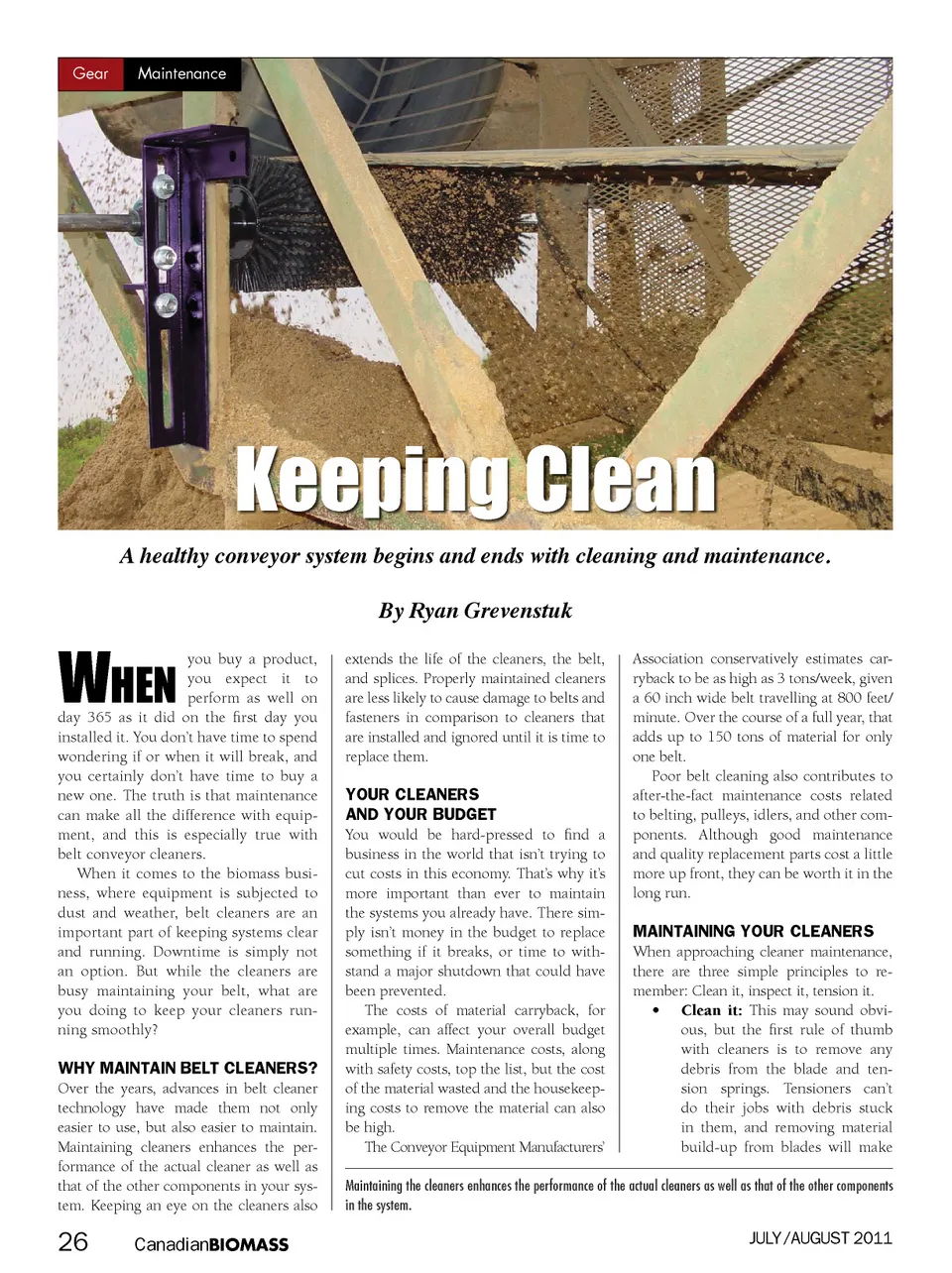
Gear Maintenance Keeping Clean A healthy conveyor system begins and ends with cleaning and maintenance. By Ryan Grevenstuk W hen you buy a product, you expect it to perform as well on day 365 as it did on the first day you installed it. You don’t have time to spend wondering if or when it will break, and you certainly don’t have time to buy a new one. The truth is that maintenance can make all the difference with equip-ment, and this is especially true with belt conveyor cleaners. When it comes to the biomass busi-ness, where equipment is subjected to dust and weather, belt cleaners are an important part of keeping systems clear and running. Downtime is simply not an option. But while the cleaners are busy maintaining your belt, what are you doing to keep your cleaners run-ning smoothly? extends the life of the cleaners, the belt, and splices. Properly maintained cleaners are less likely to cause damage to belts and fasteners in comparison to cleaners that are installed and ignored until it is time to replace them. your cleaners and your Budget Why maintain Belt cleaners? Over the years, advances in belt cleaner technology have made them not only easier to use, but also easier to maintain. Maintaining cleaners enhances the per-formance of the actual cleaner as well as that of the other components in your sys-tem. Keeping an eye on the cleaners also You would be hard-pressed to find a business in the world that isn’t trying to cut costs in this economy. That’s why it’s more important than ever to maintain the systems you already have. There sim-ply isn’t money in the budget to replace something if it breaks, or time to with-stand a major shutdown that could have been prevented. The costs of material carryback, for example, can affect your overall budget multiple times. Maintenance costs, along with safety costs, top the list, but the cost of the material wasted and the housekeep-ing costs to remove the material can also be high. The Conveyor Equipment Manufacturers’ Association conservatively estimates car-ryback to be as high as 3 tons/week, given a 60 inch wide belt travelling at 800 feet/ minute. Over the course of a full year, that adds up to 150 tons of material for only one belt. Poor belt cleaning also contributes to after-the-fact maintenance costs related to belting, pulleys, idlers, and other com-ponents. Although good maintenance and quality replacement parts cost a little more up front, they can be worth it in the long run. maintaining your cleaners When approaching cleaner maintenance, there are three simple principles to re-member: Clean it, inspect it, tension it. • Clean it: This may sound obvi-ous, but the first rule of thumb with cleaners is to remove any debris from the blade and ten-sion springs. Tensioners can’t do their jobs with debris stuck in them, and removing material build-up from blades will make Maintaining the cleaners enhances the performance of the actual cleaners as well as that of the other components in the system. July/August 2011 26 Canadian BIOMASS
Canadian Biomass July/August 2011: Page 26