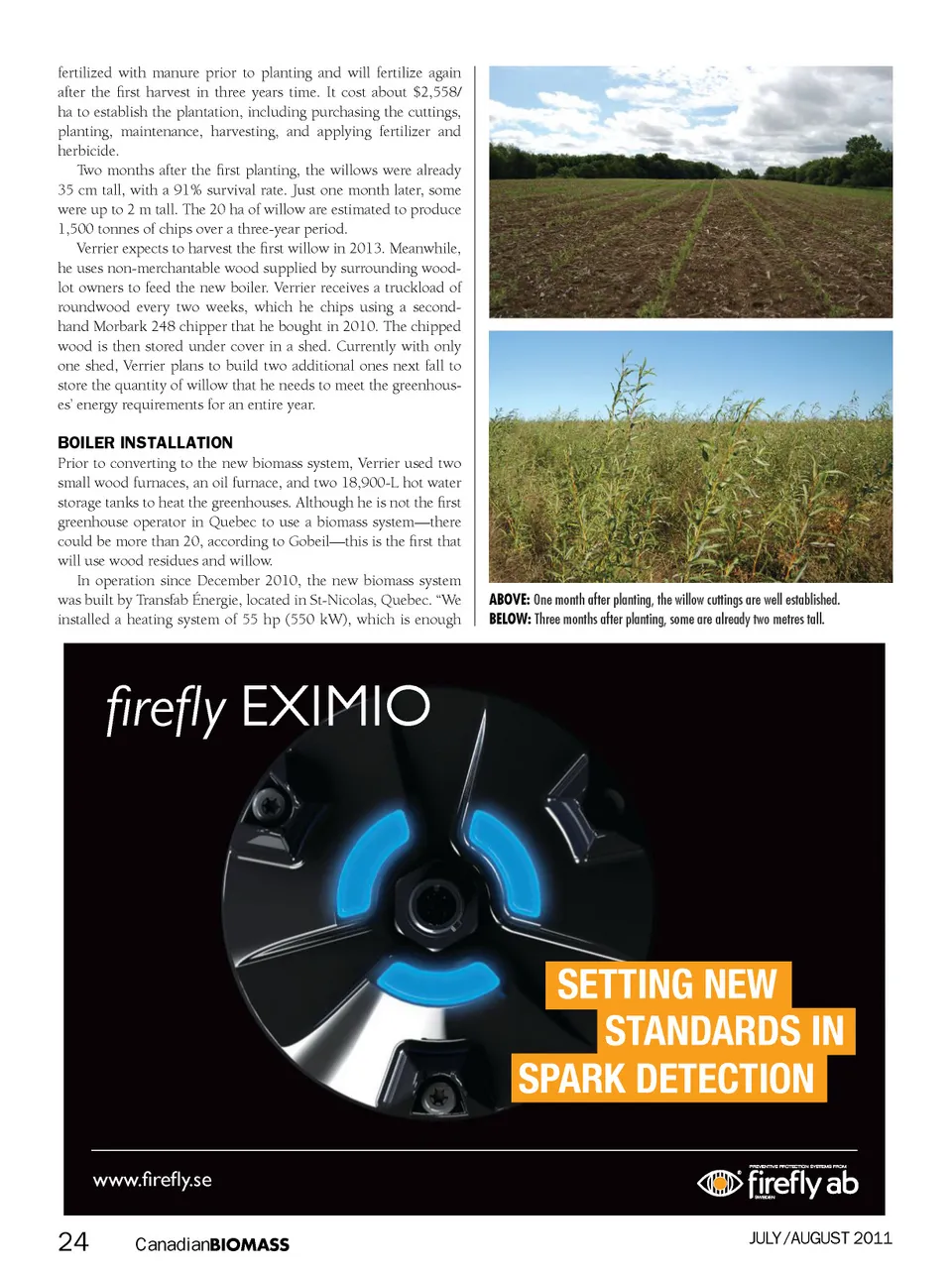
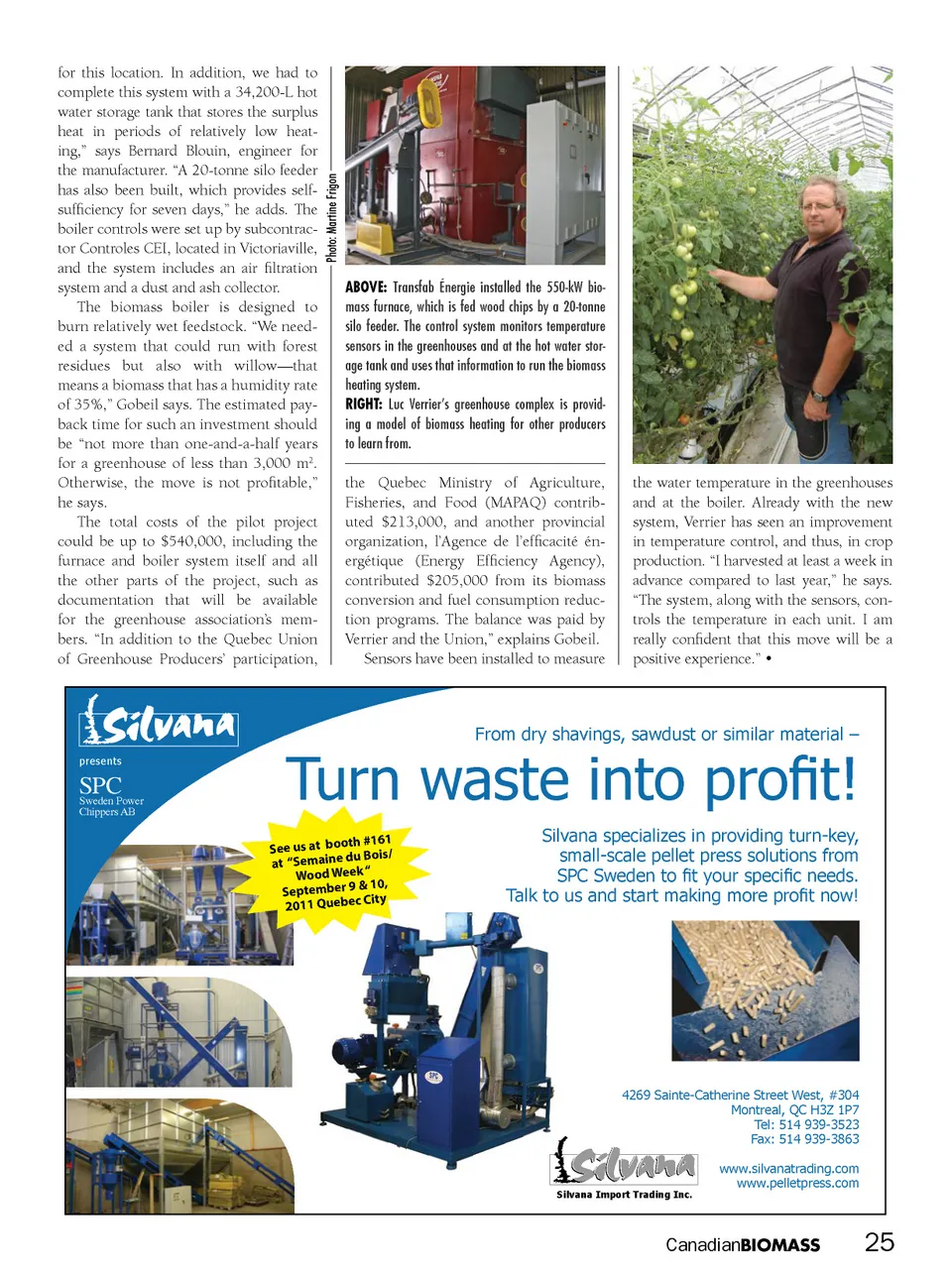
fertilized with manure prior to planting and will fertilize again after the first harvest in three years time. It cost about $2,558/ ha to establish the plantation, including purchasing the cuttings, planting, maintenance, harvesting, and applying fertilizer and herbicide. Two months after the first planting, the willows were already 35 cm tall, with a 91% survival rate. Just one month later, some were up to 2 m tall. The 20 ha of willow are estimated to produce 1,500 tonnes of chips over a three-year period. Verrier expects to harvest the first willow in 2013. Meanwhile, he uses non-merchantable wood supplied by surrounding wood-lot owners to feed the new boiler. Verrier receives a truckload of roundwood every two weeks, which he chips using a second-hand Morbark 248 chipper that he bought in 2010. The chipped wood is then stored under cover in a shed. Currently with only one shed, Verrier plans to build two additional ones next fall to store the quantity of willow that he needs to meet the greenhous-es’ energy requirements for an entire year. Boiler installation Prior to converting to the new biomass system, Verrier used two small wood furnaces, an oil furnace, and two 18,900-L hot water storage tanks to heat the greenhouses. Although he is not the first greenhouse operator in Quebec to use a biomass system—there could be more than 20, according to Gobeil—this is the first that will use wood residues and willow. In operation since December 2010, the new biomass system was built by Transfab Énergie, located in St-Nicolas, Quebec. “We installed a heating system of 55 hp (550 kW), which is enough AboVE: One month after planting, the willow cuttings are well established. bEloW: Three months after planting, some are already two metres tall. firefly EXIMIO Setting new StandardS in Spark detection www.firefly.se 24 Canadian BIOMASS July/August 2011
Canadian Biomass July/August 2011: Page 24