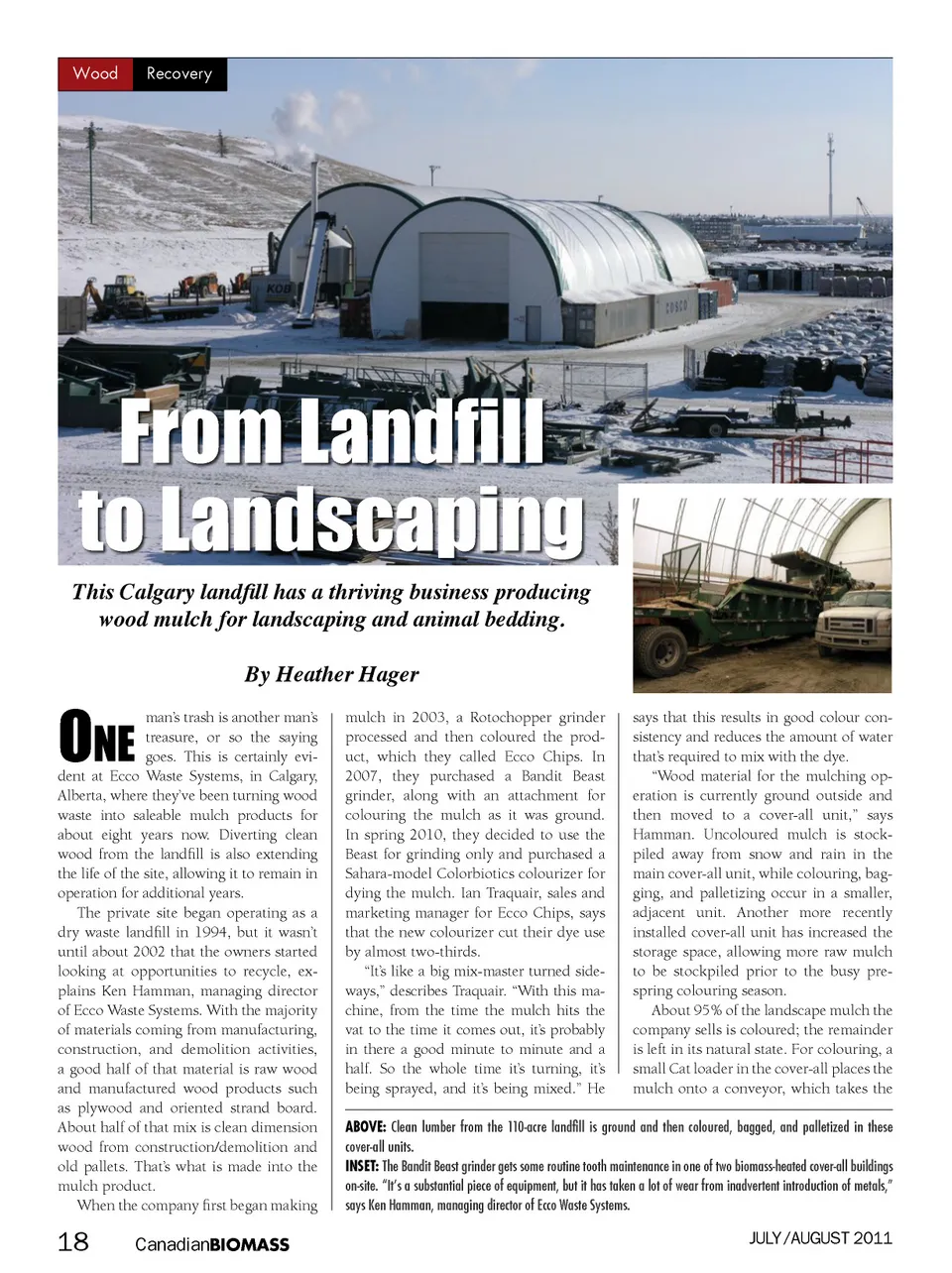
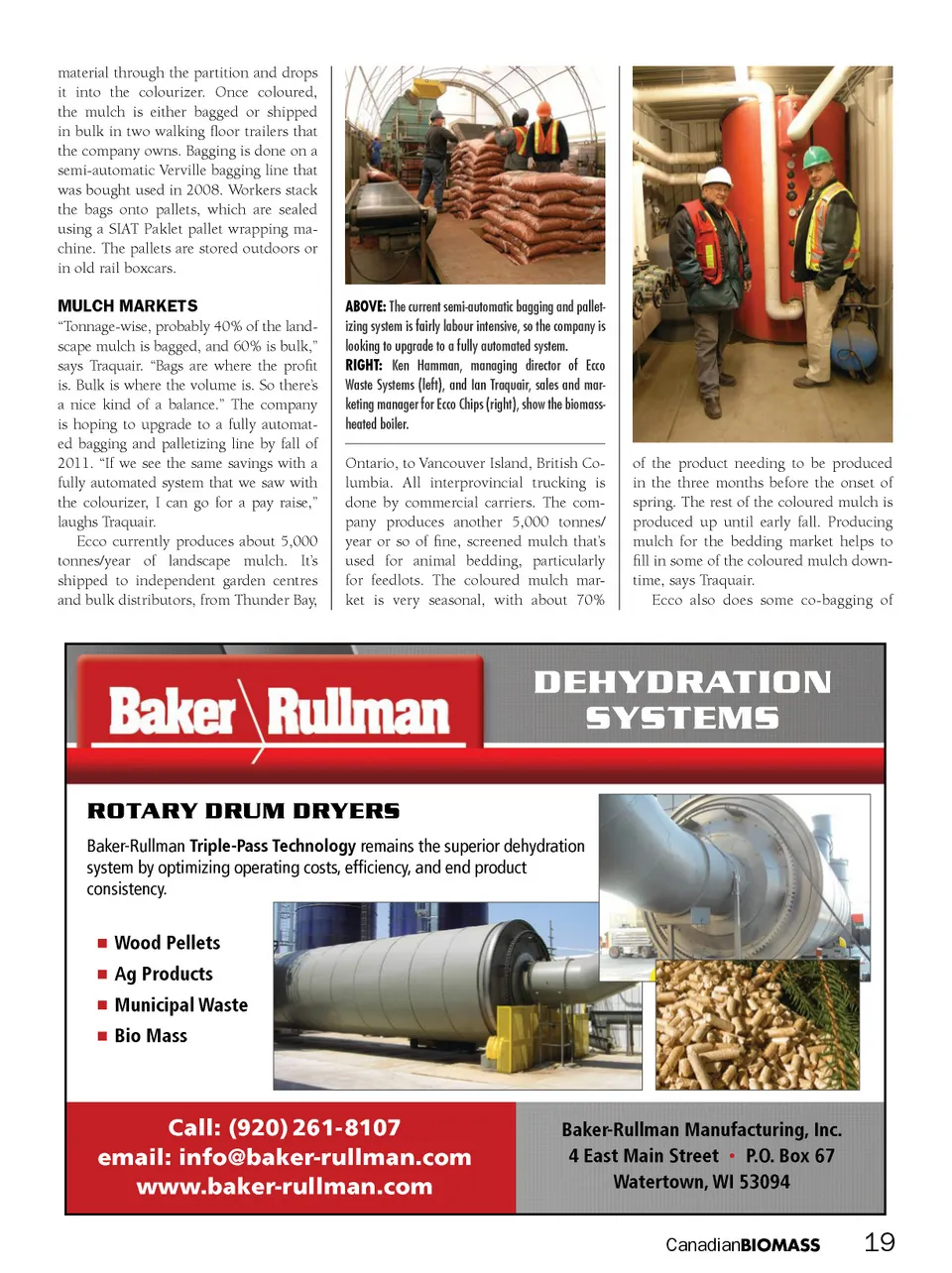
Wood Recovery From Landfill to Landscaping This Calgary landfill has a thriving business producing wood mulch for landscaping and animal bedding. By Heather Hager man’s trash is another man’s treasure, or so the saying goes. This is certainly evi-dent at Ecco Waste Systems, in Calgary, Alberta, where they’ve been turning wood waste into saleable mulch products for about eight years now. Diverting clean wood from the landfill is also extending the life of the site, allowing it to remain in operation for additional years. The private site began operating as a dry waste landfill in 1994, but it wasn’t until about 2002 that the owners started looking at opportunities to recycle, ex-plains Ken Hamman, managing director of Ecco Waste Systems. With the majority of materials coming from manufacturing, construction, and demolition activities, a good half of that material is raw wood and manufactured wood products such as plywood and oriented strand board. About half of that mix is clean dimension wood from construction/demolition and old pallets. That’s what is made into the mulch product. When the company first began making o ne mulch in 2003, a Rotochopper grinder processed and then coloured the prod-uct, which they called Ecco Chips. In 2007, they purchased a Bandit Beast grinder, along with an attachment for colouring the mulch as it was ground. In spring 2010, they decided to use the Beast for grinding only and purchased a Sahara-model Colorbiotics colourizer for dying the mulch. Ian Traquair, sales and marketing manager for Ecco Chips, says that the new colourizer cut their dye use by almost two-thirds. “It’s like a big mix-master turned side-ways,” describes Traquair. “With this ma-chine, from the time the mulch hits the vat to the time it comes out, it’s probably in there a good minute to minute and a half. So the whole time it’s turning, it’s being sprayed, and it’s being mixed.” He says that this results in good colour con-sistency and reduces the amount of water that’s required to mix with the dye. “Wood material for the mulching op-eration is currently ground outside and then moved to a cover-all unit,” says Hamman. Uncoloured mulch is stock-piled away from snow and rain in the main cover-all unit, while colouring, bag-ging, and palletizing occur in a smaller, adjacent unit. Another more recently installed cover-all unit has increased the storage space, allowing more raw mulch to be stockpiled prior to the busy pre-spring colouring season. About 95% of the landscape mulch the company sells is coloured; the remainder is left in its natural state. For colouring, a small Cat loader in the cover-all places the mulch onto a conveyor, which takes the AboVE: Clean lumber from the 110-acre landfill is ground and then coloured, bagged, and palletized in these cover-all units. INSEt: The Bandit Beast grinder gets some routine tooth maintenance in one of two biomass-heated cover-all buildings on-site. “It’s a substantial piece of equipment, but it has taken a lot of wear from inadvertent introduction of metals,” says Ken Hamman, managing director of Ecco Waste Systems. July/August 2011 18 Canadian BIOMASS
Canadian Biomass July/August 2011: Page 18