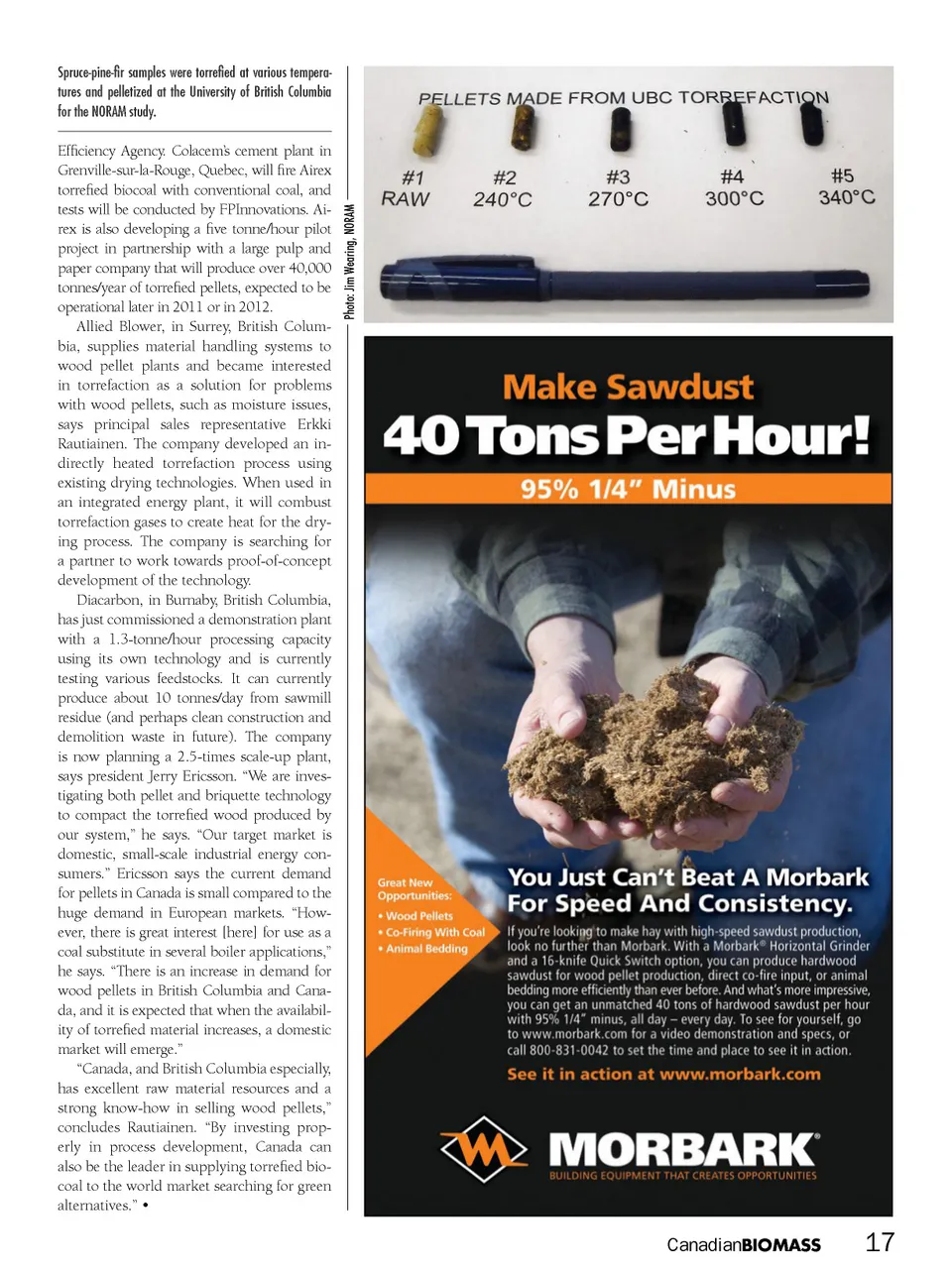
Spruce-pine-fir samples were torrefied at various tempera -tures and pelletized at the University of British Columbia for the NORAM study. Efficiency Agency. Colacem’s cement plant in Grenville-sur-la-Rouge, Quebec, will fire Airex torrefied biocoal with conventional coal, and tests will be conducted by FPInnovations. Ai-rex is also developing a five tonne/hour pilot project in partnership with a large pulp and paper company that will produce over 40,000 tonnes/year of torrefied pellets, expected to be operational later in 2011 or in 2012. Allied Blower, in Surrey, British Colum-bia, supplies material handling systems to wood pellet plants and became interested in torrefaction as a solution for problems with wood pellets, such as moisture issues, says principal sales representative Erkki Rautiainen. The company developed an in-directly heated torrefaction process using existing drying technologies. When used in an integrated energy plant, it will combust torrefaction gases to create heat for the dry-ing process. The company is searching for a partner to work towards proof-of-concept development of the technology. Diacarbon, in Burnaby, British Columbia, has just commissioned a demonstration plant with a 1.3-tonne/hour processing capacity using its own technology and is currently testing various feedstocks. It can currently produce about 10 tonnes/day from sawmill residue (and perhaps clean construction and demolition waste in future). The company is now planning a 2.5-times scale-up plant, says president Jerry Ericsson. “We are inves-tigating both pellet and briquette technology to compact the torrefied wood produced by our system,” he says. “Our target market is domestic, small-scale industrial energy con-sumers.” Ericsson says the current demand for pellets in Canada is small compared to the huge demand in European markets. “How-ever, there is great interest [here] for use as a coal substitute in several boiler applications,” he says. “There is an increase in demand for wood pellets in British Columbia and Cana-da, and it is expected that when the availabil-ity of torrefied material increases, a domestic market will emerge.” “Canada, and British Columbia especially, has excellent raw material resources and a strong know-how in selling wood pellets,” concludes Rautiainen. “By investing prop-erly in process development, Canada can also be the leader in supplying torrefied bio-coal to the world market searching for green alternatives.” • Photo: Jim Wearing, NORAM Canadian BIOMASS 17
Canadian Biomass July/August 2011: Page 17