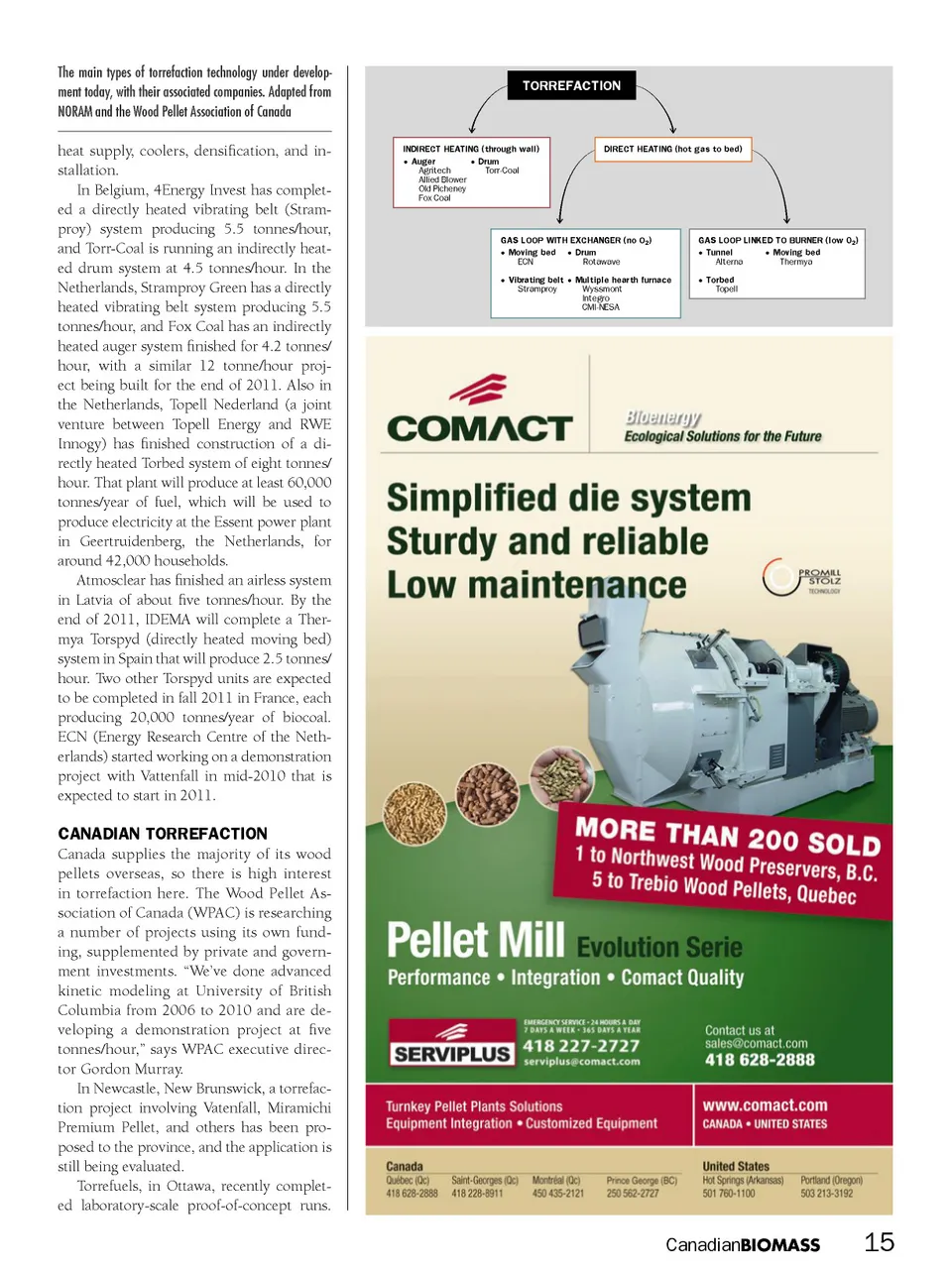
The main types of torrefaction technology under develop-ment today, with their associated companies. Adapted from NORAM and the Wood Pellet Association of Canada TORREFACTION heat supply, coolers, densification, and in-stallation. In Belgium, 4Energy Invest has complet-ed a directly heated vibrating belt (Stram-proy) system producing 5.5 tonnes/hour, and Torr-Coal is running an indirectly heat-ed drum system at 4.5 tonnes/hour. In the Netherlands, Stramproy Green has a directly heated vibrating belt system producing 5.5 tonnes/hour, and Fox Coal has an indirectly heated auger system finished for 4.2 tonnes/ hour, with a similar 12 tonne/hour proj-ect being built for the end of 2011. Also in the Netherlands, Topell Nederland (a joint venture between Topell Energy and RWE Innogy) has finished construction of a di-rectly heated Torbed system of eight tonnes/ hour. That plant will produce at least 60,000 tonnes/year of fuel, which will be used to produce electricity at the Essent power plant in Geertruidenberg, the Netherlands, for around 42,000 households. Atmosclear has finished an airless system in Latvia of about five tonnes/hour. By the end of 2011, IDEMA will complete a Ther-mya Torspyd (directly heated moving bed) system in Spain that will produce 2.5 tonnes/ hour. Two other Torspyd units are expected to be completed in fall 2011 in France, each producing 20,000 tonnes/year of biocoal. ECN (Energy Research Centre of the Neth-erlands) started working on a demonstration project with Vattenfall in mid-2010 that is expected to start in 2011. canadian torreFaction INDIRECT HEATING (through wall) • Auger • Drum Agritech Torr-Coal Allied Blower Old Picheney Fox Coal DIRECT HEATING (hot gas to bed) GAS LOOP WITH EXCHANGER (no O 2 ) • Moving bed ECN • Drum Rotawave GAS LOOP LINKED TO BURNER (low 0 2 ) • Tunnel Alterna • Torbed Topell • Moving bed Thermya • Vibrating belt • Multiple hearth furnace Stramproy Wyssmont Integro CMI-NESA Canada supplies the majority of its wood pellets overseas, so there is high interest in torrefaction here. The Wood Pellet As-sociation of Canada (WPAC) is researching a number of projects using its own fund-ing, supplemented by private and govern-ment investments. “We’ve done advanced kinetic modeling at University of British Columbia from 2006 to 2010 and are de-veloping a demonstration project at five tonnes/hour,” says WPAC executive direc-tor Gordon Murray. In Newcastle, New Brunswick, a torrefac-tion project involving Vatenfall, Miramichi Premium Pellet, and others has been pro-posed to the province, and the application is still being evaluated. Torrefuels, in Ottawa, recently complet-ed laboratory-scale proof-of-concept runs. Canadian BIOMASS 15
Canadian Biomass July/August 2011: Page 15