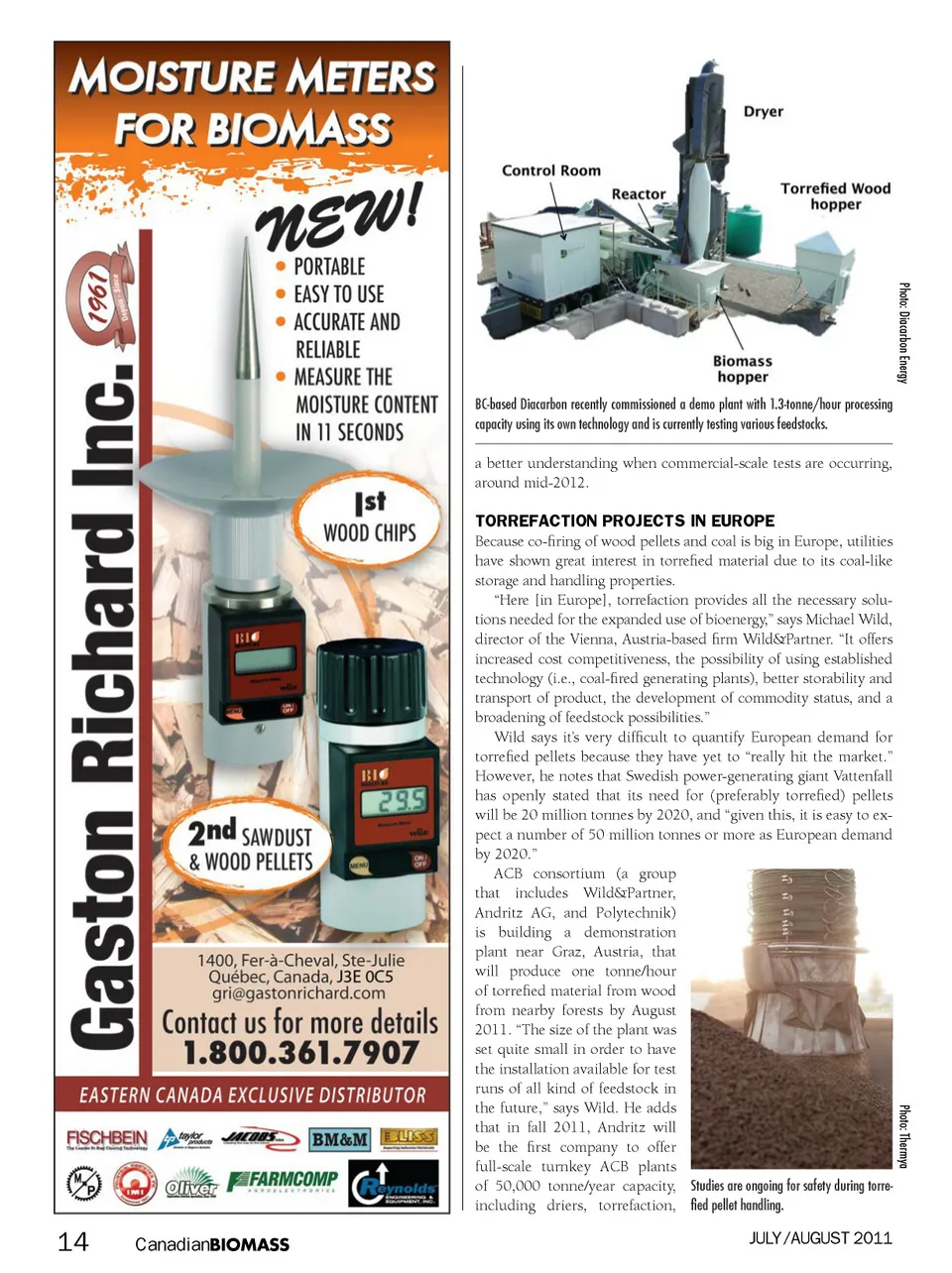
Photo: Diacarbon Energy BC-based Diacarbon recently commissioned a demo plant with 1.3-tonne/hour processing capacity using its own technology and is currently testing various feedstocks. a better understanding when commercial-scale tests are occurring, around mid-2012. torreFaction projects in europe Because co-firing of wood pellets and coal is big in Europe, utilities have shown great interest in torrefied material due to its coal-like storage and handling properties. “Here [in Europe], torrefaction provides all the necessary solu-tions needed for the expanded use of bioenergy,” says Michael Wild, director of the Vienna, Austria-based firm Wild&Partner. “It offers increased cost competitiveness, the possibility of using established technology (i.e., coal-fired generating plants), better storability and transport of product, the development of commodity status, and a broadening of feedstock possibilities.” Wild says it’s very difficult to quantify European demand for torrefied pellets because they have yet to “really hit the market.” However, he notes that Swedish power-generating giant Vattenfall has openly stated that its need for (preferably torrefied) pellets will be 20 million tonnes by 2020, and “given this, it is easy to ex-pect a number of 50 million tonnes or more as European demand by 2020.” ACB consortium (a group that includes Wild&Partner, Andritz AG, and Polytechnik) is building a demonstration plant near Graz, Austria, that will produce one tonne/hour of torrefied material from wood from nearby forests by August 2011. “The size of the plant was set quite small in order to have the installation available for test runs of all kind of feedstock in the future,” says Wild. He adds that in fall 2011, Andritz will be the first company to offer full-scale turnkey ACB plants of 50,000 tonne/year capacity, Studies are ongoing for safety during torre-including driers, torrefaction, fied pellet handling. Photo: Thermya 14 Canadian BIOMASS July/August 2011
Canadian Biomass July/August 2011: Page 14