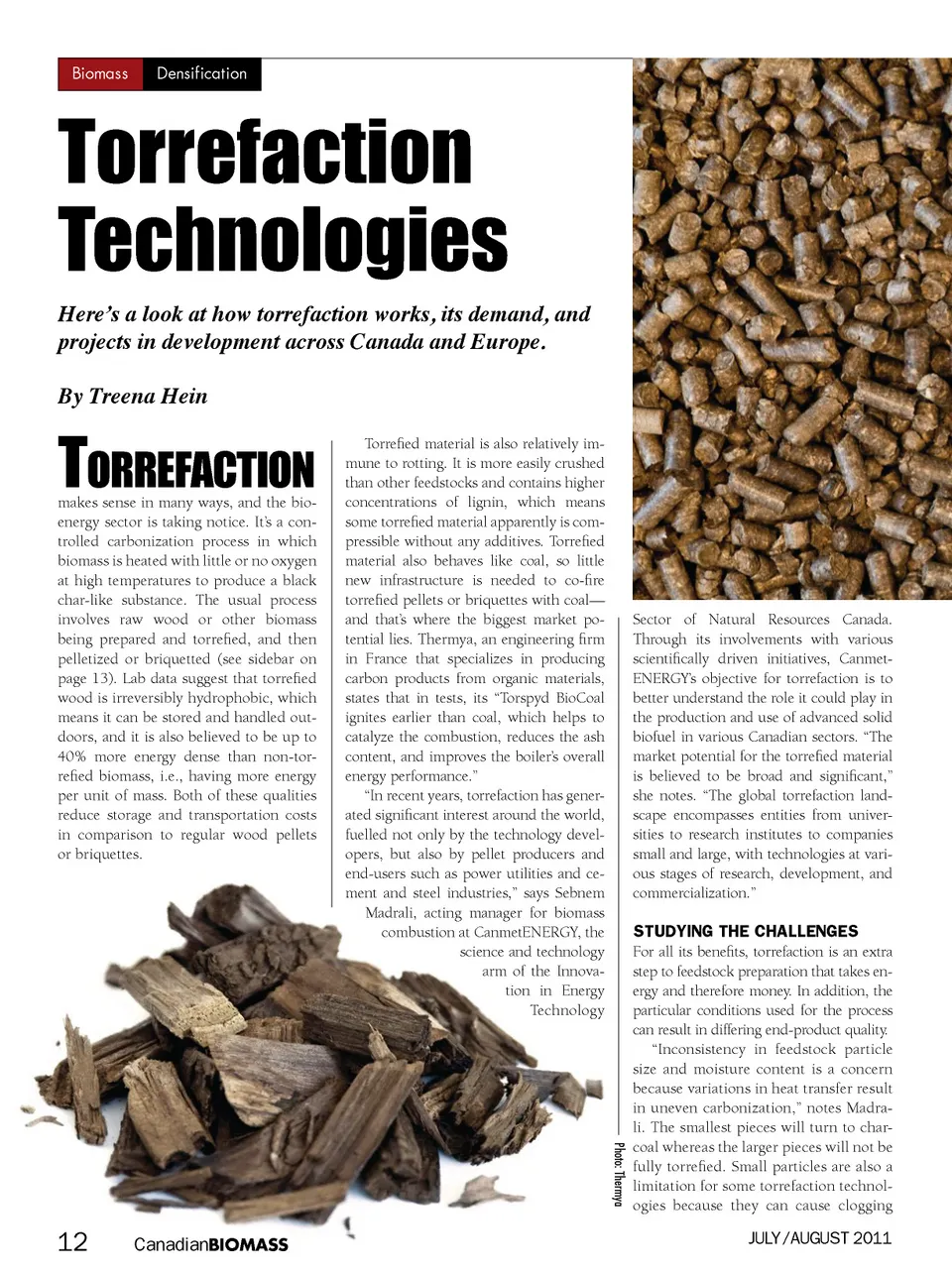
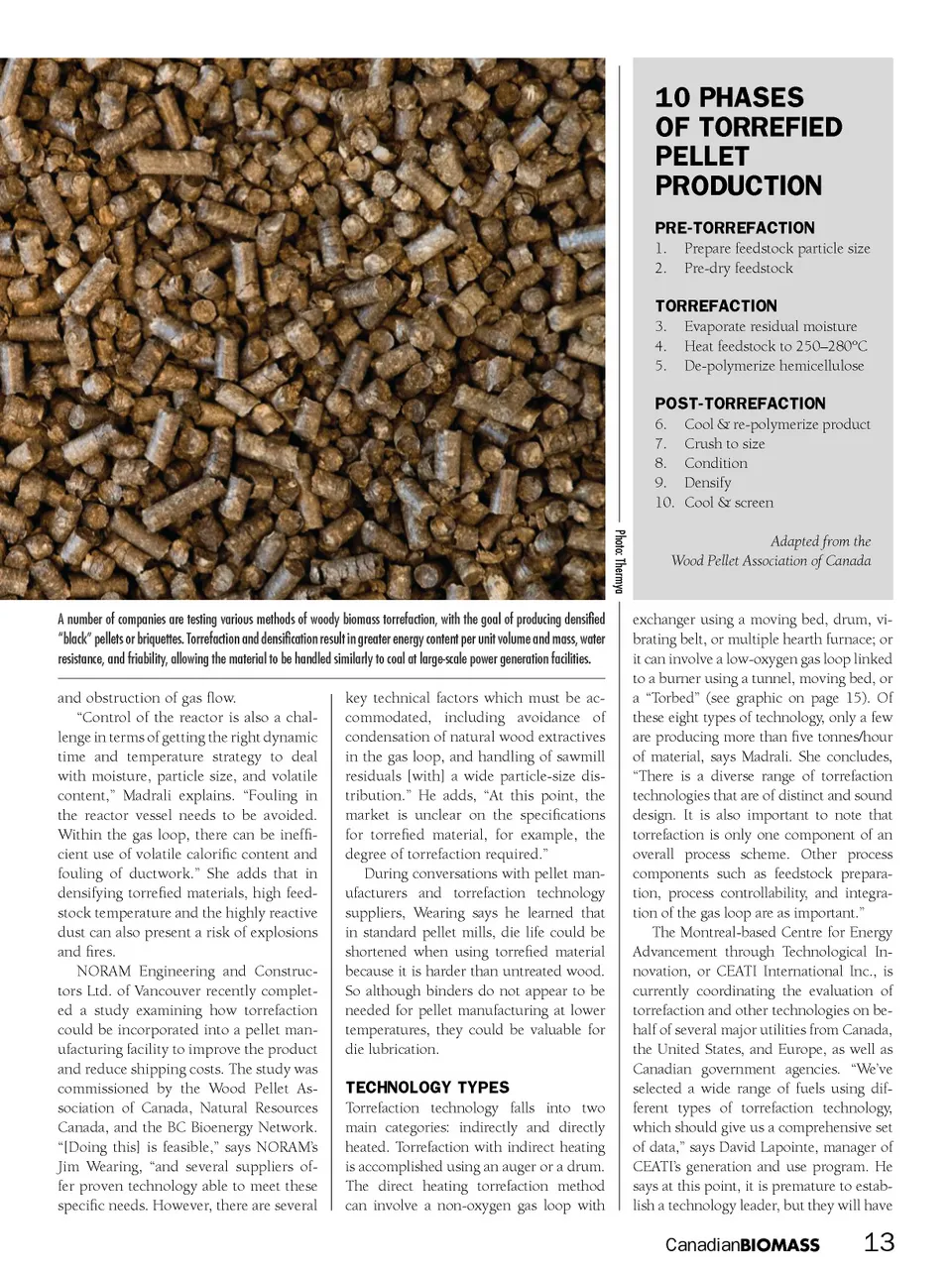
10 phases oF torreFied pellet production pre-torreFaction 1. 2. Prepare feedstock particle size Pre-dry feedstock torreFaction 3. 4. 5. Evaporate residual moisture Heat feedstock to 250–280°C De-polymerize hemicellulose post-torreFaction 6. 7. 8. 9. 10. Photo: Thermya Cool & re-polymerize product Crush to size Condition Densify Cool & screen Adapted from the Wood Pellet Association of Canada A number of companies are testing various methods of woody biomass torrefaction, with the goal of producing densified “black” pellets or briquettes. Torrefaction and densification result in greater energy content per unit volume and mass, water resistance, and friability, allowing the material to be handled similarly to coal at large-scale power generation facilities. and obstruction of gas flow. “Control of the reactor is also a chal-lenge in terms of getting the right dynamic time and temperature strategy to deal with moisture, particle size, and volatile content,” Madrali explains. “Fouling in the reactor vessel needs to be avoided. Within the gas loop, there can be ineffi-cient use of volatile calorific content and fouling of ductwork.” She adds that in densifying torrefied materials, high feed-stock temperature and the highly reactive dust can also present a risk of explosions and fires. NORAM Engineering and Construc-tors Ltd. of Vancouver recently complet-ed a study examining how torrefaction could be incorporated into a pellet man-ufacturing facility to improve the product and reduce shipping costs. The study was commissioned by the Wood Pellet As-sociation of Canada, Natural Resources Canada, and the BC Bioenergy Network. “[Doing this] is feasible,” says NORAM’s Jim Wearing, “and several suppliers of-fer proven technology able to meet these specific needs. However, there are several key technical factors which must be ac-commodated, including avoidance of condensation of natural wood extractives in the gas loop, and handling of sawmill residuals [with] a wide particle-size dis-tribution.” He adds, “At this point, the market is unclear on the specifications for torrefied material, for example, the degree of torrefaction required.” During conversations with pellet man-ufacturers and torrefaction technology suppliers, Wearing says he learned that in standard pellet mills, die life could be shortened when using torrefied material because it is harder than untreated wood. So although binders do not appear to be needed for pellet manufacturing at lower temperatures, they could be valuable for die lubrication. technology types Torrefaction technology falls into two main categories: indirectly and directly heated. Torrefaction with indirect heating is accomplished using an auger or a drum. The direct heating torrefaction method can involve a non-oxygen gas loop with exchanger using a moving bed, drum, vi-brating belt, or multiple hearth furnace; or it can involve a low-oxygen gas loop linked to a burner using a tunnel, moving bed, or a “Torbed” (see graphic on page 15). Of these eight types of technology, only a few are producing more than five tonnes/hour of material, says Madrali. She concludes, “There is a diverse range of torrefaction technologies that are of distinct and sound design. It is also important to note that torrefaction is only one component of an overall process scheme. Other process components such as feedstock prepara-tion, process controllability, and integra-tion of the gas loop are as important.” The Montreal-based Centre for Energy Advancement through Technological In-novation, or CEATI International Inc., is currently coordinating the evaluation of torrefaction and other technologies on be-half of several major utilities from Canada, the United States, and Europe, as well as Canadian government agencies. “We’ve selected a wide range of fuels using dif-ferent types of torrefaction technology, which should give us a comprehensive set of data,” says David Lapointe, manager of CEATI’s generation and use program. He says at this point, it is premature to estab-lish a technology leader, but they will have Canadian BIOMASS 13
Canadian Biomass July/August 2011: Page 13