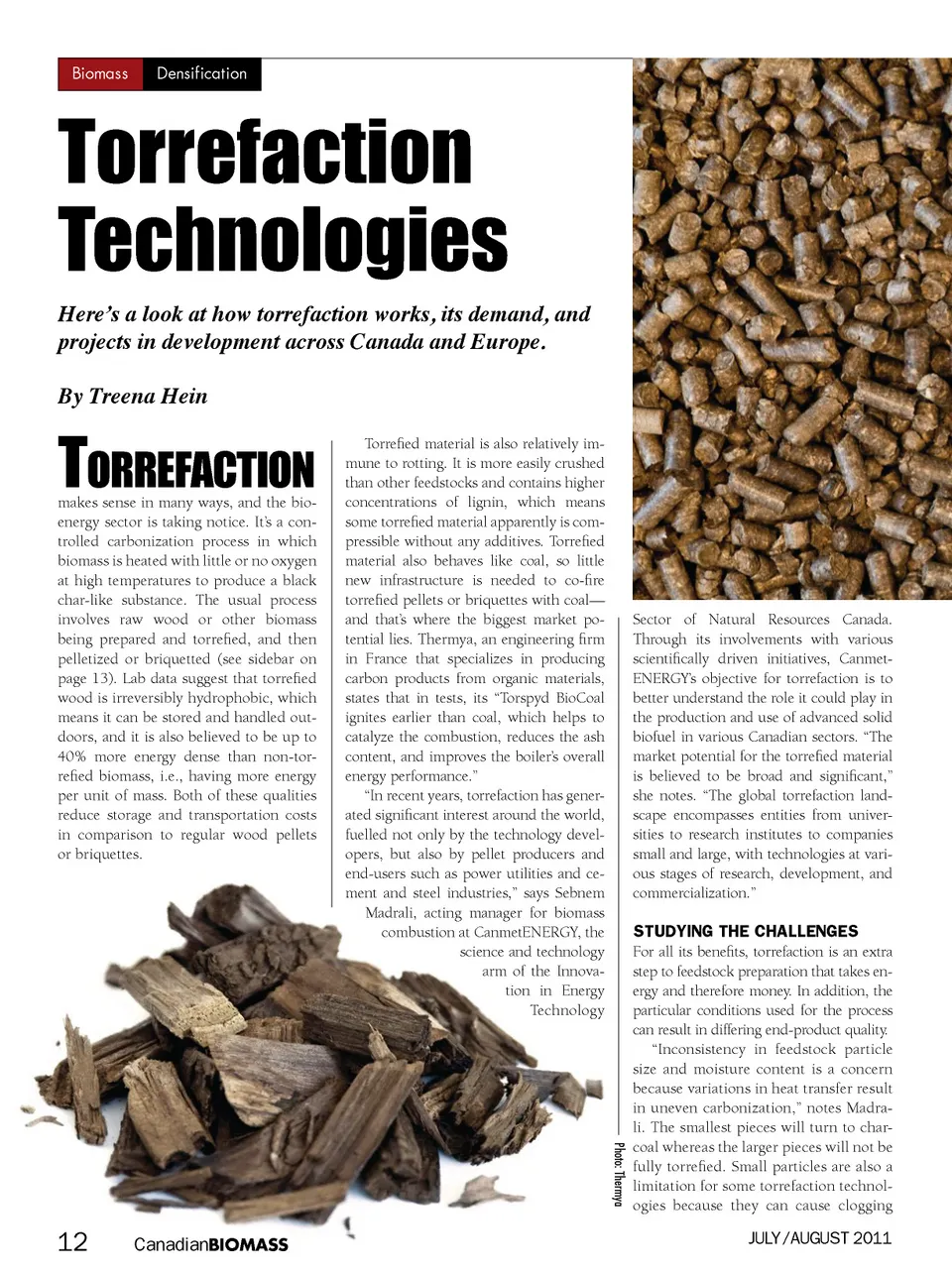
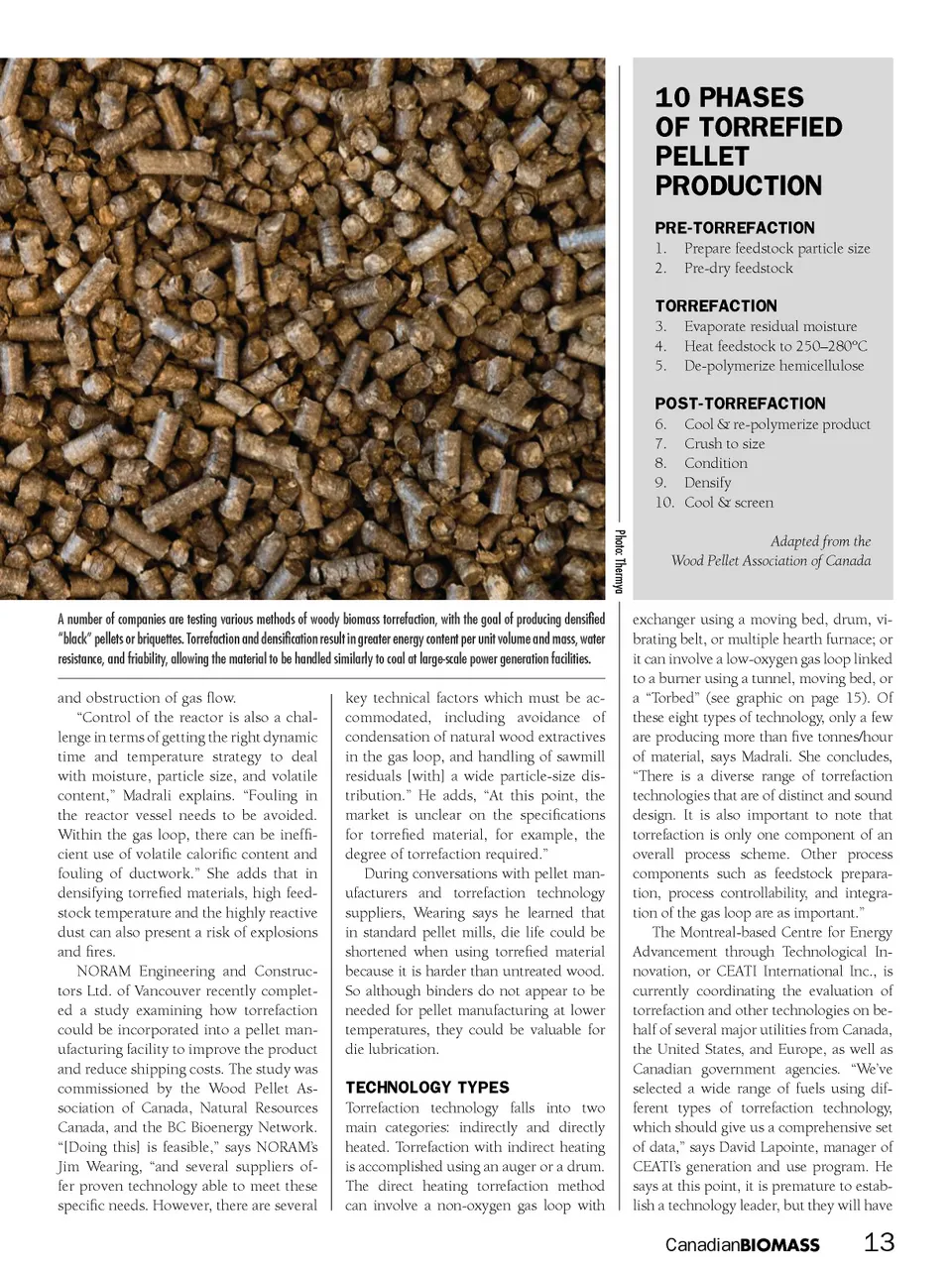
biomass densification Torrefaction Technologies Here’s a look at how torrefaction works, its demand, and projects in development across Canada and Europe. By Treena Hein T orrefacTion makes sense in many ways, and the bio-energy sector is taking notice. It’s a con-trolled carbonization process in which biomass is heated with little or no oxygen at high temperatures to produce a black char-like substance. The usual process involves raw wood or other biomass being prepared and torrefied, and then pelletized or briquetted (see sidebar on page 13). Lab data suggest that torrefied wood is irreversibly hydrophobic, which means it can be stored and handled out-doors, and it is also believed to be up to 40% more energy dense than non-tor-refied biomass, i.e., having more energy per unit of mass. Both of these qualities reduce storage and transportation costs in comparison to regular wood pellets or briquettes. Torrefied material is also relatively im-mune to rotting. It is more easily crushed than other feedstocks and contains higher concentrations of lignin, which means some torrefied material apparently is com-pressible without any additives. Torrefied material also behaves like coal, so little new infrastructure is needed to co-fire torrefied pellets or briquettes with coal— and that’s where the biggest market po-tential lies. Thermya, an engineering firm in France that specializes in producing carbon products from organic materials, states that in tests, its “Torspyd BioCoal ignites earlier than coal, which helps to catalyze the combustion, reduces the ash content, and improves the boiler’s overall energy performance.” “In recent years, torrefaction has gener-ated significant interest around the world, fuelled not only by the technology devel-opers, but also by pellet producers and end-users such as power utilities and ce-ment and steel industries,” says Sebnem Madrali, acting manager for biomass combustion at CanmetENERGY, the science and technology arm of the Innova-tion in Energy Technology Sector of Natural Resources Canada. Through its involvements with various scientifically driven initiatives, Canmet-ENERGY’s objective for torrefaction is to better understand the role it could play in the production and use of advanced solid biofuel in various Canadian sectors. “The market potential for the torrefied material is believed to be broad and significant,” she notes. “The global torrefaction land-scape encompasses entities from univer-sities to research institutes to companies small and large, with technologies at vari-ous stages of research, development, and commercialization.” studying the challenges For all its benefits, torrefaction is an extra step to feedstock preparation that takes en-ergy and therefore money. In addition, the particular conditions used for the process can result in differing end-product quality. “Inconsistency in feedstock particle size and moisture content is a concern because variations in heat transfer result in uneven carbonization,” notes Madra-li. The smallest pieces will turn to char-coal whereas the larger pieces will not be fully torrefied. Small particles are also a limitation for some torrefaction technol-ogies because they can cause clogging July/August 2011 Photo: Thermya 12 Canadian BIOMASS
Canadian Biomass July/August 2011: Page 12