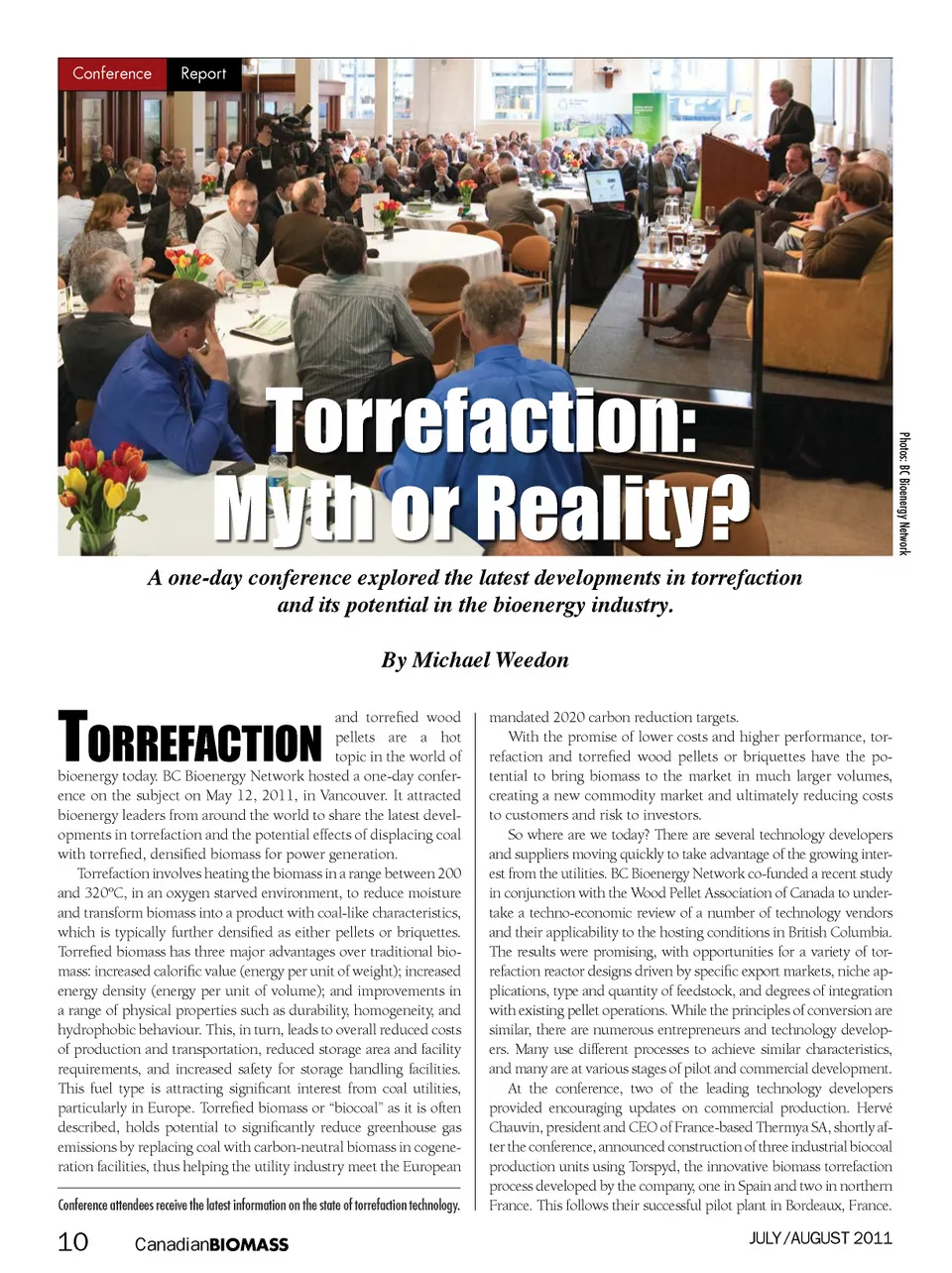
Conference Report A one-day conference explored the latest developments in torrefaction and its potential in the bioenergy industry. By Michael Weedon Torrefaction: Myth or Reality? Photos: BC Bioenergy Network T orrefacTion and torrefied wood pellets are a hot topic in the world of bioenergy today. BC Bioenergy Network hosted a one-day confer-ence on the subject on May 12, 2011, in Vancouver. It attracted bioenergy leaders from around the world to share the latest devel-opments in torrefaction and the potential effects of displacing coal with torrefied, densified biomass for power generation. Torrefaction involves heating the biomass in a range between 200 and 320°C, in an oxygen starved environment, to reduce moisture and transform biomass into a product with coal-like characteristics, which is typically further densified as either pellets or briquettes. Torrefied biomass has three major advantages over traditional bio-mass: increased calorific value (energy per unit of weight); increased energy density (energy per unit of volume); and improvements in a range of physical properties such as durability, homogeneity, and hydrophobic behaviour. This, in turn, leads to overall reduced costs of production and transportation, reduced storage area and facility requirements, and increased safety for storage handling facilities. This fuel type is attracting significant interest from coal utilities, particularly in Europe. Torrefied biomass or “biocoal” as it is often described, holds potential to significantly reduce greenhouse gas emissions by replacing coal with carbon-neutral biomass in cogene-ration facilities, thus helping the utility industry meet the European Conference attendees receive the latest information on the state of torrefaction technology. mandated 2020 carbon reduction targets. With the promise of lower costs and higher performance, tor-refaction and torrefied wood pellets or briquettes have the po-tential to bring biomass to the market in much larger volumes, creating a new commodity market and ultimately reducing costs to customers and risk to investors. So where are we today? There are several technology developers and suppliers moving quickly to take advantage of the growing inter-est from the utilities. BC Bioenergy Network co-funded a recent study in conjunction with the Wood Pellet Association of Canada to under-take a techno-economic review of a number of technology vendors and their applicability to the hosting conditions in British Columbia. The results were promising, with opportunities for a variety of tor-refaction reactor designs driven by specific export markets, niche ap-plications, type and quantity of feedstock, and degrees of integration with existing pellet operations. While the principles of conversion are similar, there are numerous entrepreneurs and technology develop-ers. Many use different processes to achieve similar characteristics, and many are at various stages of pilot and commercial development. At the conference, two of the leading technology developers provided encouraging updates on commercial production. Hervé Chauvin, president and CEO of France-based Thermya SA, shortly af-ter the conference, announced construction of three industrial biocoal production units using Torspyd, the innovative biomass torrefaction process developed by the company, one in Spain and two in northern France. This follows their successful pilot plant in Bordeaux, France. July/August 2011 10 Canadian BIOMASS
Canadian Biomass July/August 2011: Page 10