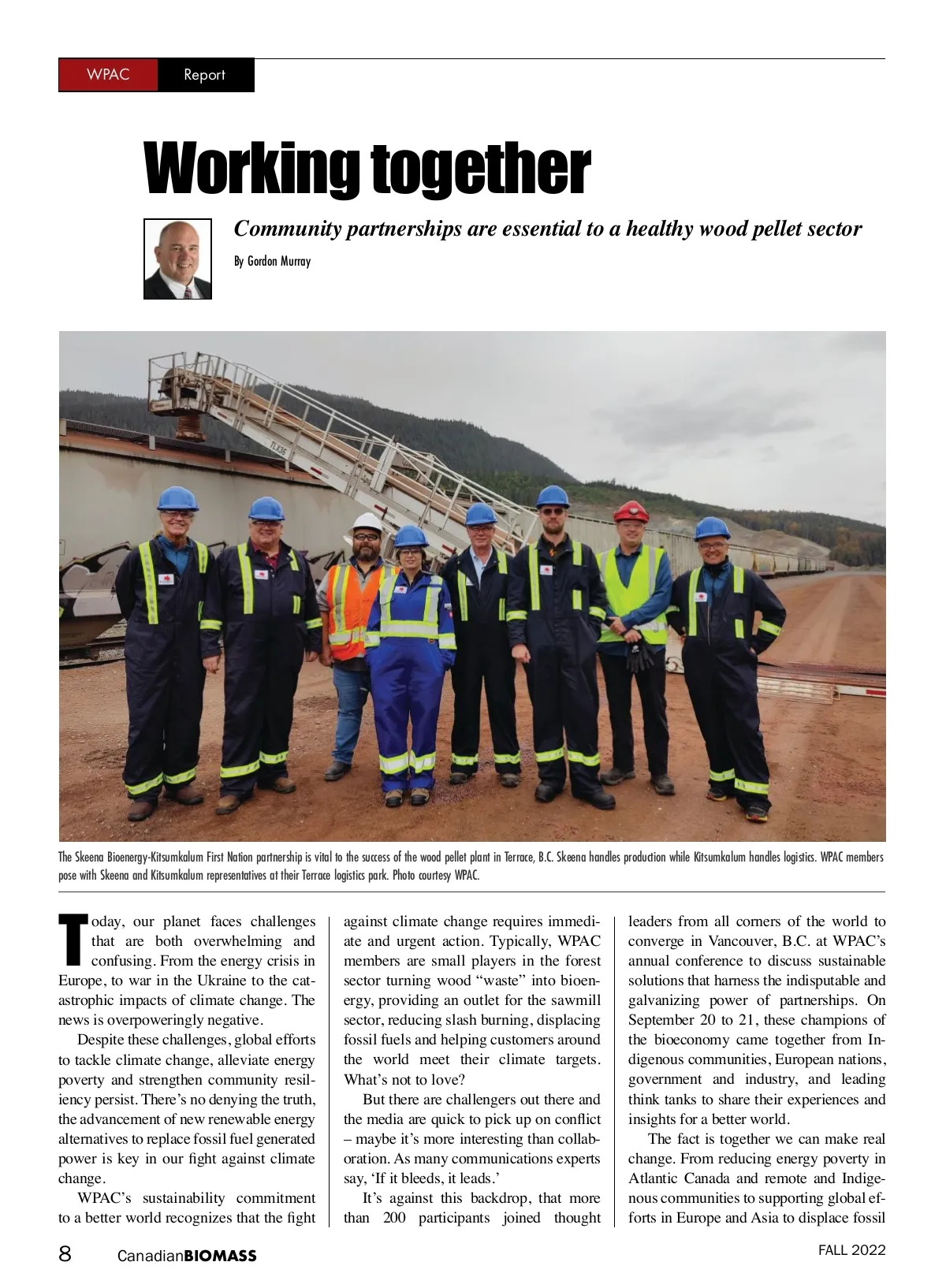
WPAC Report Working together By Gordon Murray Community partnerships are essential to a healthy wood pellet sector The Skeena Bioenergy-Kitsumkalum First Nation partnership is vital to the success of the wood pellet plant in Terrace, B.C. Skeena handles production while Kitsumkalum handles logistics. WPAC members pose with Skeena and Kitsumkalum representatives at their Terrace logistics park. Photo courtesy WPAC. oday, our planet faces challenges that are both overwhelming and confusing. From the energy crisis in Europe, to war in the Ukraine to the cat-astrophic impacts of climate change. The news is overpoweringly negative. Despite these challenges, global efforts to tackle climate change, alleviate energy poverty and strengthen community resil-iency persist. There’s no denying the truth, the advancement of new renewable energy alternatives to replace fossil fuel generated power is key in our fight against climate change. WPAC’s sustainability commitment to a better world recognizes that the fight T against climate change requires immedi-ate and urgent action. Typically, WPAC members are small players in the forest sector turning wood “waste” into bioen-ergy, providing an outlet for the sawmill sector, reducing slash burning, displacing fossil fuels and helping customers around the world meet their climate targets. What’s not to love? But there are challengers out there and the media are quick to pick up on conflict – maybe it’s more interesting than collab-oration. As many communications experts say, ‘If it bleeds, it leads.’ It’s against this backdrop, that more than 200 participants joined thought leaders from all corners of the world to converge in Vancouver, B.C. at WPAC’s annual conference to discuss sustainable solutions that harness the indisputable and galvanizing power of partnerships. On September 20 to 21, these champions of the bioeconomy came together from In-digenous communities, European nations, government and industry, and leading think tanks to share their experiences and insights for a better world. The fact is together we can make real change. From reducing energy poverty in Atlantic Canada and remote and Indige-nous communities to supporting global ef-forts in Europe and Asia to displace fossil FALL 2022 8 Canadian BIOMASS
Canadian Biomass Fall 2022: Page 8