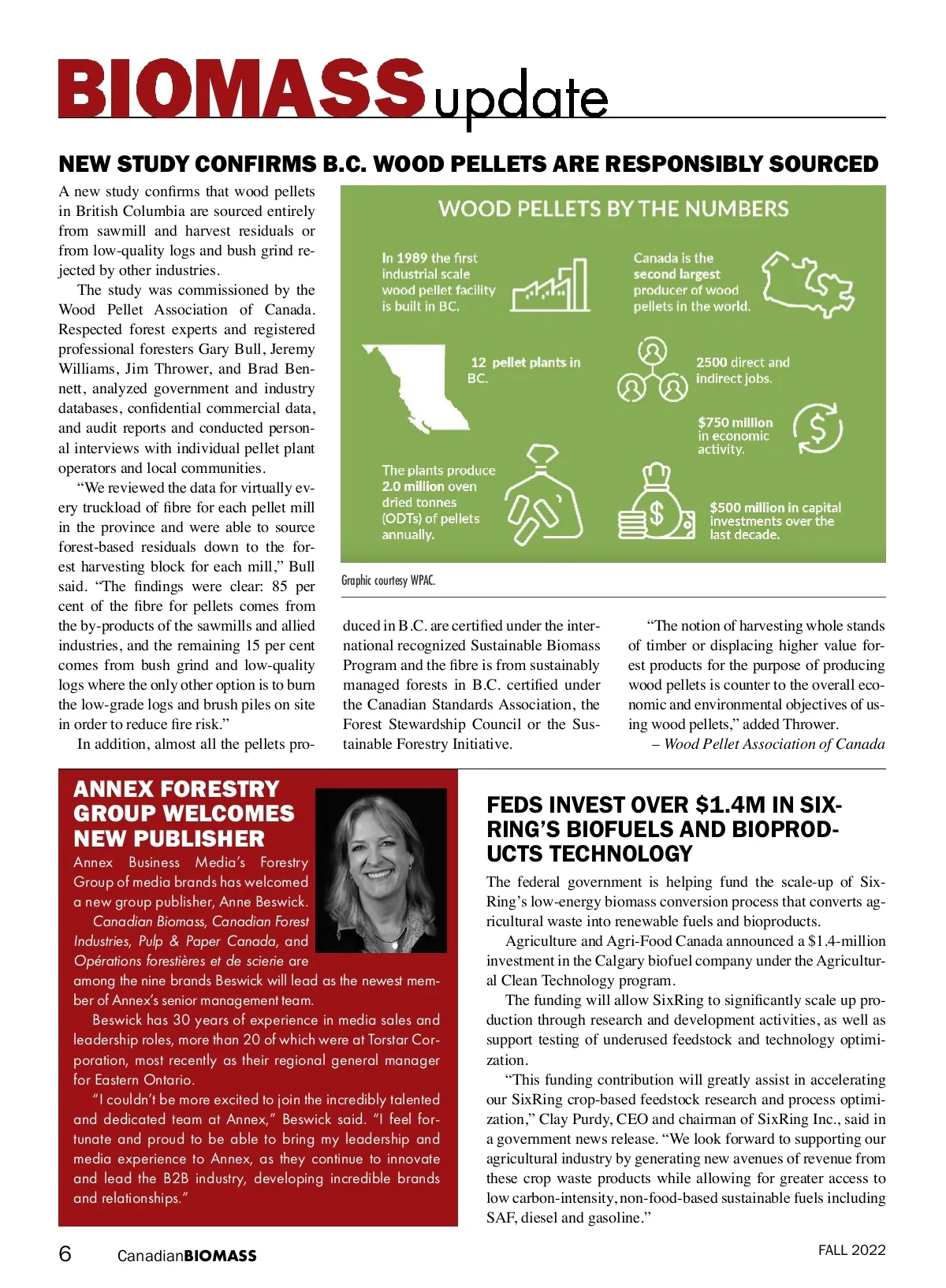
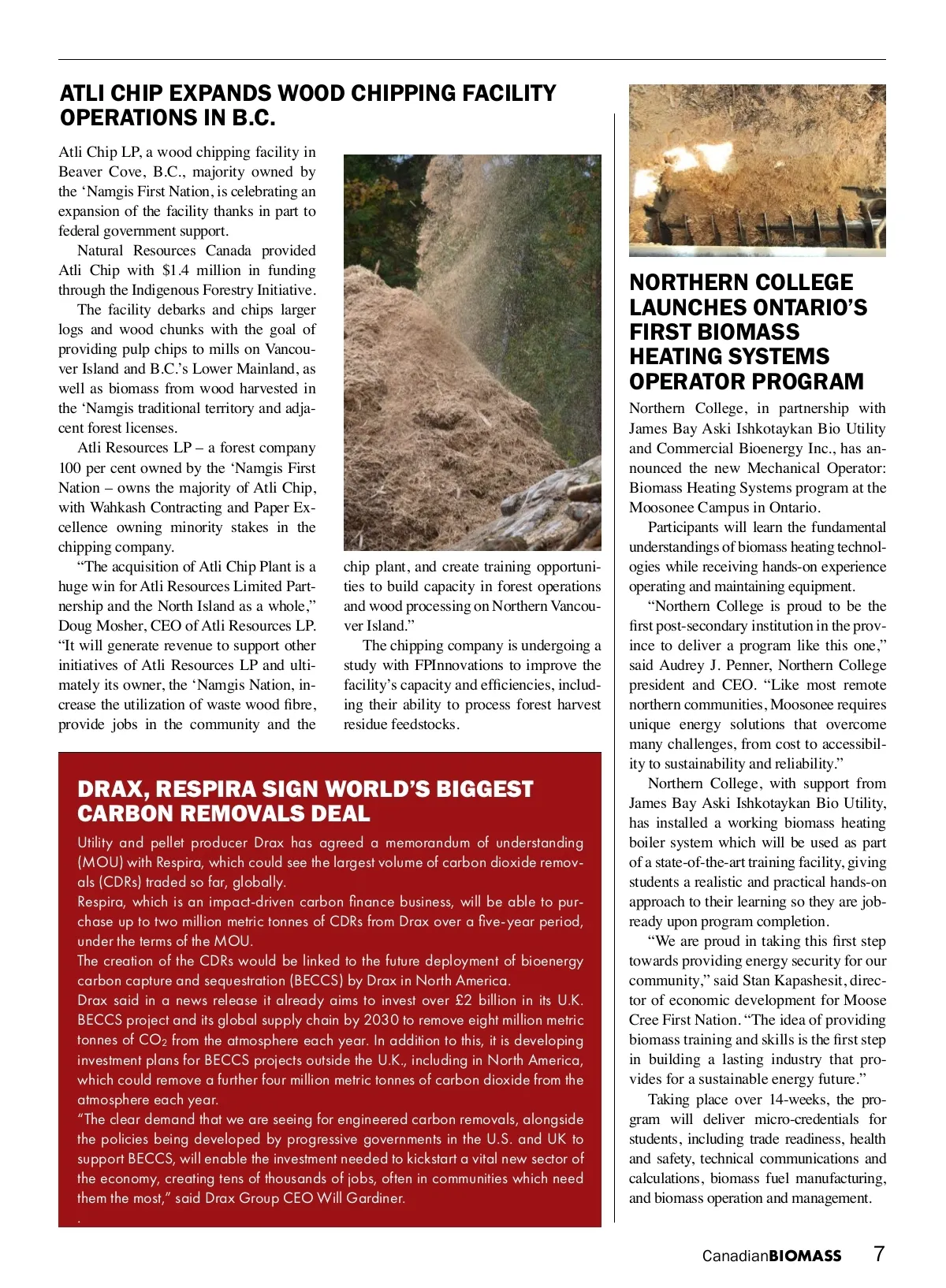
ATLI CHIP EXPANDS WOOD CHIPPING FACILITY OPERATIONS IN B.C. Atli Chip LP, a wood chipping facility in Beaver Cove, B.C., majority owned by the ‘Namgis First Nation, is celebrating an expansion of the facility thanks in part to federal government support. Natural Resources Canada provided Atli Chip with $1.4 million in funding through the Indigenous Forestry Initiative. The facility debarks and chips larger logs and wood chunks with the goal of providing pulp chips to mills on Vancou-ver Island and B.C.’s Lower Mainland, as well as biomass from wood harvested in the ‘Namgis traditional territory and adja-cent forest licenses. Atli Resources LP – a forest company 100 per cent owned by the ‘Namgis First Nation – owns the majority of Atli Chip, with Wahkash Contracting and Paper Ex-cellence owning minority stakes in the chipping company. “The acquisition of Atli Chip Plant is a huge win for Atli Resources Limited Part-nership and the North Island as a whole,” Doug Mosher, CEO of Atli Resources LP. “It will generate revenue to support other initiatives of Atli Resources LP and ulti-mately its owner, the ‘Namgis Nation, in-crease the utilization of waste wood fibre, provide jobs in the community and the NORTHERN COLLEGE LAUNCHES ONTARIO’S FIRST BIOMASS HEATING SYSTEMS OPERATOR PROGRAM chip plant, and create training opportuni-ties to build capacity in forest operations and wood processing on Northern Vancou-ver Island.” The chipping company is undergoing a study with FPInnovations to improve the facility’s capacity and efficiencies, includ -ing their ability to process forest harvest residue feedstocks. DRAX, RESPIRA SIGN WORLD’S BIGGEST CARBON REMOVALS DEAL Utility and pellet producer Drax has agreed a memorandum of understanding (MOU) with Respira, which could see the largest volume of carbon dioxide remov-als (CDRs) traded so far, globally. Respira, which is an impact-driven carbon finance business, will be able to pur-chase up to two million metric tonnes of CDRs from Drax over a five-year period, under the terms of the MOU. The creation of the CDRs would be linked to the future deployment of bioenergy carbon capture and sequestration (BECCS) by Drax in North America. Drax said in a news release it already aims to invest over £2 billion in its U.K. BECCS project and its global supply chain by 2030 to remove eight million metric tonnes of CO 2 from the atmosphere each year. In addition to this, it is developing investment plans for BECCS projects outside the U.K., including in North America, which could remove a further four million metric tonnes of carbon dioxide from the atmosphere each year. “The clear demand that we are seeing for engineered carbon removals, alongside the policies being developed by progressive governments in the U.S. and UK to support BECCS, will enable the investment needed to kickstart a vital new sector of the economy, creating tens of thousands of jobs, often in communities which need them the most,” said Drax Group CEO Will Gardiner. . Northern College, in partnership with James Bay Aski Ishkotaykan Bio Utility and Commercial Bioenergy Inc., has an-nounced the new Mechanical Operator: Biomass Heating Systems program at the Moosonee Campus in Ontario. Participants will learn the fundamental understandings of biomass heating technol-ogies while receiving hands-on experience operating and maintaining equipment. “Northern College is proud to be the first post-secondary institution in the prov -ince to deliver a program like this one,” said Audrey J. Penner, Northern College president and CEO. “Like most remote northern communities, Moosonee requires unique energy solutions that overcome many challenges, from cost to accessibil-ity to sustainability and reliability.” Northern College, with support from James Bay Aski Ishkotaykan Bio Utility, has installed a working biomass heating boiler system which will be used as part of a state-of-the-art training facility, giving students a realistic and practical hands-on approach to their learning so they are job-ready upon program completion. “We are proud in taking this first step towards providing energy security for our community,” said Stan Kapashesit, direc-tor of economic development for Moose Cree First Nation. “The idea of providing biomass training and skills is the first step in building a lasting industry that pro-vides for a sustainable energy future.” Taking place over 14-weeks, the pro-gram will deliver micro-credentials for students, including trade readiness, health and safety, technical communications and calculations, biomass fuel manufacturing, and biomass operation and management. Canadian BIOMASS 7
Canadian Biomass Fall 2022: Page 7