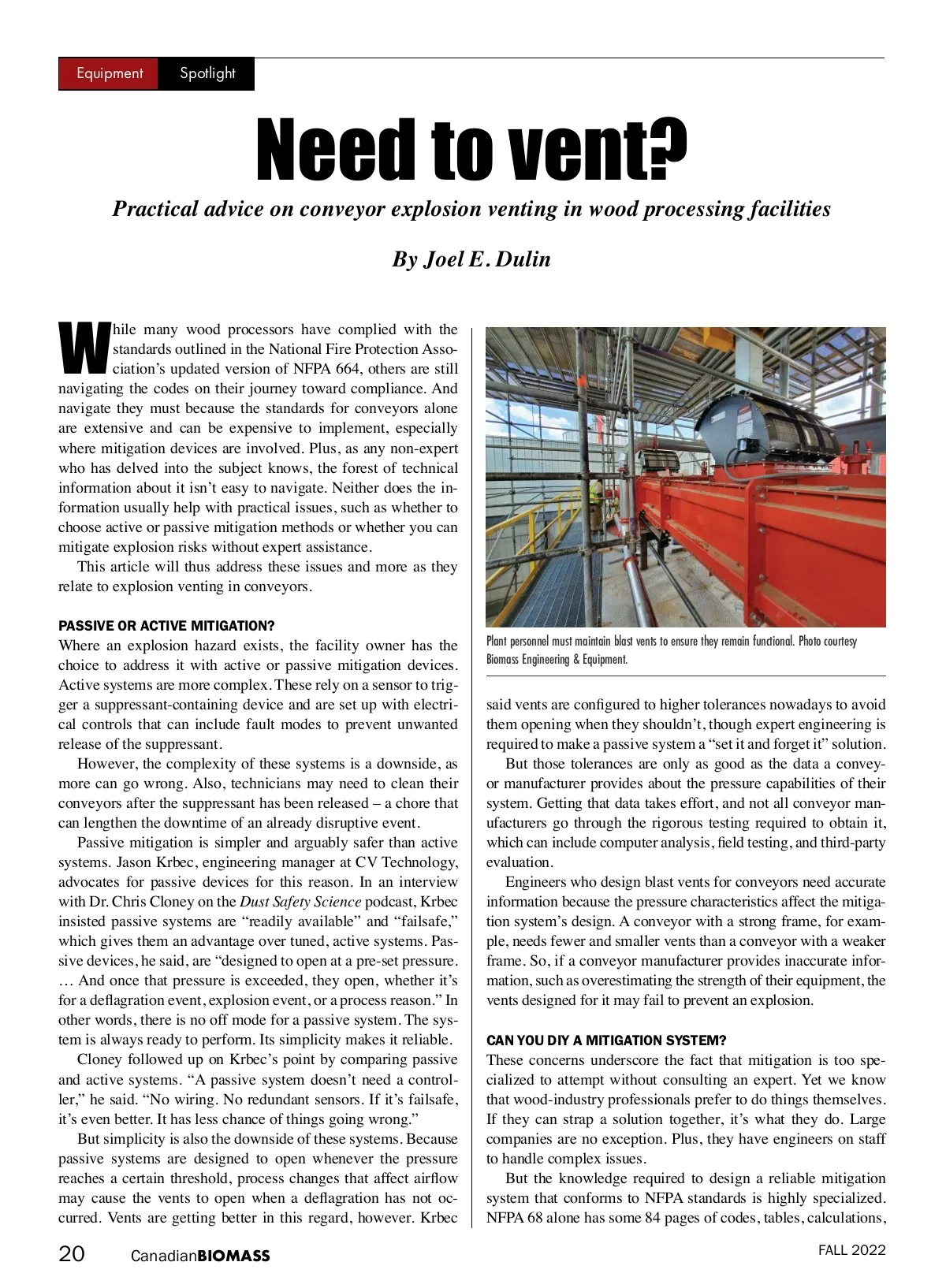
and exceptions for explosion mitigation devices, and missing one detail can put a facility out of compliance. Worse, it may nullify the system’s effectiveness. Bernardo Sanson, a sales engineer with CV Tech, spoke to this point on a recent call, saying, “Ventilation requires expertise in the sense you’re required to know and be able to determine the burst pressure of the explosion panels. In the past, they were manufactured without much control for bust pressure. So, with-out knowing that, you don’t know the side effect a deflagration would have on your conveyor or the atmosphere. That’s only determined with testing. Plus, you have to be compliant with ATEC’s approvals in quality and protocol [as they relate to testing and manufacturing controls].” Army Test and Evaluation Command approval isn’t likely something a wood processor will get from a panel designed by a staff engineer and manufactured in a company fab shop. Manufacturing in-tricacies are yet another reason to rely on professionals for this service and not at-tempt a do-it-yourself solution. POST-INSTALLATION CARE DIY efforts do come into play post instal-ment, of course. While passive systems require less care than active systems, they still need attention. As with other systems, plant personnel must know how post-instalment work may affect them and how they wear over time. According to Krbec, it’s not uncommon for technicians to add insulation to blast panels on their equipment. This is a prob-lem, as insulation adds inertia to the panel and affects how it will perform in the event of a deflagration. The same idea holds for changes to the conveyor the vents protect. For example, replacing a top or bottom panel with material thinner than original equipment manufacturer specifications makes the conveyor weaker. Because the system’s parameters have changed, the vents may no longer adequately protect it. Adding components around a blast panel likewise can affect how the system performs. Objects placed to the side of a panel may deflect energy up and increase the distance the fireball travels. Changes to the material inside the vessel may also affect the system, as can process changes that add vibrations or alter the air pressure. Due to the complexities associated with mitigation it’s best to consult the blast pan-el’s manufacturer before making changes. Plant personnel must also maintain blast vents to ensure they remain func-tional. Panels must be kept free of debris, snow, ice, and large amounts of dust. They may also need protection from pests and precipitation. Furthermore, panels are not rust-proof, and vibrations will weaken them over time. A panels manu-facturer can provide the best estimate for a panel’s expected lifespan. Because mitigation systems are so nu-anced, it’s best to talk to an expert before altering anything that may affect them. Professionals understand the ins and outs of these systems – what’s required, what to avoid, and how to manufacture devices to code. The forest of information on mit-igation and dust safety may be thick, but such experts can help you navigate it. • Joel E. Dulin is the director of marketing for Biomass Engineering & Equipment. TSI BUILDS MACHINERY FOR THE BIOMASS INDUSTRY This includes Rotary Drum Dryers coupled with Heat Energy systems; TSI also builds Wet Electrostatic Precipitators when required to meet Client’s emission goals. TSI also offers technology for Torrefaction. TSI machinery is custom designed and ranges from 50,000 tons/year to 450,000 tons/year. Zlatko (Zo) Savovic (425) 239-7490 • www.tsi-inc.net Canadian BIOMASS CB_TSI_HP_Dect21_CWM.indd 1 2021-12-16 3:13 PM 21
Canadian Biomass Fall 2022: Page 21