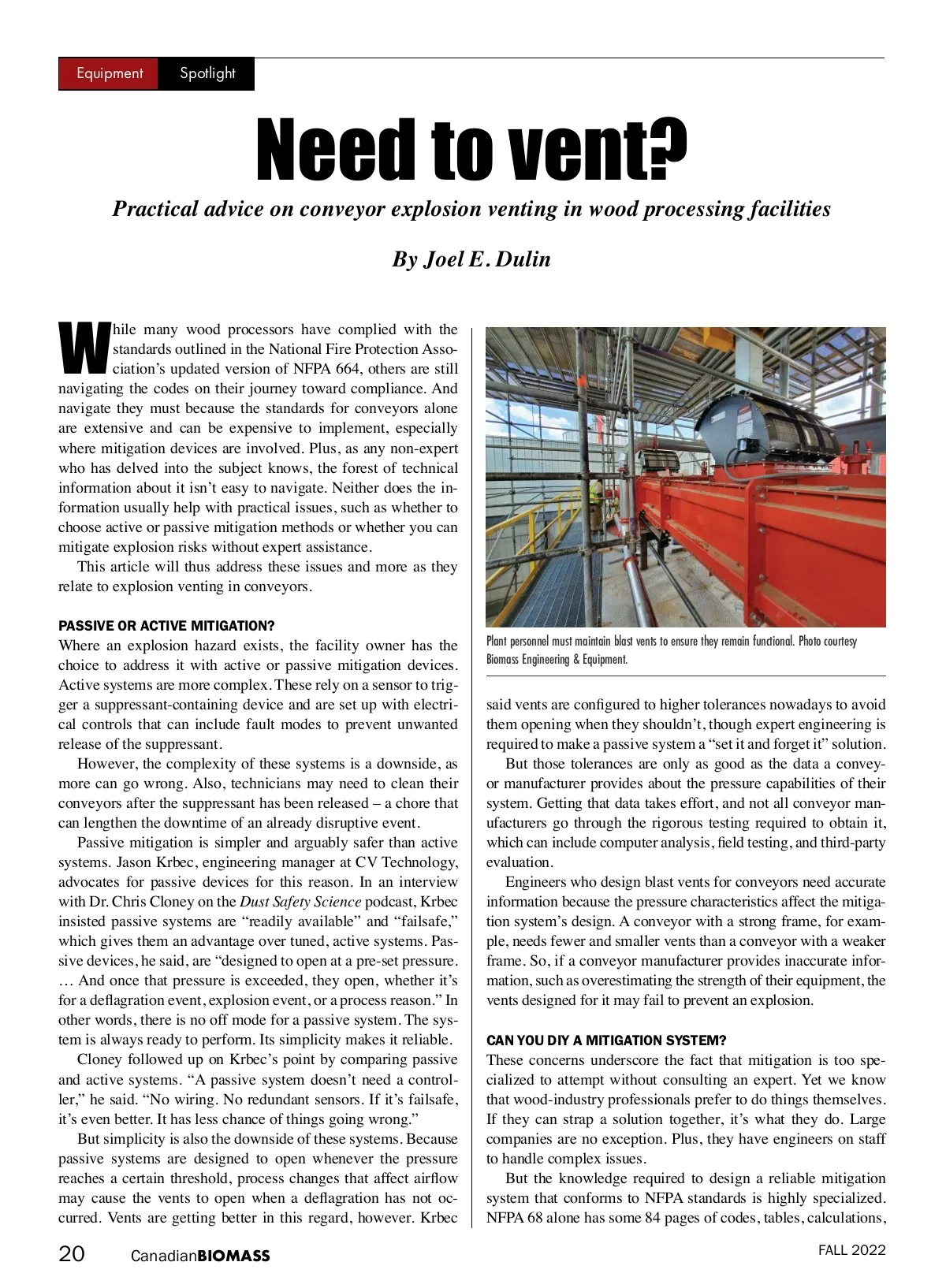
Equipment Spotlight Practical advice on conveyor explosion venting in wood processing facilities By Joel E. Dulin hile many wood processors have complied with the standards outlined in the National Fire Protection Asso-ciation’s updated version of NFPA 664, others are still navigating the codes on their journey toward compliance. And navigate they must because the standards for conveyors alone are extensive and can be expensive to implement, especially where mitigation devices are involved. Plus, as any non-expert who has delved into the subject knows, the forest of technical information about it isn’t easy to navigate. Neither does the in-formation usually help with practical issues, such as whether to choose active or passive mitigation methods or whether you can mitigate explosion risks without expert assistance. This article will thus address these issues and more as they relate to explosion venting in conveyors. PASSIVE OR ACTIVE MITIGATION? Need to vent? W Where an explosion hazard exists, the facility owner has the choice to address it with active or passive mitigation devices. Active systems are more complex. These rely on a sensor to trig-ger a suppressant-containing device and are set up with electri-cal controls that can include fault modes to prevent unwanted release of the suppressant. However, the complexity of these systems is a downside, as more can go wrong. Also, technicians may need to clean their conveyors after the suppressant has been released – a chore that can lengthen the downtime of an already disruptive event. Passive mitigation is simpler and arguably safer than active systems. Jason Krbec, engineering manager at CV Technology, advocates for passive devices for this reason. In an interview with Dr. Chris Cloney on the Dust Safety Science podcast, Krbec insisted passive systems are “readily available” and “failsafe,” which gives them an advantage over tuned, active systems. Pas-sive devices, he said, are “designed to open at a pre-set pressure. … And once that pressure is exceeded, they open, whether it’s for a deflagration event, explosion event, or a process reason.” In other words, there is no off mode for a passive system. The sys-tem is always ready to perform. Its simplicity makes it reliable. Cloney followed up on Krbec’s point by comparing passive and active systems. “A passive system doesn’t need a control-ler,” he said. “No wiring. No redundant sensors. If it’s failsafe, it’s even better. It has less chance of things going wrong.” But simplicity is also the downside of these systems. Because passive systems are designed to open whenever the pressure reaches a certain threshold, process changes that affect airflow may cause the vents to open when a deflagration has not oc -curred. Vents are getting better in this regard, however. Krbec Plant personnel must maintain blast vents to ensure they remain functional. Photo courtesy Biomass Engineering & Equipment. said vents are configured to higher tolerances nowadays to avoid them opening when they shouldn’t, though expert engineering is required to make a passive system a “set it and forget it” solution. But those tolerances are only as good as the data a convey-or manufacturer provides about the pressure capabilities of their system. Getting that data takes effort, and not all conveyor man-ufacturers go through the rigorous testing required to obtain it, which can include computer analysis, field testing, and third-party evaluation. Engineers who design blast vents for conveyors need accurate information because the pressure characteristics affect the mitiga-tion system’s design. A conveyor with a strong frame, for exam-ple, needs fewer and smaller vents than a conveyor with a weaker frame. So, if a conveyor manufacturer provides inaccurate infor-mation, such as overestimating the strength of their equipment, the vents designed for it may fail to prevent an explosion. CAN YOU DIY A MITIGATION SYSTEM? These concerns underscore the fact that mitigation is too spe-cialized to attempt without consulting an expert. Yet we know that wood-industry professionals prefer to do things themselves. If they can strap a solution together, it’s what they do. Large companies are no exception. Plus, they have engineers on staff to handle complex issues. But the knowledge required to design a reliable mitigation system that conforms to NFPA standards is highly specialized. NFPA 68 alone has some 84 pages of codes, tables, calculations, FALL 2022 20 Canadian BIOMASS
Canadian Biomass Fall 2022: Page 20