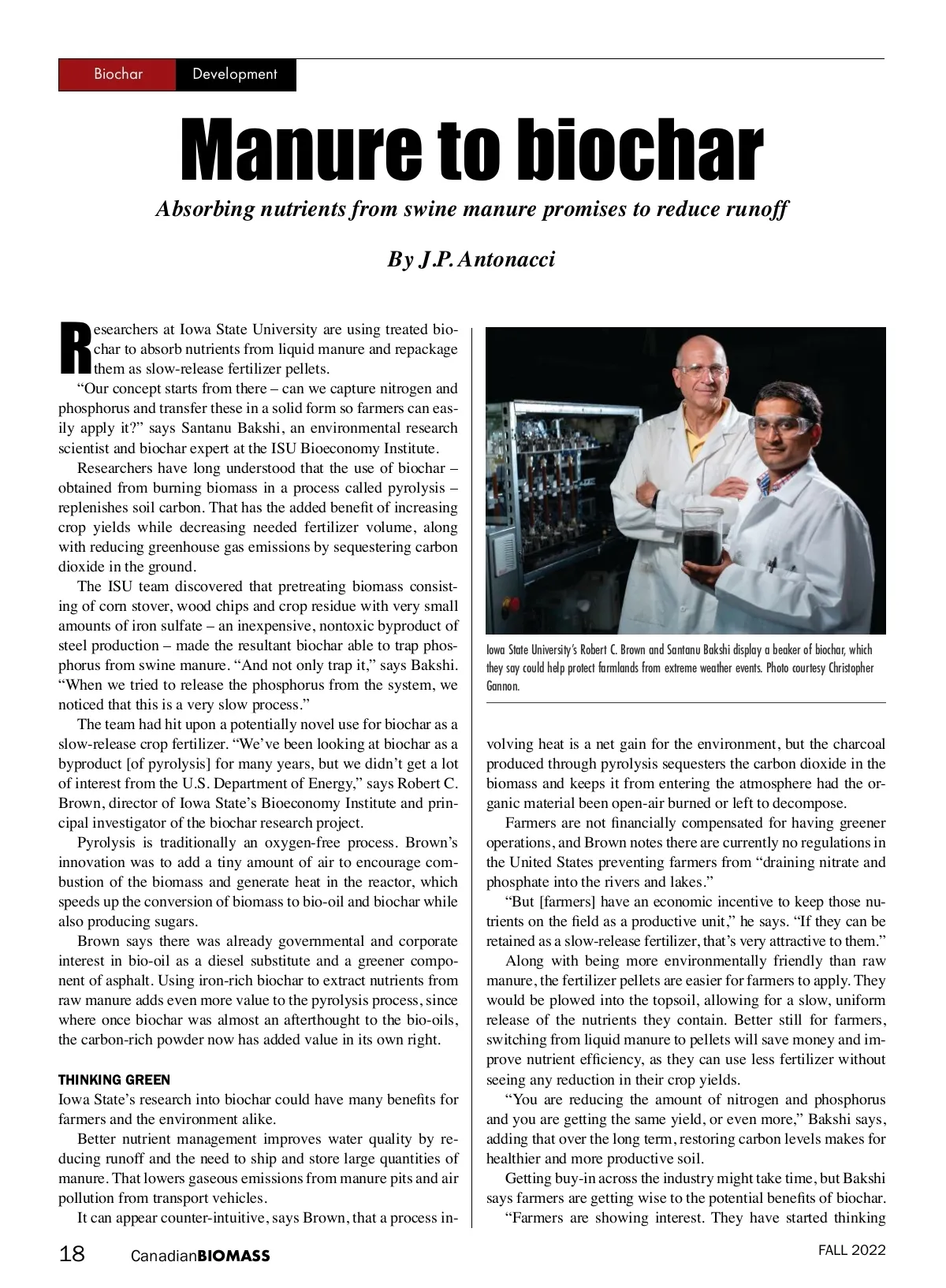
[about how] to reduce tons and tons of inorganic fertilizer,” he says. “We’re improving water quality, we’re reducing green-house gases, we are reducing transportation problems of volumi-nous manure, and we are improving the economics [of manure].” BIOCHAR, EH? THE BOTTOM LINE Biochar is also getting attention north of the border. In a March 2022 report for Agriculture and Agri-Food Canada, soil scien-tist Vicky Lévesque says adding carbon compounds to soil “can have a positive effect on Canadian soil health and productivity and help to reduce greenhouse gas emissions.” Biochar, Lévesque pointed out, is not a new concept. People living in the Amazonian rainforest thousands of years ago added carbon – in the form of charcoal from cooking fires mixed with manure, animal bones and broken pottery – to produce “excep-tionally fertile soil.” Turning maple bark, pine chips and other organic residue into a carbon-rich soil additive has helped regenerate soil and boost productivity in warmer climates, and Lévesque’s research is focused on applying that same technique in higher latitudes. She used biochar while growing sweet peppers and greenhouse tomatoes in soils typical of northern farms. The results were impressive, with biochar increasing the size and volume of the vegetables and adding beneficial bacteria to the soil, while also cutting fertilizer use by up to half the recommended application and reducing nutrient runoff. “All of that is good news for farmers and the environment,” the report read. “Significantly, the use of biochar could also pro -vide an opportunity to help agriculture lands better recover from extreme weather events linked to climate change, and support food security.” WORKING OUT THE DETAILS Another challenge researchers must confront is the cost of bio-char, which at present is highly prized by home gardeners. “You can sell it on eBay for $1,000 a ton, and that’s because consum-ers get a little bucket of it to put in all their pots or their plants in the house,” says Brown. But at that price, he added, “it’s not going to work scaling it to conventional agriculture.” Brown suspects farmers could be swayed by biochar’s ability to build soil carbon and reduce nutrient runoff if it sold in the $100-per-ton range. “It may be significantly less than that,” he says. “We still need to have a business model that is not based solely on selling biochar.” Lévesque also identified cost as a potential limitation for bio -char’s wider agricultural use. “The current high cost for farmers to purchase biochar might make it more suited for high-cost val-ue crops, such as orchards and vineyards,” she says. However, Agriculture and Agri-Food Canada predicts Can-ada is poised to expand well beyond the 50 or so biochar pro -ducers currently active in the country, and it is hoped the added volume could lower costs. “It might take some time before we see the profound effect that biochar could have for Canadian farmers and the environment, but the future is burning bright,” the AAFC report says. Armed with a $1-million USDA grant, the next step for Brown’s team is to scale up biochar production and take the research into a small-scale industrial biochar system during a three-year pyrolysis demonstration project. • 371, Boulevard des Chutes Bureau #102 Québec, QC, G1E 3G1 1-800-463-4862 551, Ferdinand Blvd. Unit 4 Dieppe, NB, E1A 7G1 1-800-931-9611 om w.c Brown hopes having a practical use for biochar in agriculture will make farmers more enthusiastic about pyrolysis as a whole, thus expanding the use of the green technology. Logistical questions remain. While Brown says it would not be practical for each farm to house its own pyrolysis system since there is no economy of scale, neither does he think it makes much sense to ship biomass over long distances to centralized biorefineries. He advocates for a solution where farmers or sub -contractors would only have to move biomass “a very short dis-tance” to regional hubs where “small, modular reactors” have been assembled on site. “We think the answer is not an on-farm system, not one gi-gantic centralized system, but a system that’s just right,” says Brown. “Instead of trying to pull biomass from hundreds of miles, let’s look at something that’s more on the scale of a coun-ty. That notion is it doesn’t sit on a single farm. It’s actually more like a co-operative enterprise, like you see in some of the grain elevators.” Farmers could be paid in cash for the biomass they provide or receive biochar for their later use on the farm, he mused. Down the road, Bakshi envisions an automated bioreactor system that would move manure through biochar and zeolite chambers where nutrients are separated, captured and processed. “I’m very confident that we will be successful,” he says. “If it works on a small scale, we can obviously increase the scale.” dinalsa www.car our team to get IN Contact yours today, or to schedule a demo! STOCK The Next Generation in Shredding Perfect Balance of Power and Performance INVENTHOR 6 SM 720.2 Trommel Screen See it in action [email protected] Canadian BIOMASS 19 2022-02-02 10:45 AM CB_EquipmentCardinal-quarter_Winter22_CSA.indd 1
Canadian Biomass Fall 2022: Page 19