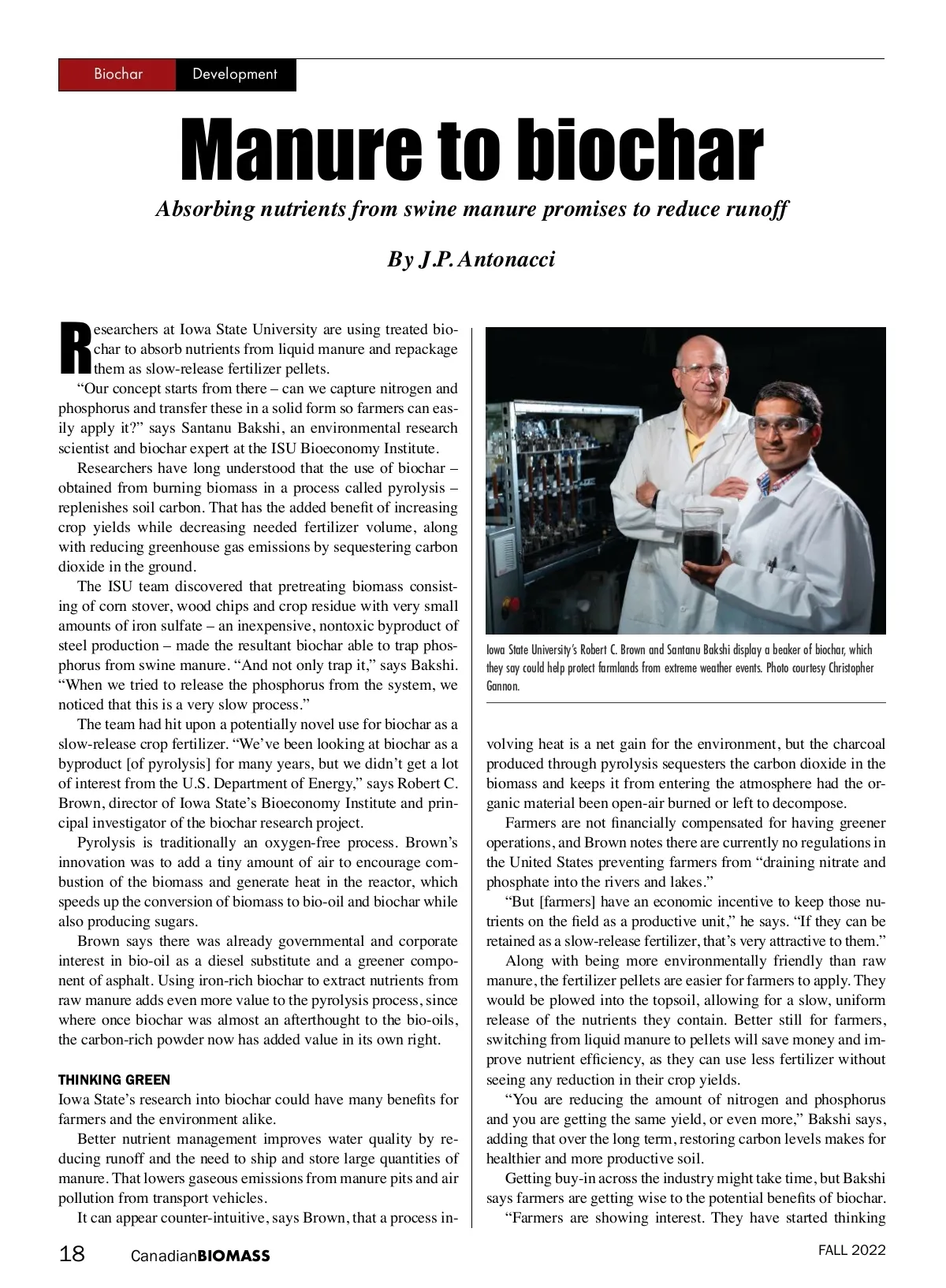
Biochar Development Absorbing nutrients from swine manure promises to reduce runoff By J.P. Antonacci esearchers at Iowa State University are using treated bio-char to absorb nutrients from liquid manure and repackage them as slow-release fertilizer pellets. “Our concept starts from there – can we capture nitrogen and phosphorus and transfer these in a solid form so farmers can eas-ily apply it?” says Santanu Bakshi, an environmental research scientist and biochar expert at the ISU Bioeconomy Institute. Researchers have long understood that the use of biochar – obtained from burning biomass in a process called pyrolysis – replenishes soil carbon. That has the added benefit of increasing crop yields while decreasing needed fertilizer volume, along with reducing greenhouse gas emissions by sequestering carbon dioxide in the ground. The ISU team discovered that pretreating biomass consist-ing of corn stover, wood chips and crop residue with very small amounts of iron sulfate – an inexpensive, nontoxic byproduct of steel production – made the resultant biochar able to trap phos-phorus from swine manure. “And not only trap it,” says Bakshi. “When we tried to release the phosphorus from the system, we noticed that this is a very slow process.” The team had hit upon a potentially novel use for biochar as a slow-release crop fertilizer. “We’ve been looking at biochar as a byproduct [of pyrolysis] for many years, but we didn’t get a lot of interest from the U.S. Department of Energy,” says Robert C. Brown, director of Iowa State’s Bioeconomy Institute and prin-cipal investigator of the biochar research project. Pyrolysis is traditionally an oxygen-free process. Brown’s innovation was to add a tiny amount of air to encourage com-bustion of the biomass and generate heat in the reactor, which speeds up the conversion of biomass to bio-oil and biochar while also producing sugars. Brown says there was already governmental and corporate interest in bio-oil as a diesel substitute and a greener compo-nent of asphalt. Using iron-rich biochar to extract nutrients from raw manure adds even more value to the pyrolysis process, since where once biochar was almost an afterthought to the bio-oils, the carbon-rich powder now has added value in its own right. THINKING GREEN Manure to biochar R Iowa State University’s Robert C. Brown and Santanu Bakshi display a beaker of biochar, which they say could help protect farmlands from extreme weather events. Photo courtesy Christopher Gannon. Iowa State’s research into biochar could have many benefits for farmers and the environment alike. Better nutrient management improves water quality by re-ducing runoff and the need to ship and store large quantities of manure. That lowers gaseous emissions from manure pits and air pollution from transport vehicles. It can appear counter-intuitive, says Brown, that a process in-volving heat is a net gain for the environment, but the charcoal produced through pyrolysis sequesters the carbon dioxide in the biomass and keeps it from entering the atmosphere had the or-ganic material been open-air burned or left to decompose. Farmers are not financially compensated for having greener operations, and Brown notes there are currently no regulations in the United States preventing farmers from “draining nitrate and phosphate into the rivers and lakes.” “But [farmers] have an economic incentive to keep those nu-trients on the field as a productive unit,” he says. “If they can be retained as a slow-release fertilizer, that’s very attractive to them.” Along with being more environmentally friendly than raw manure, the fertilizer pellets are easier for farmers to apply. They would be plowed into the topsoil, allowing for a slow, uniform release of the nutrients they contain. Better still for farmers, switching from liquid manure to pellets will save money and im-prove nutrient efficiency, as they can use less fertilizer without seeing any reduction in their crop yields. “You are reducing the amount of nitrogen and phosphorus and you are getting the same yield, or even more,” Bakshi says, adding that over the long term, restoring carbon levels makes for healthier and more productive soil. Getting buy-in across the industry might take time, but Bakshi says farmers are getting wise to the potential benefits of biochar. “Farmers are showing interest. They have started thinking FALL 2022 18 Canadian BIOMASS
Canadian Biomass Fall 2022: Page 18