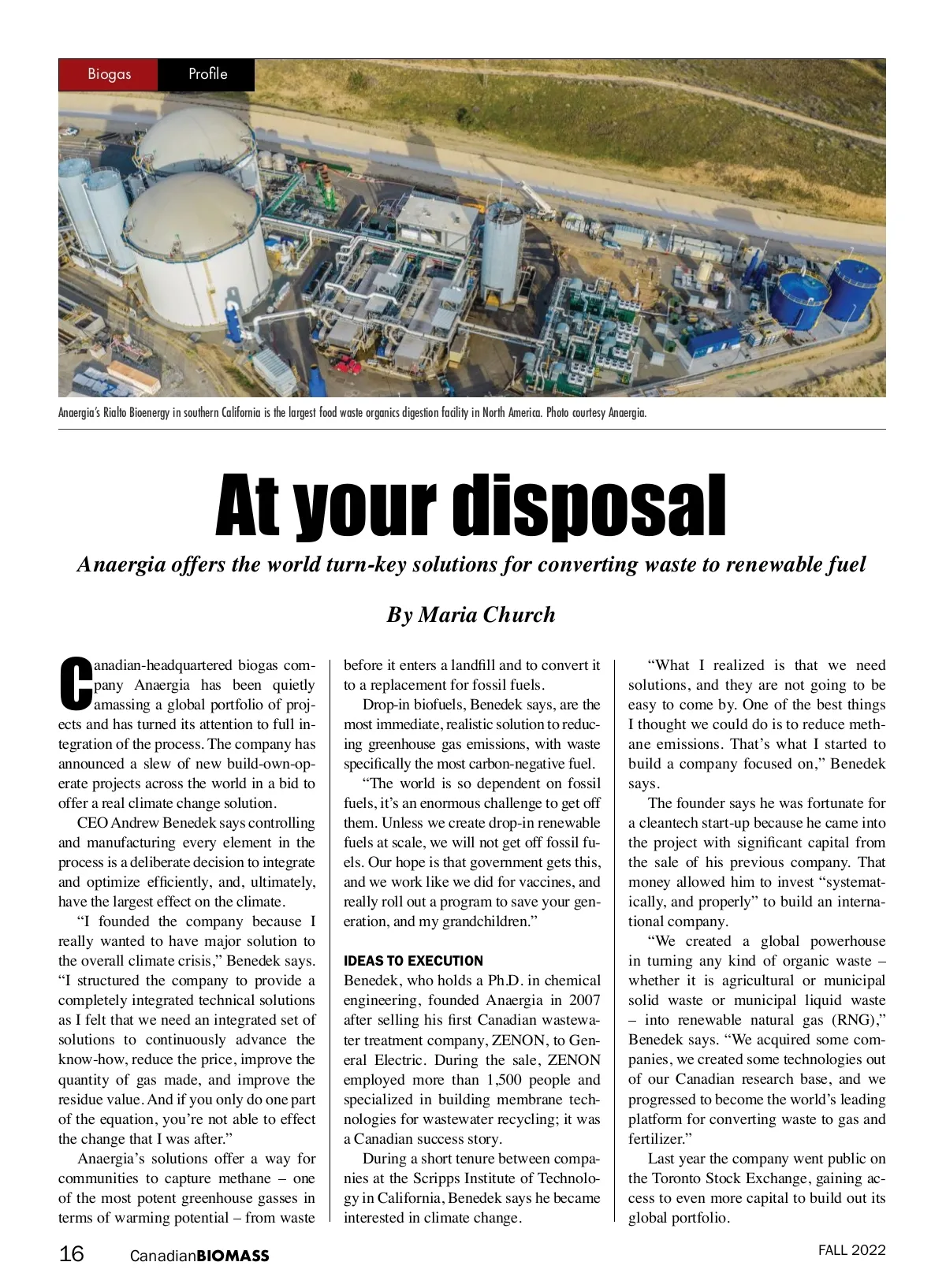
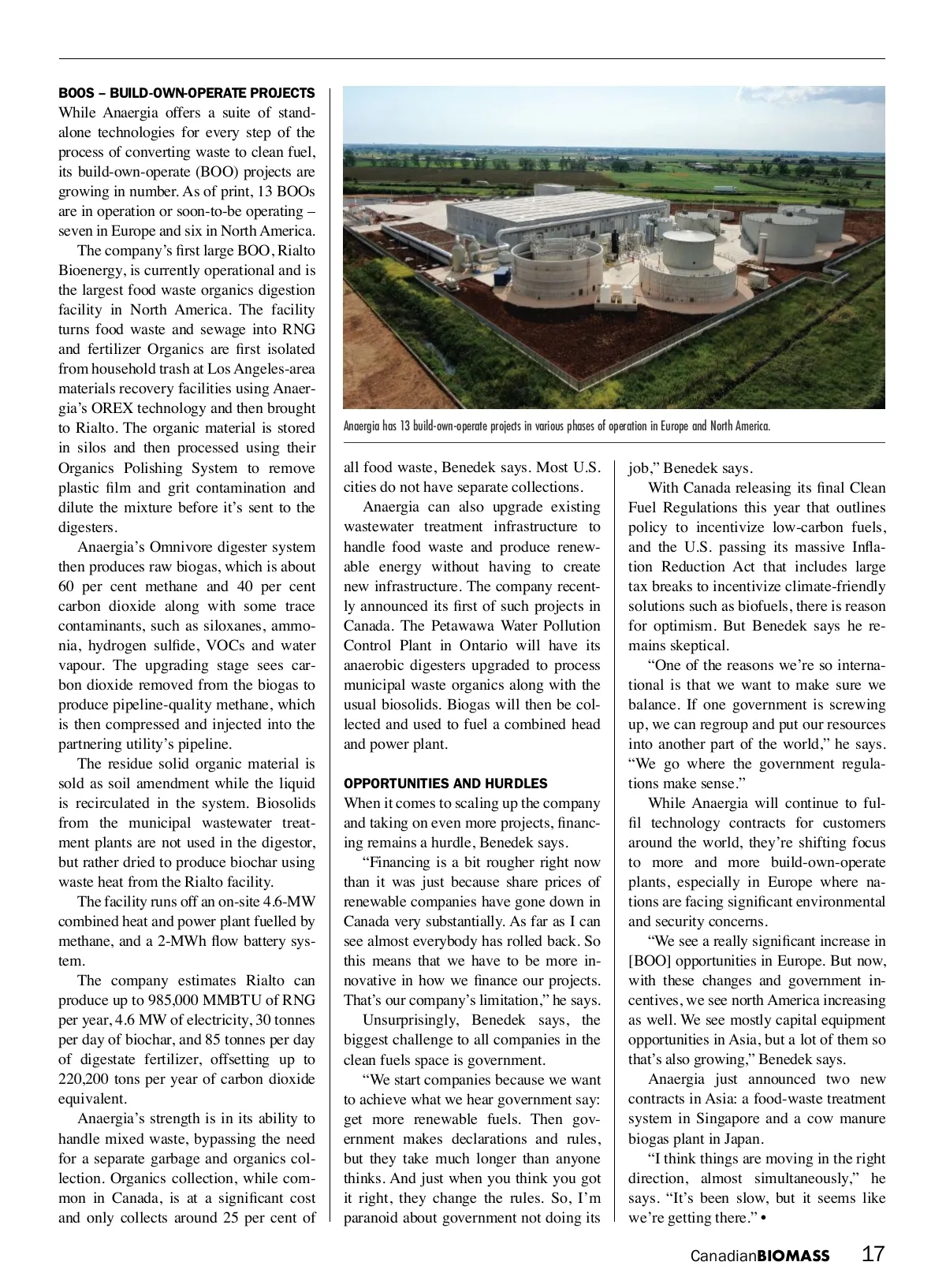
BOOS – BUILD-OWN-OPERATE PROJECTS While Anaergia offers a suite of stand-alone technologies for every step of the process of converting waste to clean fuel, its build-own-operate (BOO) projects are growing in number. As of print, 13 BOOs are in operation or soon-to-be operating – seven in Europe and six in North America. The company’s first large BOO, Rialto Bioenergy, is currently operational and is the largest food waste organics digestion facility in North America. The facility turns food waste and sewage into RNG and fertilizer Organics are first isolated from household trash at Los Angeles-area materials recovery facilities using Anaer-gia’s OREX technology and then brought to Rialto. The organic material is stored in silos and then processed using their Organics Polishing System to remove plastic film and grit contamination and dilute the mixture before it’s sent to the digesters. Anaergia’s Omnivore digester system then produces raw biogas, which is about 60 per cent methane and 40 per cent carbon dioxide along with some trace contaminants, such as siloxanes, ammo-nia, hydrogen sulfide, VOCs and water vapour. The upgrading stage sees car-bon dioxide removed from the biogas to produce pipeline-quality methane, which is then compressed and injected into the partnering utility’s pipeline. The residue solid organic material is sold as soil amendment while the liquid is recirculated in the system. Biosolids from the municipal wastewater treat-ment plants are not used in the digestor, but rather dried to produce biochar using waste heat from the Rialto facility. The facility runs off an on-site 4.6-MW combined heat and power plant fuelled by methane, and a 2-MWh flow battery sys -tem. The company estimates Rialto can produce up to 985,000 MMBTU of RNG per year, 4.6 MW of electricity, 30 tonnes per day of biochar, and 85 tonnes per day of digestate fertilizer, offsetting up to 220,200 tons per year of carbon dioxide equivalent. Anaergia’s strength is in its ability to handle mixed waste, bypassing the need for a separate garbage and organics col-lection. Organics collection, while com-mon in Canada, is at a significant cost and only collects around 25 per cent of Anaergia has 13 build-own-operate projects in various phases of operation in Europe and North America. all food waste, Benedek says. Most U.S. cities do not have separate collections. Anaergia can also upgrade existing wastewater treatment infrastructure to handle food waste and produce renew-able energy without having to create new infrastructure. The company recent-ly announced its first of such projects in Canada. The Petawawa Water Pollution Control Plant in Ontario will have its anaerobic digesters upgraded to process municipal waste organics along with the usual biosolids. Biogas will then be col-lected and used to fuel a combined head and power plant. OPPORTUNITIES AND HURDLES When it comes to scaling up the company and taking on even more projects, financ -ing remains a hurdle, Benedek says. “Financing is a bit rougher right now than it was just because share prices of renewable companies have gone down in Canada very substantially. As far as I can see almost everybody has rolled back. So this means that we have to be more in-novative in how we finance our projects. That’s our company’s limitation,” he says. Unsurprisingly, Benedek says, the biggest challenge to all companies in the clean fuels space is government. “We start companies because we want to achieve what we hear government say: get more renewable fuels. Then gov-ernment makes declarations and rules, but they take much longer than anyone thinks. And just when you think you got it right, they change the rules. So, I’m paranoid about government not doing its job,” Benedek says. With Canada releasing its final Clean Fuel Regulations this year that outlines policy to incentivize low-carbon fuels, and the U.S. passing its massive Infla -tion Reduction Act that includes large tax breaks to incentivize climate-friendly solutions such as biofuels, there is reason for optimism. But Benedek says he re-mains skeptical. “One of the reasons we’re so interna-tional is that we want to make sure we balance. If one government is screwing up, we can regroup and put our resources into another part of the world,” he says. “We go where the government regula-tions make sense.” While Anaergia will continue to ful-fil technology contracts for customers around the world, they’re shifting focus to more and more build-own-operate plants, especially in Europe where na-tions are facing significant environmental and security concerns. “We see a really significant increase in [BOO] opportunities in Europe. But now, with these changes and government in-centives, we see north America increasing as well. We see mostly capital equipment opportunities in Asia, but a lot of them so that’s also growing,” Benedek says. Anaergia just announced two new contracts in Asia: a food-waste treatment system in Singapore and a cow manure biogas plant in Japan. “I think things are moving in the right direction, almost simultaneously,” he says. “It’s been slow, but it seems like we’re getting there.” • Canadian BIOMASS 17
Canadian Biomass Fall 2022: Page 17