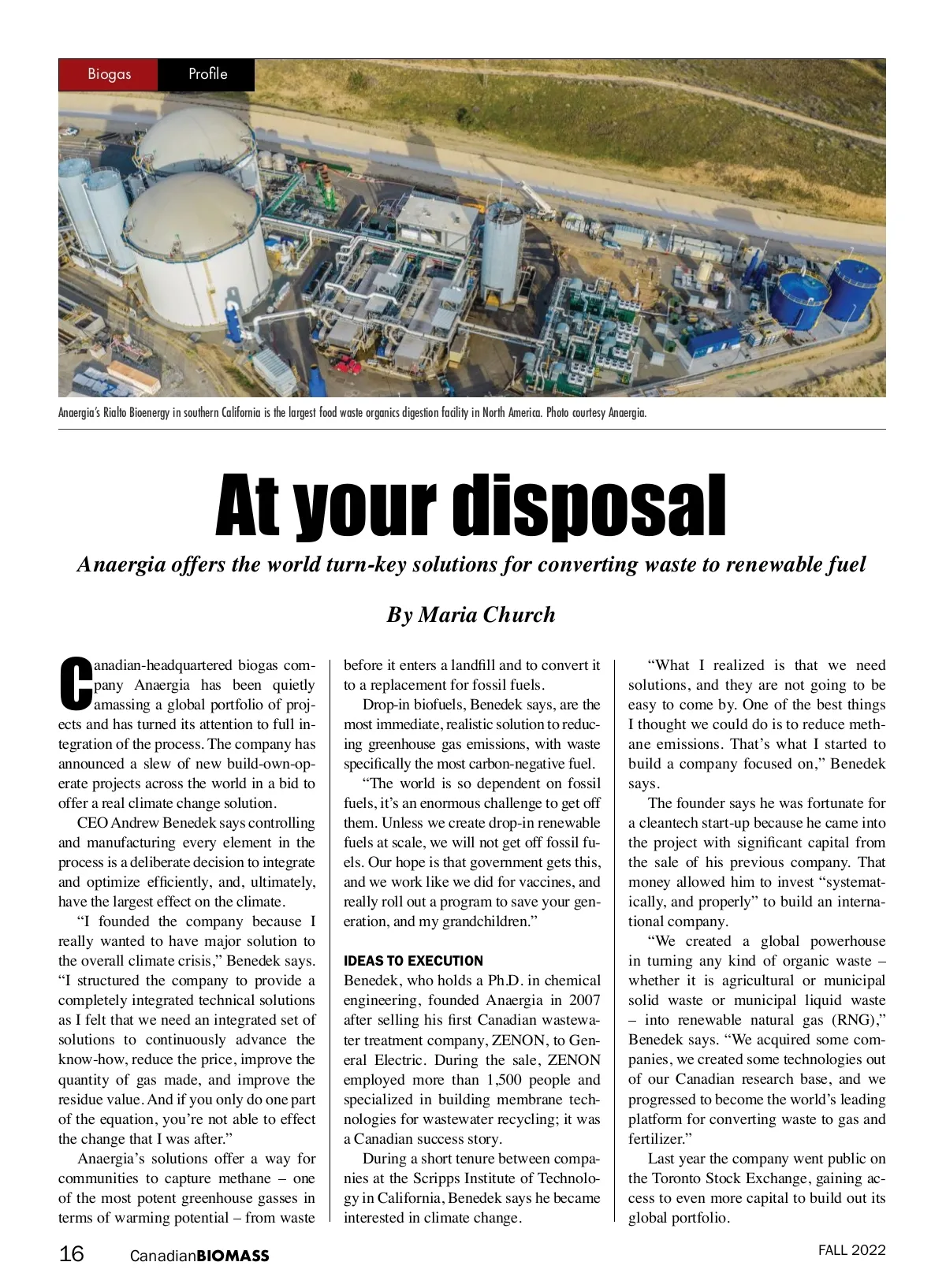
Biogas Profile Anaergia’s Rialto Bioenergy in southern California is the largest food waste organics digestion facility in North America. Photo courtesy Anaergia. Anaergia offers the world turn-key solutions for converting waste to renewable fuel By Maria Church At your disposal before it enters a landfill and to convert it to a replacement for fossil fuels. Drop-in biofuels, Benedek says, are the most immediate, realistic solution to reduc-ing greenhouse gas emissions, with waste specifically the most carbon-negative fuel. “The world is so dependent on fossil fuels, it’s an enormous challenge to get off them. Unless we create drop-in renewable fuels at scale, we will not get off fossil fu-els. Our hope is that government gets this, and we work like we did for vaccines, and really roll out a program to save your gen-eration, and my grandchildren.” IDEAS TO EXECUTION C anadian-headquartered biogas com-pany Anaergia has been quietly amassing a global portfolio of proj-ects and has turned its attention to full in-tegration of the process. The company has announced a slew of new build-own-op-erate projects across the world in a bid to offer a real climate change solution. CEO Andrew Benedek says controlling and manufacturing every element in the process is a deliberate decision to integrate and optimize efficiently, and, ultimately, have the largest effect on the climate. “I founded the company because I really wanted to have major solution to the overall climate crisis,” Benedek says. “I structured the company to provide a completely integrated technical solutions as I felt that we need an integrated set of solutions to continuously advance the know-how, reduce the price, improve the quantity of gas made, and improve the residue value. And if you only do one part of the equation, you’re not able to effect the change that I was after.” Anaergia’s solutions offer a way for communities to capture methane – one of the most potent greenhouse gasses in terms of warming potential – from waste Benedek, who holds a Ph.D. in chemical engineering, founded Anaergia in 2007 after selling his first Canadian wastewa -ter treatment company, ZENON, to Gen-eral Electric. During the sale, ZENON employed more than 1,500 people and specialized in building membrane tech-nologies for wastewater recycling; it was a Canadian success story. During a short tenure between compa-nies at the Scripps Institute of Technolo-gy in California, Benedek says he became interested in climate change. “What I realized is that we need solutions, and they are not going to be easy to come by. One of the best things I thought we could do is to reduce meth-ane emissions. That’s what I started to build a company focused on,” Benedek says. The founder says he was fortunate for a cleantech start-up because he came into the project with significant capital from the sale of his previous company. That money allowed him to invest “systemat-ically, and properly” to build an interna-tional company. “We created a global powerhouse in turning any kind of organic waste – whether it is agricultural or municipal solid waste or municipal liquid waste – into renewable natural gas (RNG),” Benedek says. “We acquired some com-panies, we created some technologies out of our Canadian research base, and we progressed to become the world’s leading platform for converting waste to gas and fertilizer.” Last year the company went public on the Toronto Stock Exchange, gaining ac-cess to even more capital to build out its global portfolio. FALL 2022 16 Canadian BIOMASS
Canadian Biomass Fall 2022: Page 16