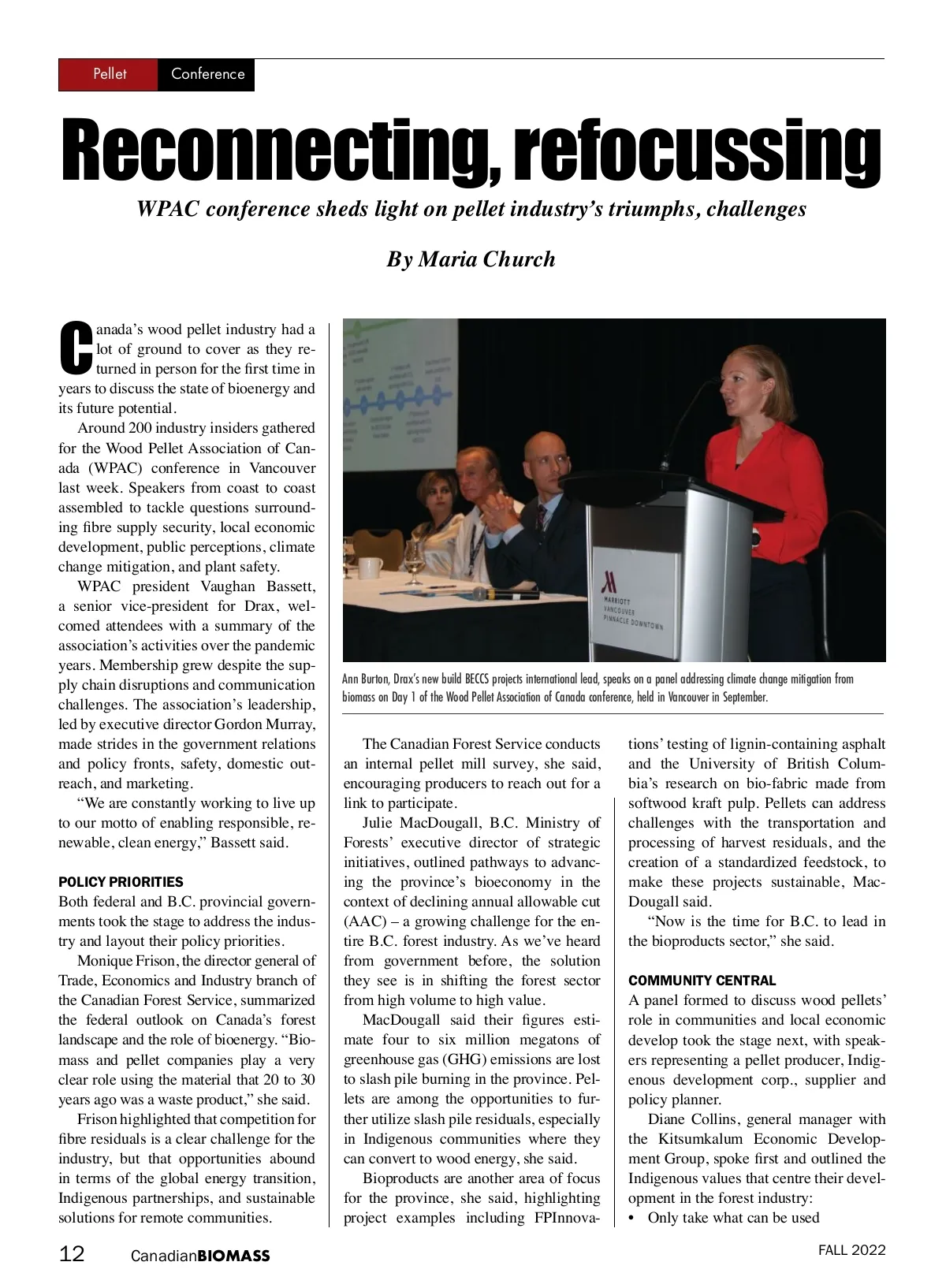
Pellet Conference Reconnecting, refocussing WPAC conference sheds light on pellet industry’s triumphs, challenges By Maria Church C anada’s wood pellet industry had a lot of ground to cover as they re-turned in person for the first time in years to discuss the state of bioenergy and its future potential. Around 200 industry insiders gathered for the Wood Pellet Association of Can-ada (WPAC) conference in Vancouver last week. Speakers from coast to coast assembled to tackle questions surround-ing fibre supply security, local economic development, public perceptions, climate change mitigation, and plant safety. WPAC president Vaughan Bassett, a senior vice-president for Drax, wel-comed attendees with a summary of the association’s activities over the pandemic years. Membership grew despite the sup-ply chain disruptions and communication challenges. The association’s leadership, led by executive director Gordon Murray, made strides in the government relations and policy fronts, safety, domestic out-reach, and marketing. “We are constantly working to live up to our motto of enabling responsible, re-newable, clean energy,” Bassett said. Ann Burton, Drax’s new build BECCS projects international lead, speaks on a panel addressing climate change mitigation from biomass on Day 1 of the Wood Pellet Association of Canada conference, held in Vancouver in September. POLICY PRIORITIES Both federal and B.C. provincial govern-ments took the stage to address the indus-try and layout their policy priorities. Monique Frison, the director general of Trade, Economics and Industry branch of the Canadian Forest Service, summarized the federal outlook on Canada’s forest landscape and the role of bioenergy. “Bio-mass and pellet companies play a very clear role using the material that 20 to 30 years ago was a waste product,” she said. Frison highlighted that competition for fibre residuals is a clear challenge for the industry, but that opportunities abound in terms of the global energy transition, Indigenous partnerships, and sustainable solutions for remote communities. The Canadian Forest Service conducts an internal pellet mill survey, she said, encouraging producers to reach out for a link to participate. Julie MacDougall, B.C. Ministry of Forests’ executive director of strategic initiatives, outlined pathways to advanc-ing the province’s bioeconomy in the context of declining annual allowable cut (AAC) – a growing challenge for the en-tire B.C. forest industry. As we’ve heard from government before, the solution they see is in shifting the forest sector from high volume to high value. MacDougall said their figures esti -mate four to six million megatons of greenhouse gas (GHG) emissions are lost to slash pile burning in the province. Pel-lets are among the opportunities to fur-ther utilize slash pile residuals, especially in Indigenous communities where they can convert to wood energy, she said. Bioproducts are another area of focus for the province, she said, highlighting project examples including FPInnova-tions’ testing of lignin-containing asphalt and the University of British Colum-bia’s research on bio-fabric made from softwood kraft pulp. Pellets can address challenges with the transportation and processing of harvest residuals, and the creation of a standardized feedstock, to make these projects sustainable, Mac-Dougall said. “Now is the time for B.C. to lead in the bioproducts sector,” she said. COMMUNITY CENTRAL A panel formed to discuss wood pellets’ role in communities and local economic develop took the stage next, with speak-ers representing a pellet producer, Indig-enous development corp., supplier and policy planner. Diane Collins, general manager with the Kitsumkalum Economic Develop-ment Group, spoke first and outlined the Indigenous values that centre their devel-opment in the forest industry: • Only take what can be used FALL 2022 12 Canadian BIOMASS
Canadian Biomass Fall 2022: Page 12