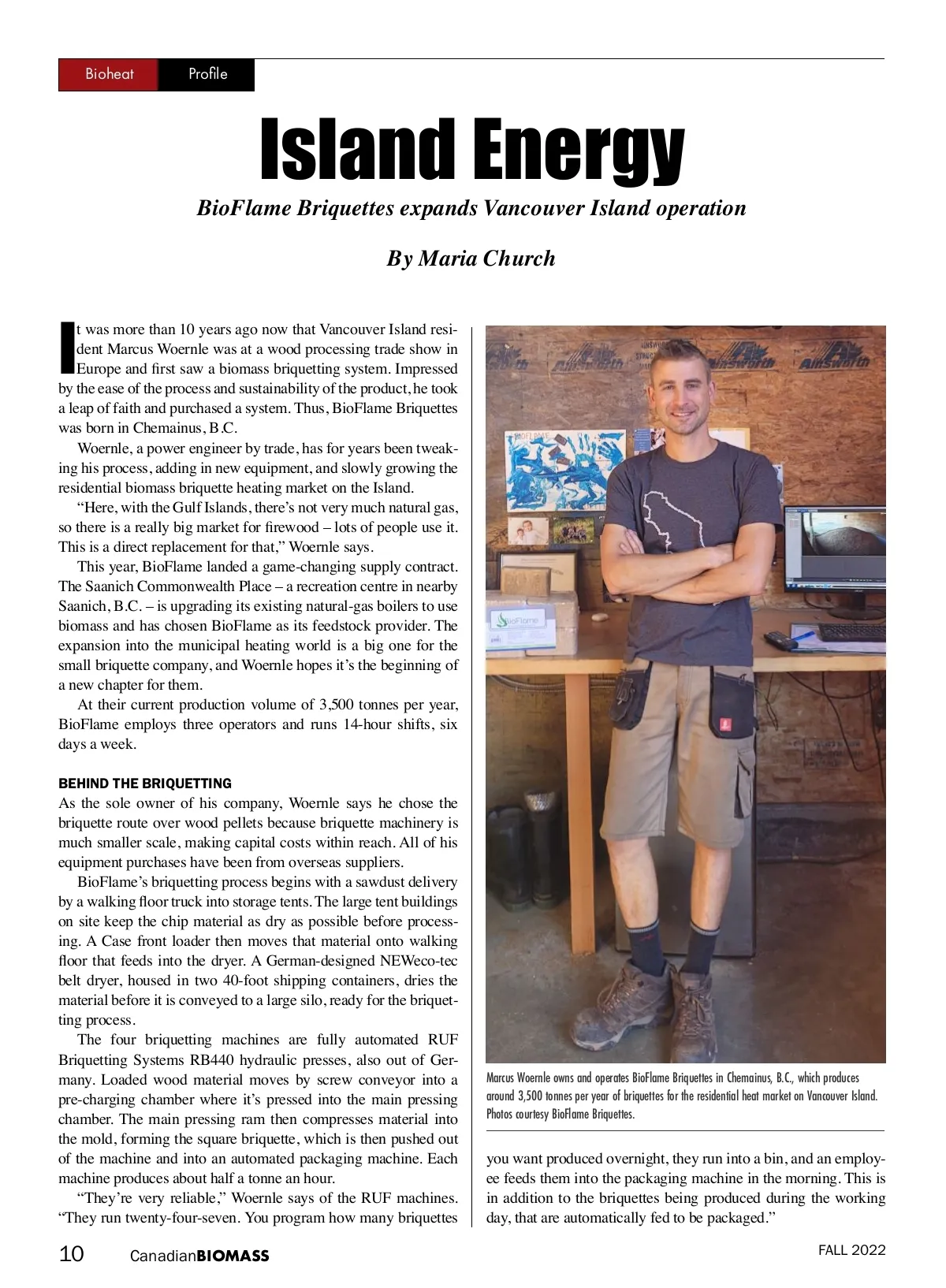
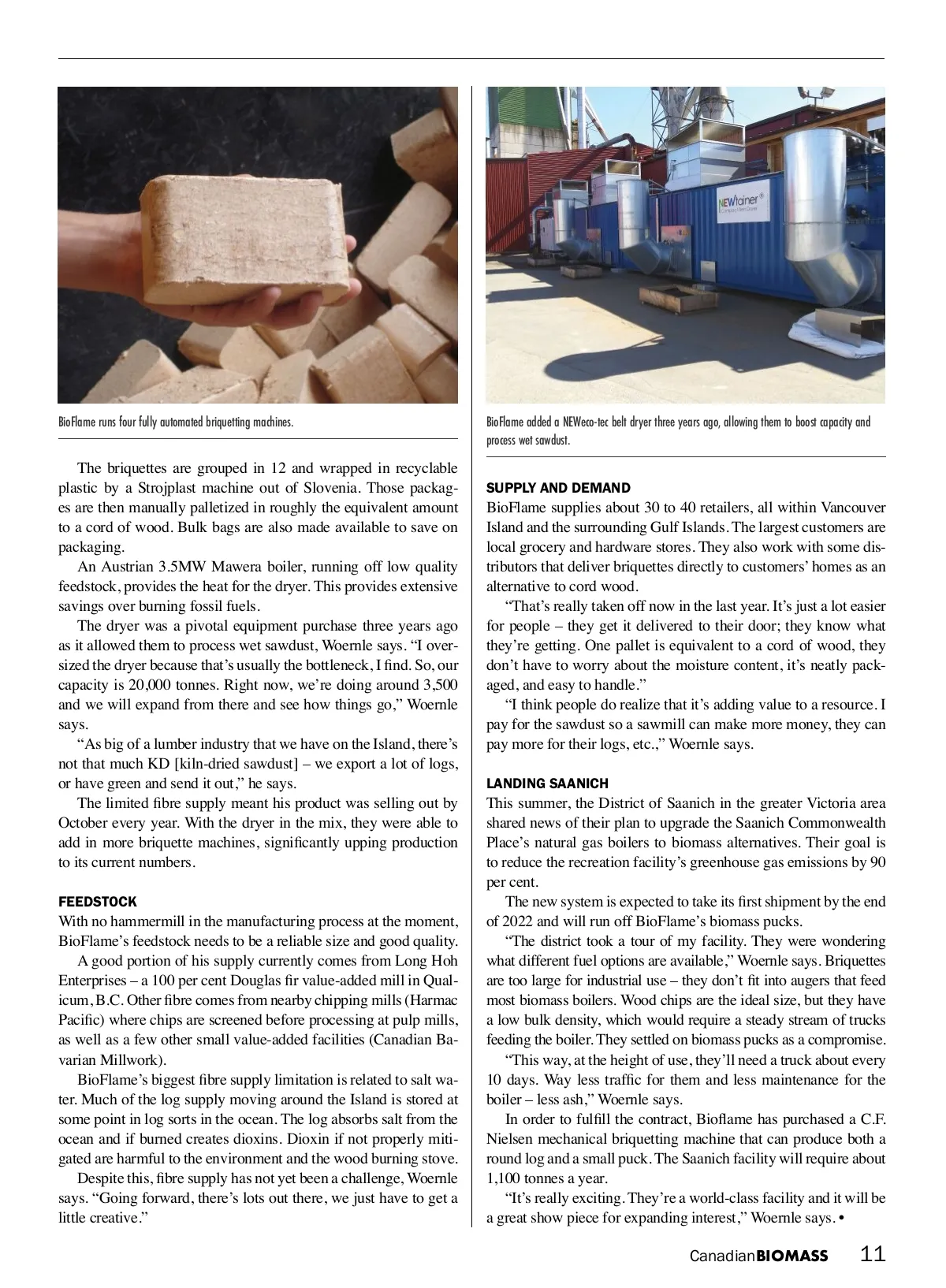
BioFlame runs four fully automated briquetting machines. BioFlame added a NEWeco-tec belt dryer three years ago, allowing them to boost capacity and process wet sawdust. SUPPLY AND DEMAND The briquettes are grouped in 12 and wrapped in recyclable plastic by a Strojplast machine out of Slovenia. Those packag-es are then manually palletized in roughly the equivalent amount to a cord of wood. Bulk bags are also made available to save on packaging. An Austrian 3.5MW Mawera boiler, running off low quality feedstock, provides the heat for the dryer. This provides extensive savings over burning fossil fuels. The dryer was a pivotal equipment purchase three years ago as it allowed them to process wet sawdust, Woernle says. “I over-sized the dryer because that’s usually the bottleneck, I find. So, our capacity is 20,000 tonnes. Right now, we’re doing around 3,500 and we will expand from there and see how things go,” Woernle says. “As big of a lumber industry that we have on the Island, there’s not that much KD [kiln-dried sawdust] – we export a lot of logs, or have green and send it out,” he says. The limited fibre supply meant his product was selling out by October every year. With the dryer in the mix, they were able to add in more briquette machines, significantly upping production to its current numbers. FEEDSTOCK BioFlame supplies about 30 to 40 retailers, all within Vancouver Island and the surrounding Gulf Islands. The largest customers are local grocery and hardware stores. They also work with some dis-tributors that deliver briquettes directly to customers’ homes as an alternative to cord wood. “That’s really taken off now in the last year. It’s just a lot easier for people – they get it delivered to their door; they know what they’re getting. One pallet is equivalent to a cord of wood, they don’t have to worry about the moisture content, it’s neatly pack-aged, and easy to handle.” “I think people do realize that it’s adding value to a resource. I pay for the sawdust so a sawmill can make more money, they can pay more for their logs, etc.,” Woernle says. LANDING SAANICH With no hammermill in the manufacturing process at the moment, BioFlame’s feedstock needs to be a reliable size and good quality. A good portion of his supply currently comes from Long Hoh Enterprises – a 100 per cent Douglas fir value-added mill in Qual -icum, B.C. Other fibre comes from nearby chipping mills (Harmac Pacific) where chips are screened before processing at pulp mills, as well as a few other small value-added facilities (Canadian Ba-varian Millwork). BioFlame’s biggest fibre supply limitation is related to salt wa -ter. Much of the log supply moving around the Island is stored at some point in log sorts in the ocean. The log absorbs salt from the ocean and if burned creates dioxins. Dioxin if not properly miti-gated are harmful to the environment and the wood burning stove. Despite this, fibre supply has not yet been a challenge, Woernle says. “Going forward, there’s lots out there, we just have to get a little creative.” This summer, the District of Saanich in the greater Victoria area shared news of their plan to upgrade the Saanich Commonwealth Place’s natural gas boilers to biomass alternatives. Their goal is to reduce the recreation facility’s greenhouse gas emissions by 90 per cent. The new system is expected to take its first shipment by the end of 2022 and will run off BioFlame’s biomass pucks. “The district took a tour of my facility. They were wondering what different fuel options are available,” Woernle says. Briquettes are too large for industrial use – they don’t fit into augers that feed most biomass boilers. Wood chips are the ideal size, but they have a low bulk density, which would require a steady stream of trucks feeding the boiler. They settled on biomass pucks as a compromise. “This way, at the height of use, they’ll need a truck about every 10 days. Way less traffic for them and less maintenance for the boiler – less ash,” Woernle says. In order to fulfill the contract, Bioflame has purchased a C.F. Nielsen mechanical briquetting machine that can produce both a round log and a small puck. The Saanich facility will require about 1,100 tonnes a year. “It’s really exciting. They’re a world-class facility and it will be a great show piece for expanding interest,” Woernle says. • Canadian BIOMASS 11
Canadian Biomass Fall 2022: Page 11