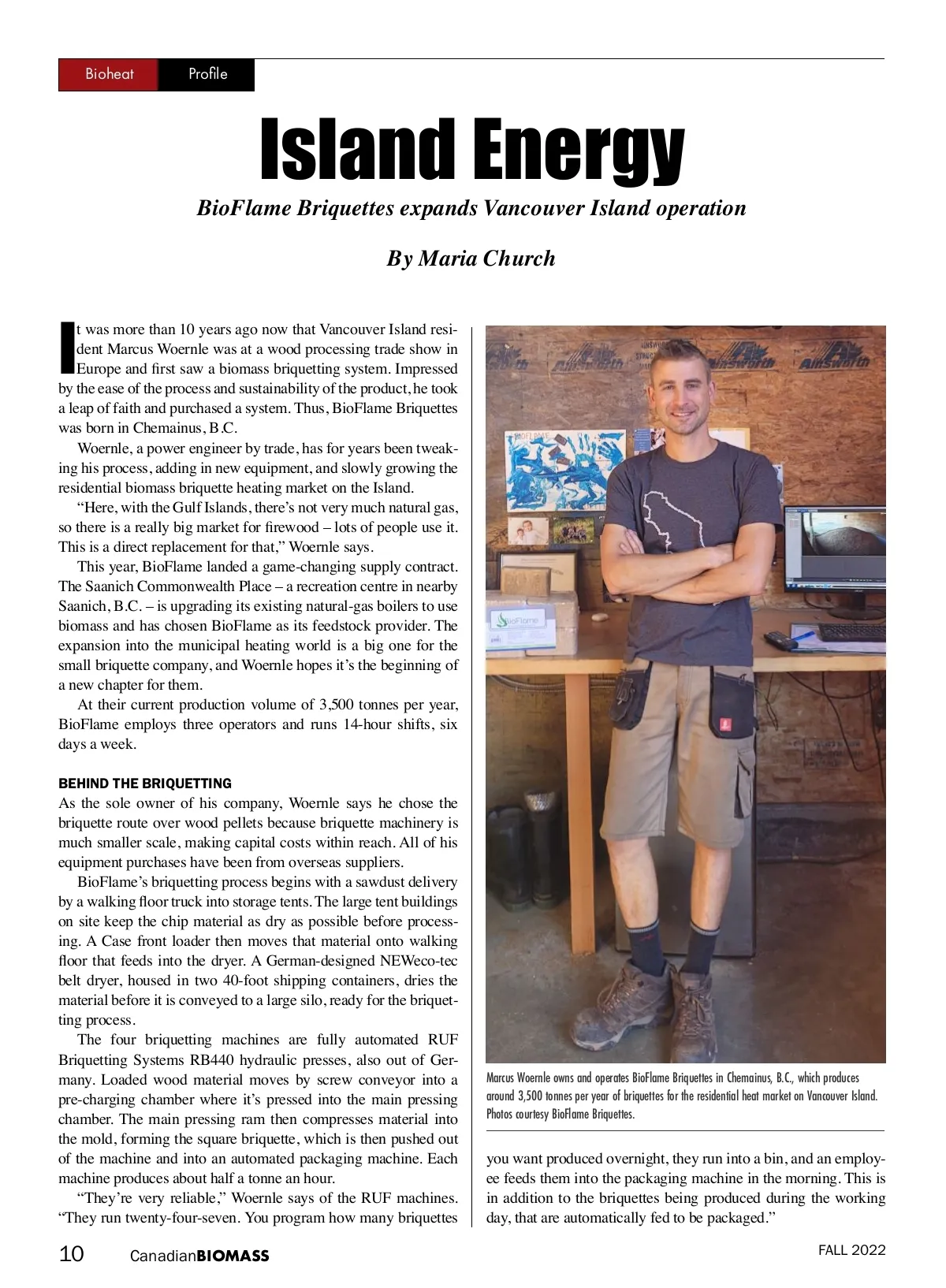
Bioheat Profile BioFlame Briquettes expands Vancouver Island operation By Maria Church t was more than 10 years ago now that Vancouver Island resi-dent Marcus Woernle was at a wood processing trade show in Europe and first saw a biomass briquetting system. Impressed by the ease of the process and sustainability of the product, he took a leap of faith and purchased a system. Thus, BioFlame Briquettes was born in Chemainus, B.C. Woernle, a power engineer by trade, has for years been tweak-ing his process, adding in new equipment, and slowly growing the residential biomass briquette heating market on the Island. “Here, with the Gulf Islands, there’s not very much natural gas, so there is a really big market for firewood – lots of people use it. This is a direct replacement for that,” Woernle says. This year, BioFlame landed a game-changing supply contract. The Saanich Commonwealth Place – a recreation centre in nearby Saanich, B.C. – is upgrading its existing natural-gas boilers to use biomass and has chosen BioFlame as its feedstock provider. The expansion into the municipal heating world is a big one for the small briquette company, and Woernle hopes it’s the beginning of a new chapter for them. At their current production volume of 3,500 tonnes per year, BioFlame employs three operators and runs 14-hour shifts, six days a week. BEHIND THE BRIQUETTING Island Energy I As the sole owner of his company, Woernle says he chose the briquette route over wood pellets because briquette machinery is much smaller scale, making capital costs within reach. All of his equipment purchases have been from overseas suppliers. BioFlame’s briquetting process begins with a sawdust delivery by a walking floor truck into storage tents. The large tent buildings on site keep the chip material as dry as possible before process-ing. A Case front loader then moves that material onto walking floor that feeds into the dryer. A German-designed NEWeco-tec belt dryer, housed in two 40-foot shipping containers, dries the material before it is conveyed to a large silo, ready for the briquet-ting process. The four briquetting machines are fully automated RUF Briquetting Systems RB440 hydraulic presses, also out of Ger-many. Loaded wood material moves by screw conveyor into a pre-charging chamber where it’s pressed into the main pressing chamber. The main pressing ram then compresses material into the mold, forming the square briquette, which is then pushed out of the machine and into an automated packaging machine. Each machine produces about half a tonne an hour. “They’re very reliable,” Woernle says of the RUF machines. “They run twenty-four-seven. You program how many briquettes Marcus Woernle owns and operates BioFlame Briquettes in Chemainus, B.C., which produces around 3,500 tonnes per year of briquettes for the residential heat market on Vancouver Island. Photos courtesy BioFlame Briquettes. you want produced overnight, they run into a bin, and an employ-ee feeds them into the packaging machine in the morning. This is in addition to the briquettes being produced during the working day, that are automatically fed to be packaged.” FALL 2022 10 Canadian BIOMASS
Canadian Biomass Fall 2022: Page 10