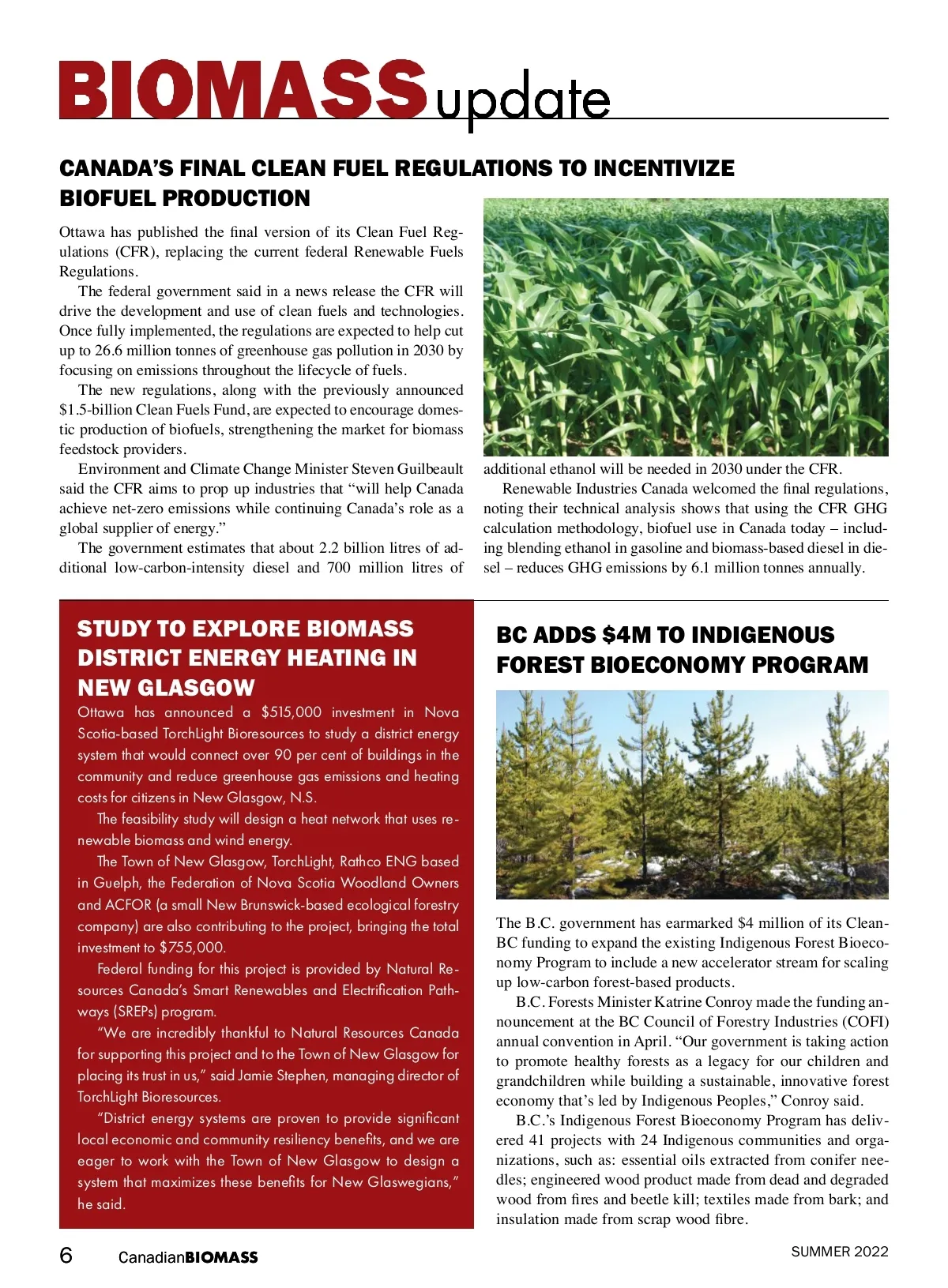
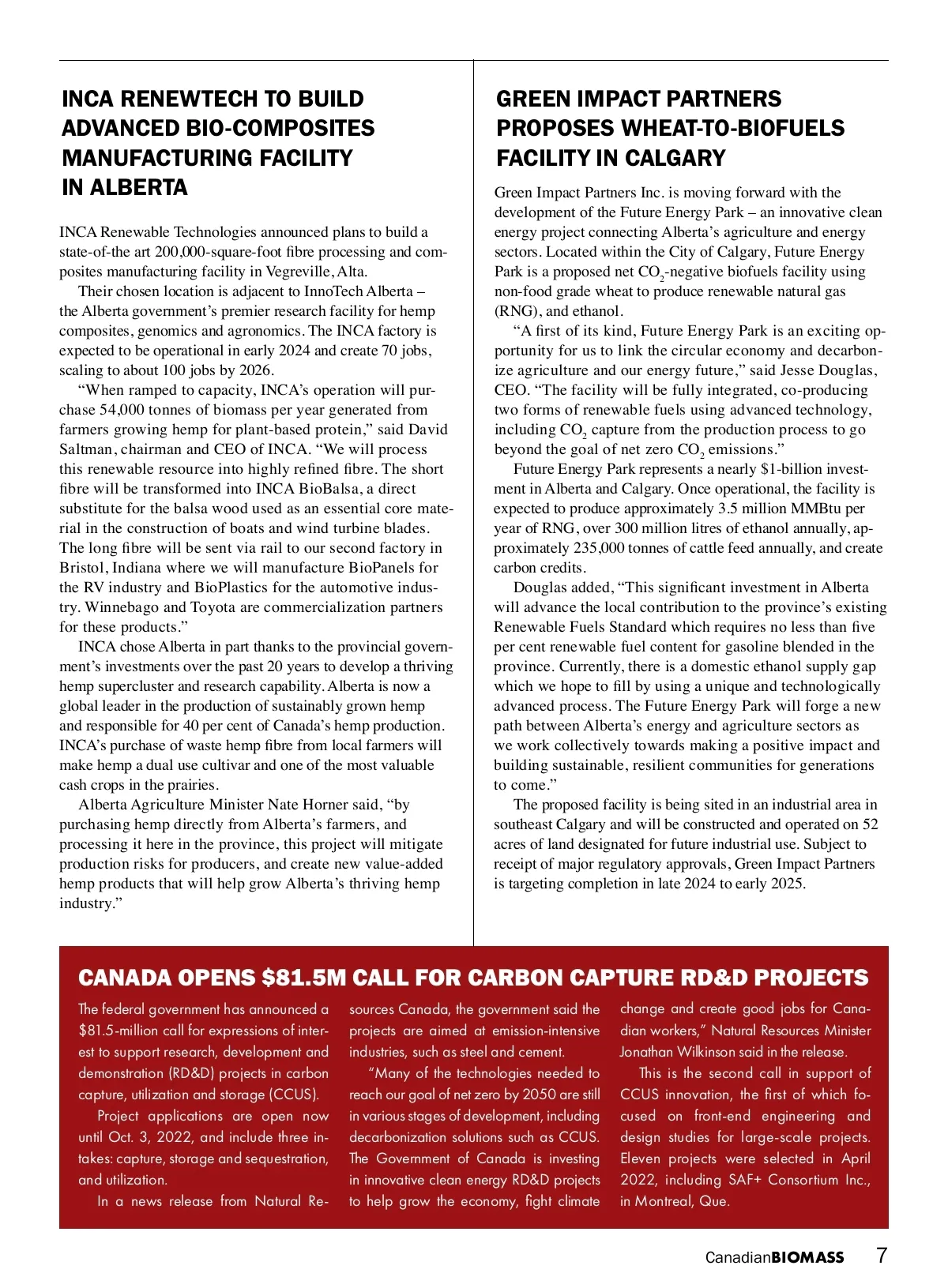
CANADA’S FINAL CLEAN FUEL REGULATIONS TO INCENTIVIZE BIOFUEL PRODUCTION Ottawa has published the final version of its Clean Fuel Reg -ulations (CFR), replacing the current federal Renewable Fuels Regulations. The federal government said in a news release the CFR will drive the development and use of clean fuels and technologies. Once fully implemented, the regulations are expected to help cut up to 26.6 million tonnes of greenhouse gas pollution in 2030 by focusing on emissions throughout the lifecycle of fuels. The new regulations, along with the previously announced $1.5-billion Clean Fuels Fund, are expected to encourage domes -tic production of biofuels, strengthening the market for biomass feedstock providers. Environment and Climate Change Minister Steven Guilbeault said the CFR aims to prop up industries that “will help Canada achieve net-zero emissions while continuing Canada’s role as a global supplier of energy.” The government estimates that about 2.2 billion litres of ad-ditional low-carbon-intensity diesel and 700 million litres of additional ethanol will be needed in 2030 under the CFR. Renewable Industries Canada welcomed the final regulations, noting their technical analysis shows that using the CFR GHG calculation methodology, biofuel use in Canada today – includ-ing blending ethanol in gasoline and biomass-based diesel in die-sel – reduces GHG emissions by 6.1 million tonnes annually. STUDY TO EXPLORE BIOMASS DISTRICT ENERGY HEATING IN NEW GLASGOW Ottawa has announced a $515,000 investment in Nova Scotia-based TorchLight Bioresources to study a district energy system that would connect over 90 per cent of buildings in the community and reduce greenhouse gas emissions and heating costs for citizens in New Glasgow, N.S. The feasibility study will design a heat network that uses re-newable biomass and wind energy. The Town of New Glasgow, TorchLight, Rathco ENG based in Guelph, the Federation of Nova Scotia Woodland Owners and ACFOR (a small New Brunswick-based ecological forestry company) are also contributing to the project, bringing the total investment to $755,000. Federal funding for this project is provided by Natural Re-sources Canada’s Smart Renewables and Electrification Path-ways (SREPs) program. “We are incredibly thankful to Natural Resources Canada for supporting this project and to the Town of New Glasgow for placing its trust in us,” said Jamie Stephen, managing director of TorchLight Bioresources. “District energy systems are proven to provide significant local economic and community resiliency benefits, and we are eager to work with the Town of New Glasgow to design a system that maximizes these benefits for New Glaswegians,” he said. BC ADDS $4M TO INDIGENOUS FOREST BIOECONOMY PROGRAM The B.C. government has earmarked $4 million of its Clean-BC funding to expand the existing Indigenous Forest Bioeco-nomy Program to include a new accelerator stream for scaling up low-carbon forest-based products. B.C. Forests Minister Katrine Conroy made the funding an-nouncement at the BC Council of Forestry Industries (COFI) annual convention in April. “Our government is taking action to promote healthy forests as a legacy for our children and grandchildren while building a sustainable, innovative forest economy that’s led by Indigenous Peoples,” Conroy said. B.C.’s Indigenous Forest Bioeconomy Program has deliv -ered 41 projects with 24 Indigenous communities and orga-nizations, such as: essential oils extracted from conifer nee-dles; engineered wood product made from dead and degraded wood from fires and beetle kill; textiles made from bark; and insulation made from scrap wood fibre. SUMMER 2022 6 Canadian BIOMASS
Canadian Biomass Summer 2022: Page 6