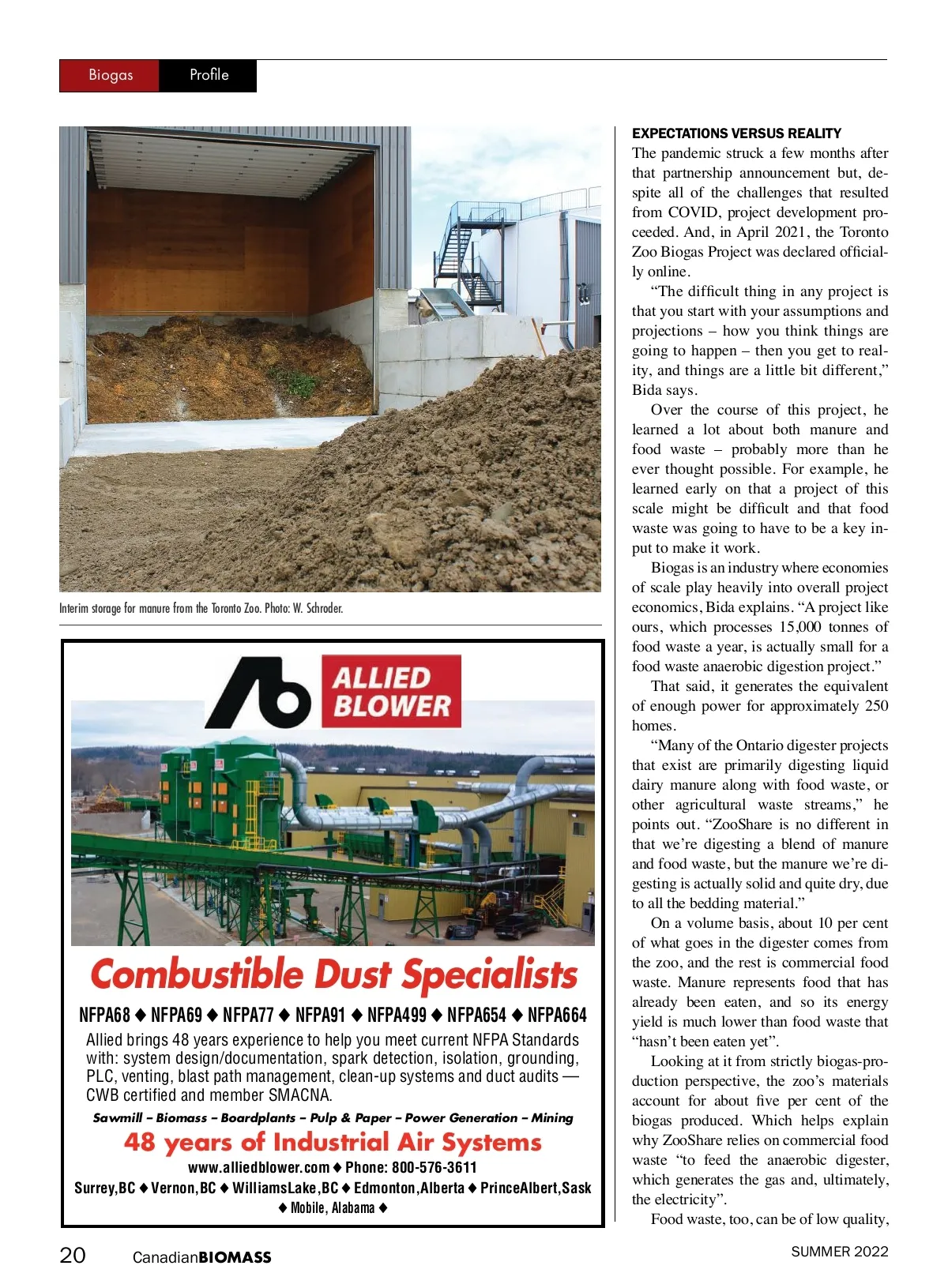
Biogas Profile EXPECTATIONS VERSUS REALITY Interim storage for manure from the Toronto Zoo. Photo: W. Schroder. Combustible Dust Specialists NFPA68 ◆ NFPA69 ◆ NFPA77 ◆ NFPA91 ◆ NFPA499 ◆ NFPA654 ◆ NFPA664 Allied brings 48 years experience to help you meet current NFPA Standards with: system design/documentation, spark detection, isolation, grounding, PLC, venting, blast path management, clean-up systems and duct audits — CWB certified and member SMACNA. Sawmill – Biomass – Boardplants – Pulp & Paper – Power Generation – Mining 48 years of Industrial Air Systems www.alliedblower.com ◆ Phone: 800-576-3611 Surrey,BC ◆ Vernon,BC ◆ WilliamsLake,BC ◆ Edmonton,Alberta ◆ PrinceAlbert,Sask ◆ Mobile, Alabama ◆ The pandemic struck a few months after that partnership announcement but, de-spite all of the challenges that resulted from COVID, project development pro-ceeded. And, in April 2021, the Toronto Zoo Biogas Project was declared official -ly online. “The difficult thing in any project is that you start with your assumptions and projections – how you think things are going to happen – then you get to real-ity, and things are a little bit different,” Bida says. Over the course of this project, he learned a lot about both manure and food waste – probably more than he ever thought possible. For example, he learned early on that a project of this scale might be difficult and that food waste was going to have to be a key in-put to make it work. Biogas is an industry where economies of scale play heavily into overall project economics, Bida explains. “A project like ours, which processes 15,000 tonnes of food waste a year, is actually small for a food waste anaerobic digestion project.” That said, it generates the equivalent of enough power for approximately 250 homes. “Many of the Ontario digester projects that exist are primarily digesting liquid dairy manure along with food waste, or other agricultural waste streams,” he points out. “ZooShare is no different in that we’re digesting a blend of manure and food waste, but the manure we’re di-gesting is actually solid and quite dry, due to all the bedding material.” On a volume basis, about 10 per cent of what goes in the digester comes from the zoo, and the rest is commercial food waste. Manure represents food that has already been eaten, and so its energy yield is much lower than food waste that “hasn’t been eaten yet”. Looking at it from strictly biogas-pro-duction perspective, the zoo’s materials account for about five per cent of the biogas produced. Which helps explain why ZooShare relies on commercial food waste “to feed the anaerobic digester, which generates the gas and, ultimately, the electricity”. Food waste, too, can be of low quality, SUMMER 2022 20 Canadian BIOMASS
Canadian Biomass Summer 2022: Page 20