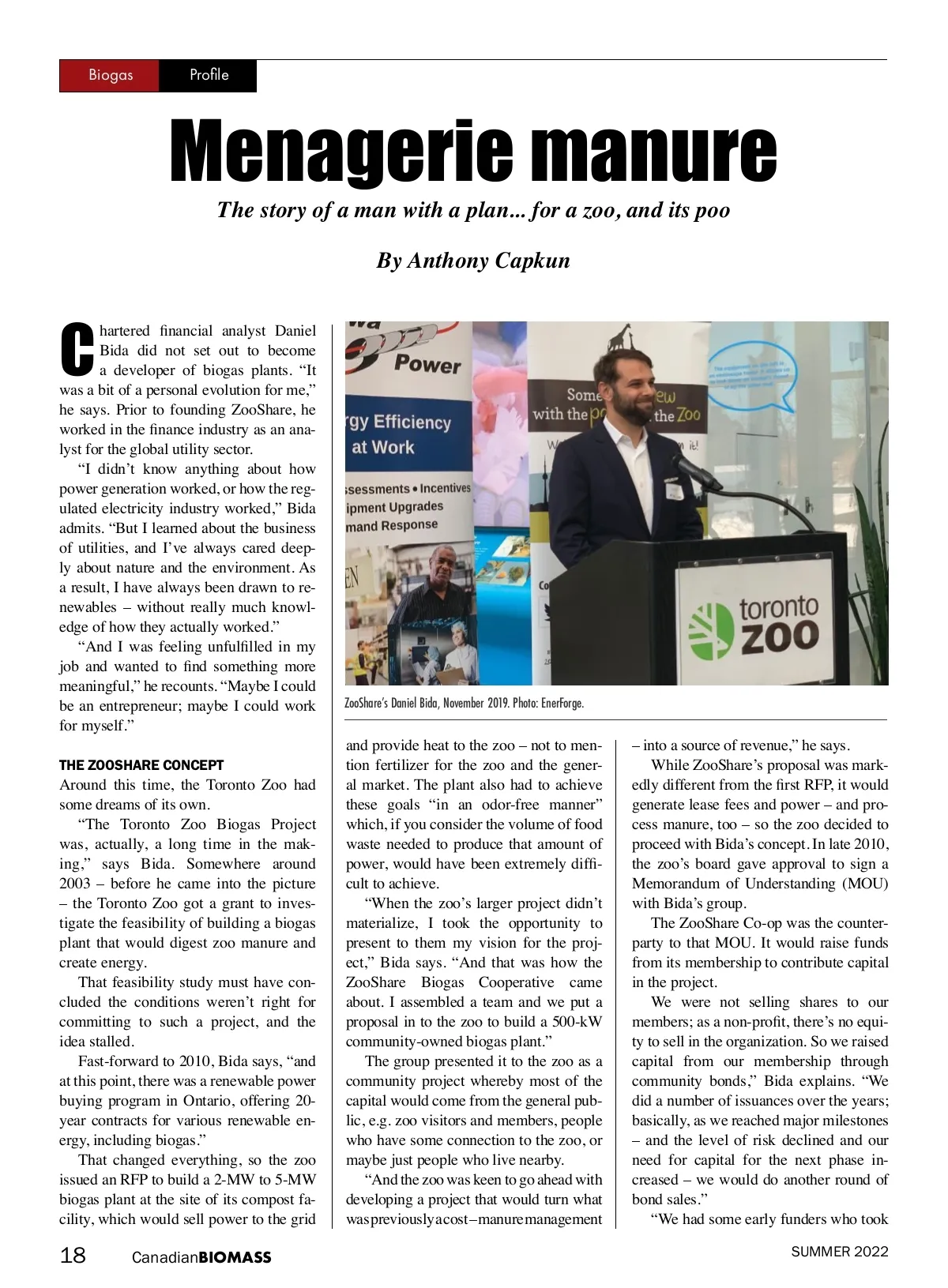
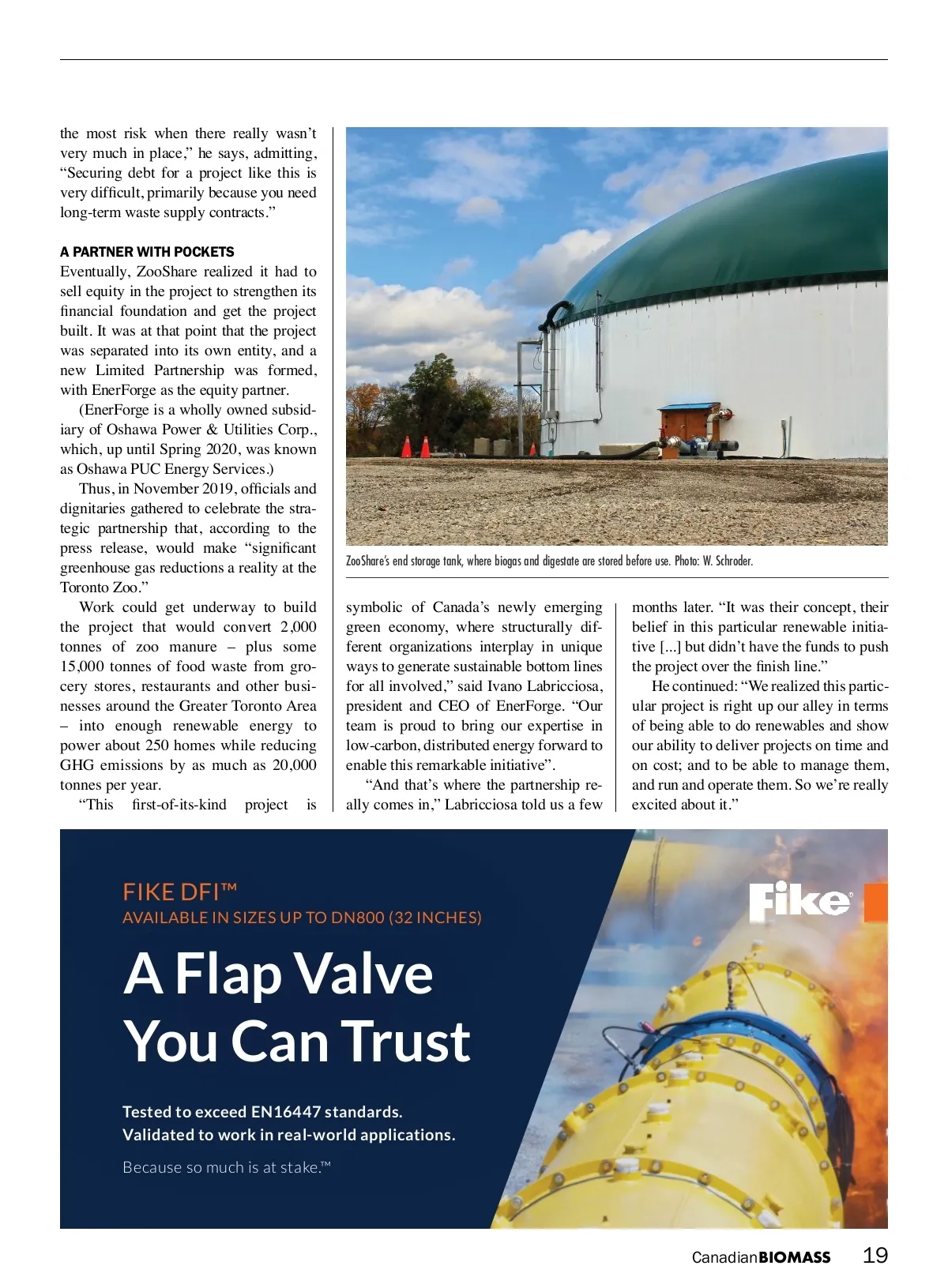
Biogas Profile Menagerie manure The story of a man with a plan... for a zoo, and its poo By Anthony Capkun hartered financial analyst Daniel Bida did not set out to become a developer of biogas plants. “It was a bit of a personal evolution for me,” he says. Prior to founding ZooShare, he worked in the finance industry as an ana -lyst for the global utility sector. “I didn’t know anything about how power generation worked, or how the reg-ulated electricity industry worked,” Bida admits. “But I learned about the business of utilities, and I’ve always cared deep-ly about nature and the environment. As a result, I have always been drawn to re-newables – without really much knowl-edge of how they actually worked.” “And I was feeling unfulfilled in my job and wanted to find something more meaningful,” he recounts. “Maybe I could be an entrepreneur; maybe I could work for myself.” THE ZOOSHARE CONCEPT C ZooShare’s Daniel Bida, November 2019. Photo: EnerForge. Around this time, the Toronto Zoo had some dreams of its own. “The Toronto Zoo Biogas Project was, actually, a long time in the mak-ing,” says Bida. Somewhere around 2003 – before he came into the picture – the Toronto Zoo got a grant to inves -tigate the feasibility of building a biogas plant that would digest zoo manure and create energy. That feasibility study must have con-cluded the conditions weren’t right for committing to such a project, and the idea stalled. Fast-forward to 2010, Bida says, “and at this point, there was a renewable power buying program in Ontario, offering 20-year contracts for various renewable en-ergy, including biogas.” That changed everything, so the zoo issued an RFP to build a 2-MW to 5-MW biogas plant at the site of its compost fa-cility, which would sell power to the grid and provide heat to the zoo – not to men-tion fertilizer for the zoo and the gener-al market. The plant also had to achieve these goals “in an odor-free manner” which, if you consider the volume of food waste needed to produce that amount of power, would have been extremely diffi -cult to achieve. “When the zoo’s larger project didn’t materialize, I took the opportunity to present to them my vision for the proj-ect,” Bida says. “And that was how the ZooShare Biogas Cooperative came about. I assembled a team and we put a proposal in to the zoo to build a 500-kW community-owned biogas plant.” The group presented it to the zoo as a community project whereby most of the capital would come from the general pub-lic, e.g. zoo visitors and members, people who have some connection to the zoo, or maybe just people who live nearby. “And the zoo was keen to go ahead with developing a project that would turn what was previously a cost – manure management – into a source of revenue,” he says. While ZooShare’s proposal was mark -edly different from the first RFP, it would generate lease fees and power – and pro-cess manure, too – so the zoo decided to proceed with Bida’s concept. In late 2010, the zoo’s board gave approval to sign a Memorandum of Understanding (MOU) with Bida’s group. The ZooShare Co-op was the counter -party to that MOU. It would raise funds from its membership to contribute capital in the project. We were not selling shares to our members; as a non-profit, there’s no equi -ty to sell in the organization. So we raised capital from our membership through community bonds,” Bida explains. “We did a number of issuances over the years; basically, as we reached major milestones – and the level of risk declined and our need for capital for the next phase in-creased – we would do another round of bond sales.” “We had some early funders who took SUMMER 2022 18 Canadian BIOMASS
Canadian Biomass Summer 2022: Page 18