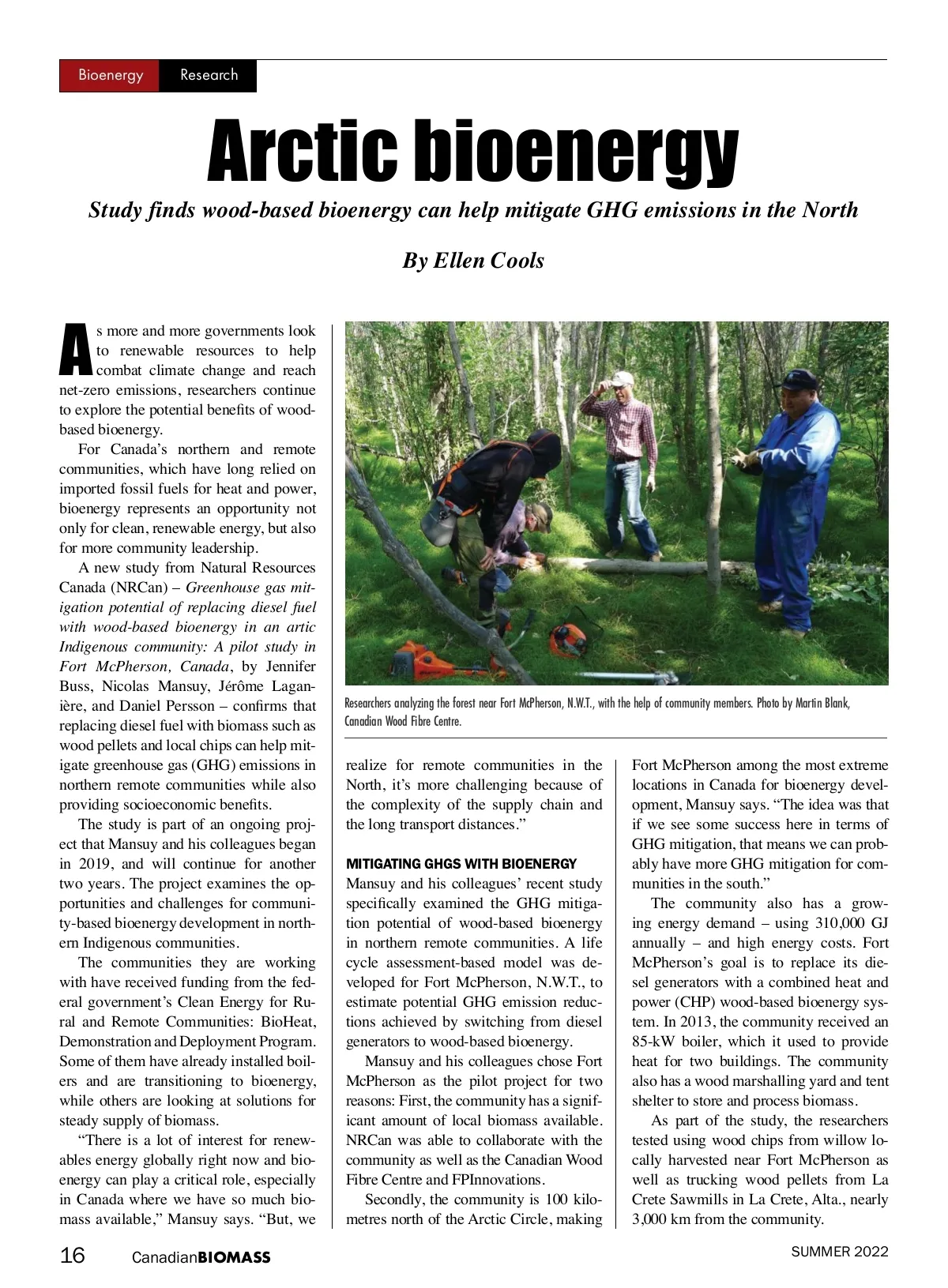
Bioenergy Research Study finds wood-based bioenergy can help mitigate GHG emissions in the North By Ellen Cools Arctic bioenergy A s more and more governments look to renewable resources to help combat climate change and reach net-zero emissions, researchers continue to explore the potential benefits of wood-based bioenergy. For Canada’s northern and remote communities, which have long relied on imported fossil fuels for heat and power, bioenergy represents an opportunity not only for clean, renewable energy, but also for more community leadership. A new study from Natural Resources Canada (NRCan) – Greenhouse gas mit-igation potential of replacing diesel fuel with wood-based bioenergy in an artic Indigenous community: A pilot study in Fort McPherson, Canada , by Jennifer Buss, Nicolas Mansuy, J é rôme Lagan-ière, and Daniel Persson – confirms that replacing diesel fuel with biomass such as wood pellets and local chips can help mit-igate greenhouse gas (GHG) emissions in northern remote communities while also providing socioeconomic benefits. The study is part of an ongoing proj-ect that Mansuy and his colleagues began in 2019, and will continue for another two years. The project examines the op-portunities and challenges for communi-ty-based bioenergy development in north-ern Indigenous communities. The communities they are working with have received funding from the fed-eral government’s Clean Energy for Ru-ral and Remote Communities: BioHeat, Demonstration and Deployment Program. Some of them have already installed boil-ers and are transitioning to bioenergy, while others are looking at solutions for steady supply of biomass. “There is a lot of interest for renew-ables energy globally right now and bio-energy can play a critical role, especially in Canada where we have so much bio-mass available,” Mansuy says. “But, we Researchers analyzing the forest near Fort McPherson, N.W.T., with the help of community members. Photo by Martin Blank, Canadian Wood Fibre Centre. realize for remote communities in the North, it’s more challenging because of the complexity of the supply chain and the long transport distances.” MITIGATING GHGS WITH BIOENERGY Mansuy and his colleagues’ recent study specifically examined the GHG mitiga -tion potential of wood-based bioenergy in northern remote communities. A life cycle assessment-based model was de-veloped for Fort McPherson, N.W.T., to estimate potential GHG emission reduc-tions achieved by switching from diesel generators to wood-based bioenergy. Mansuy and his colleagues chose Fort McPherson as the pilot project for two reasons: First, the community has a signif-icant amount of local biomass available. NRCan was able to collaborate with the community as well as the Canadian Wood Fibre Centre and FPInnovations. Secondly, the community is 100 kilo-metres north of the Arctic Circle, making Fort McPherson among the most extreme locations in Canada for bioenergy devel-opment, Mansuy says. “The idea was that if we see some success here in terms of GHG mitigation, that means we can prob-ably have more GHG mitigation for com-munities in the south.” The community also has a grow-ing energy demand – using 310,000 GJ annually – and high energy costs. Fort McPherson’s goal is to replace its die -sel generators with a combined heat and power (CHP) wood-based bioenergy sys -tem. In 2013, the community received an 85-kW boiler, which it used to provide heat for two buildings. The community also has a wood marshalling yard and tent shelter to store and process biomass. As part of the study, the researchers tested using wood chips from willow lo-cally harvested near Fort McPherson as well as trucking wood pellets from La Crete Sawmills in La Crete, Alta., nearly 3,000 km from the community. SUMMER 2022 16 Canadian BIOMASS
Canadian Biomass Summer 2022: Page 16