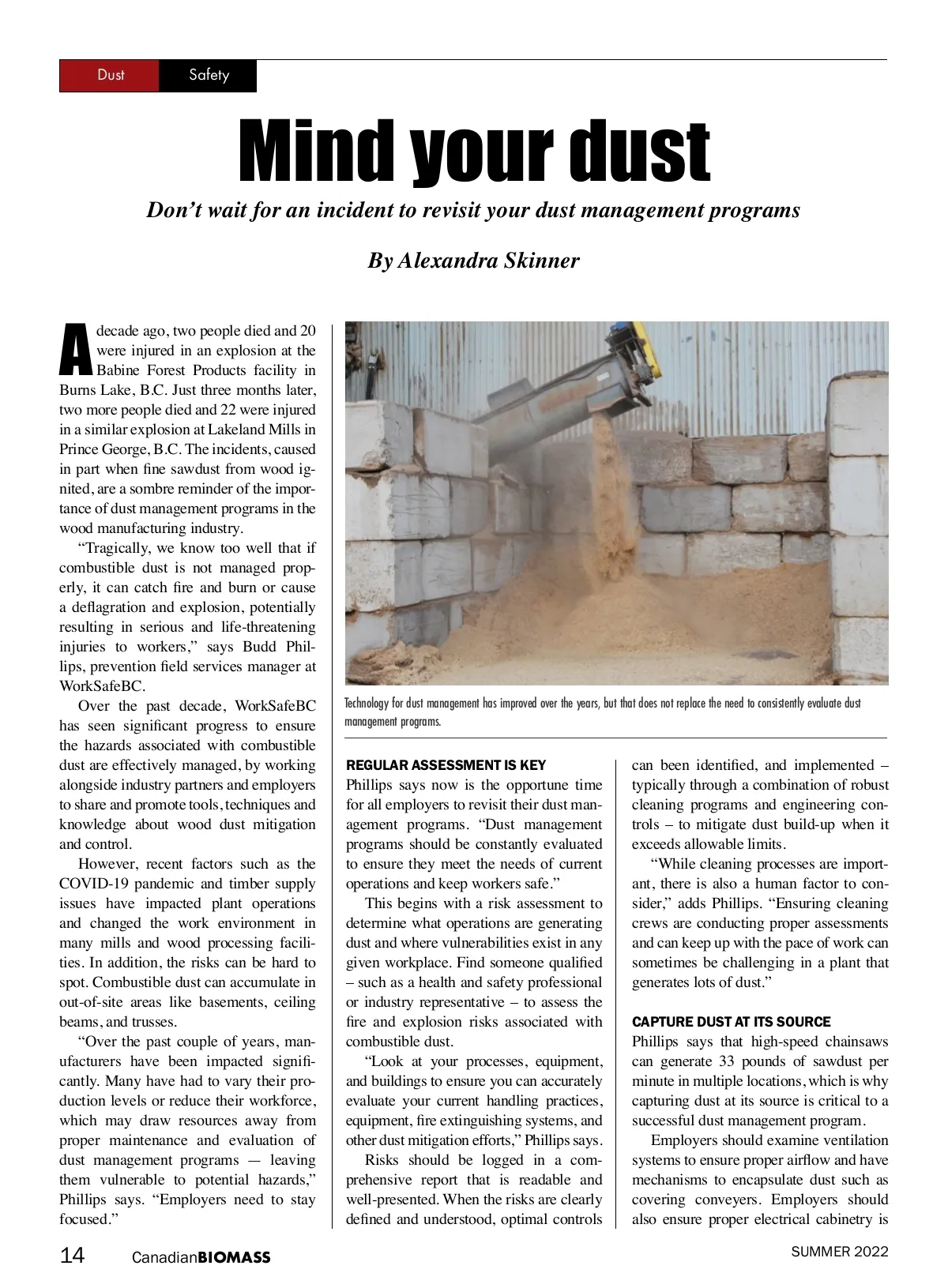
in place and cleaned properly so it does not become an ignition source. Phillips notes that technology for dust management has improved over the years. “There are many engineering controls available that extract excess dust more effectively and also help monitor dust levels. For example, some mills have comprehensive monitoring systems that include new sonic fans that help remove dust from high elevation surfaces.” However, enhanced technology does not replace the need to consistently evalu-ate dust management programs to ensure they’re sustainable. Plans should be re-eval -uated and new risk assessments should be done if any of the following occur: • Staffing changes • New or different work duties for staff • Equipment changes: including new equipment, upgrades, or downgrades. • Structural changes to the facility • Operational changes, including chang-es in production levels or processes. “The smallest change in personnel or operations could make a difference, so employers must regularly evaluate their programs to ensure they have the capacity required to keep dust levels below the al-lowable limits,” says Phillips. Even if nothing changes in a work-place, employers should review their programs at least once a year to ensure they meet occupational health and safety standards, and do not put workers at risk. Phillips says most employers know their business and are aware of where and when dust is generated. The challenge is controlling and mitigating it. Engineers that specialize in ventilation can also provide employers with a detailed assessment of a system’s effectiveness. UPDATING LEGISLATION TO REFLECT THE RISK WorkSafeBC’s prevention efforts, inspec-tion initiatives and collaboration with industry partners have been successful in combating combustible dust in wood manufacturing. One of the challenges, however, is providing guidance and reg-ulation to support smaller operations and other industries that face similar risks. “Current legislation does not address all industries that are generating hazard-ous amounts of combustible dust, like cabinet shops for example,” Phillips says. Pulp and paper waste, commercial laundry facilities, iron fillings, and sug -ar plants are just a few examples of the thousands of manufacturers that could experience catastrophic outcomes if dust levels from those products accumulate over certain levels. “Our current regulations for combus-tible dust are minimal in terms of what we can require for combustible dust pro-grams, and are limited to specific employ -ers groups,” explains Phillips. “Since our combustible dust strategy was developed in 2012, we realized that there is a signif-icant risk in many industries that needs to be addressed to keep workers safe.” New proposed legislation changes are currently in the consultation phase in B.C. These revised regulations will become part of the B.C.’s Occupational Health and Safety Regulation providing WorkSafeBC prevention officers with the opportunity to enforce safety programs in a broader range of industries. A DECADE OF LESSONS LEARNED In the 10 years since the sawmill explo-sions in Burns Lake and Prince George, there has been significant progress and tangible improvements in managing haz-ards associated with combustible wood. “We owe it to those who lost their lives or were injured to never forget the impact those explosions had on their families, their job sites and their communities – and to remain vigilant in order to prevent a tragedy like that from ever happening again,” Phillips says. RESOURCES WorkSafeBC has developed several dust management resources, available on their website: www.worksafebc.com/en • Alexandra Skinner is a manager of government and media relations with WorkSafeBC. CB_Rawlings_third_Winter22_MLD.indd 1 Canadian BIOMASS 2022-01-26 11:13 AM 15
Canadian Biomass Summer 2022: Page 15