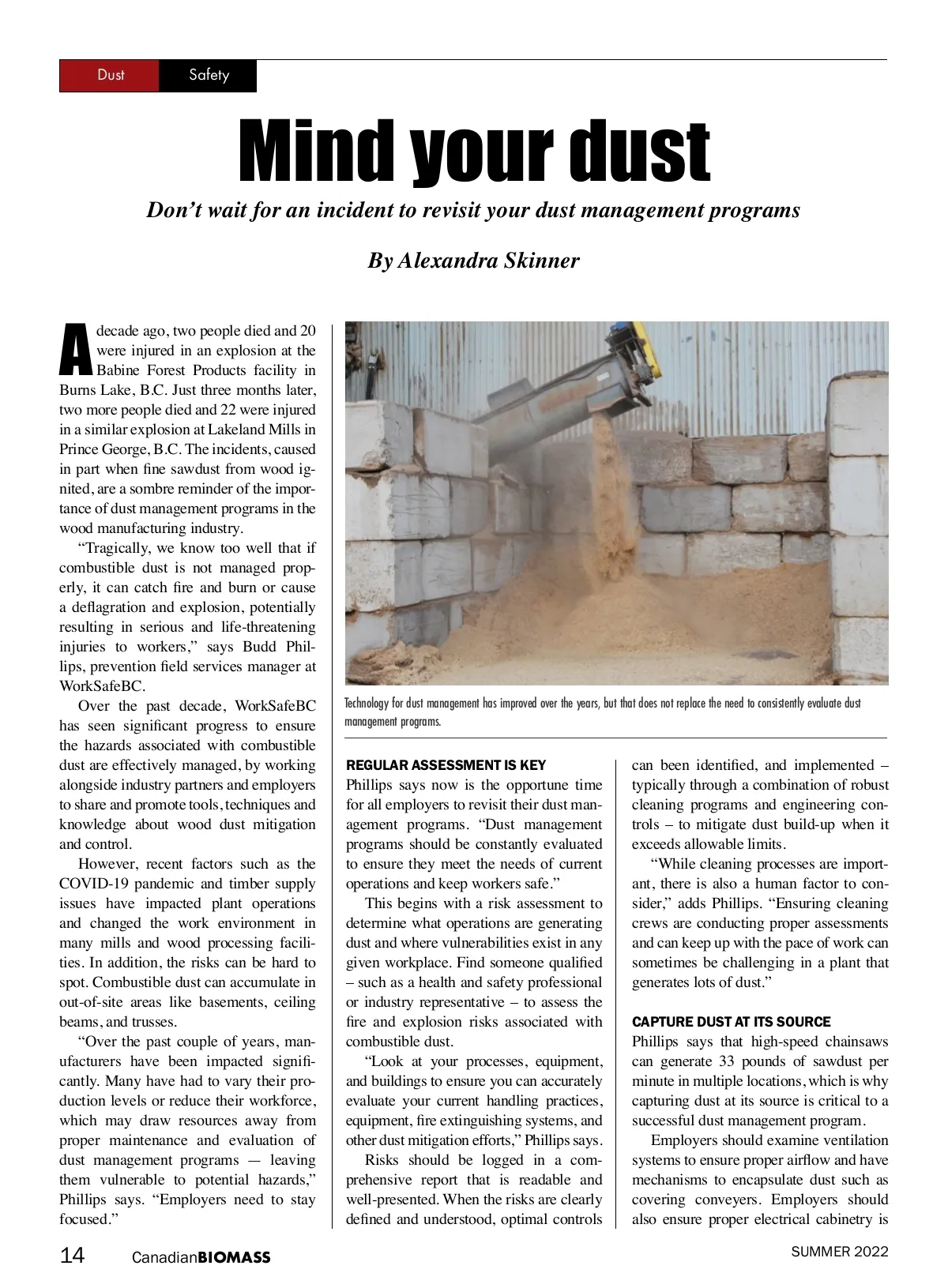
Dust Safety Don’t wait for an incident to revisit your dust management programs By Alexandra Skinner Mind your dust A decade ago, two people died and 20 were injured in an explosion at the Babine Forest Products facility in Burns Lake, B.C. Just three months later, two more people died and 22 were injured in a similar explosion at Lakeland Mills in Prince George, B.C. The incidents, caused in part when fine sawdust from wood ig -nited, are a sombre reminder of the impor-tance of dust management programs in the wood manufacturing industry. “Tragically, we know too well that if combustible dust is not managed prop-erly, it can catch fire and burn or cause a deflagration and explosion, potentially resulting in serious and life-threatening injuries to workers,” says Budd Phil -lips, prevention field services manager at WorkSafeBC. Over the past decade, WorkSafeBC has seen significant progress to ensure the hazards associated with combustible dust are effectively managed, by working alongside industry partners and employers to share and promote tools, techniques and knowledge about wood dust mitigation and control. However, recent factors such as the COVID-19 pandemic and timber supply issues have impacted plant operations and changed the work environment in many mills and wood processing facili-ties. In addition, the risks can be hard to spot. Combustible dust can accumulate in out-of-site areas like basements, ceiling beams, and trusses. “Over the past couple of years, man-ufacturers have been impacted signifi -cantly. Many have had to vary their pro-duction levels or reduce their workforce, which may draw resources away from proper maintenance and evaluation of dust management programs — leaving them vulnerable to potential hazards,” Phillips says. “Employers need to stay focused.” Technology for dust management has improved over the years, but that does not replace the need to consistently evaluate dust management programs. REGULAR ASSESSMENT IS KEY Phillips says now is the opportune time for all employers to revisit their dust man-agement programs. “Dust management programs should be constantly evaluated to ensure they meet the needs of current operations and keep workers safe.” This begins with a risk assessment to determine what operations are generating dust and where vulnerabilities exist in any given workplace. Find someone qualified – such as a health and safety professional or industry representative – to assess the fire and explosion risks associated with combustible dust. “Look at your processes, equipment, and buildings to ensure you can accurately evaluate your current handling practices, equipment, fire extinguishing systems, and other dust mitigation efforts,” Phillips says. Risks should be logged in a com-prehensive report that is readable and well-presented. When the risks are clearly defined and understood, optimal controls can been identified, and implemented – typically through a combination of robust cleaning programs and engineering con-trols – to mitigate dust build-up when it exceeds allowable limits. “While cleaning processes are import-ant, there is also a human factor to con-sider,” adds Phillips. “Ensuring cleaning crews are conducting proper assessments and can keep up with the pace of work can sometimes be challenging in a plant that generates lots of dust.” CAPTURE DUST AT ITS SOURCE Phillips says that high-speed chainsaws can generate 33 pounds of sawdust per minute in multiple locations, which is why capturing dust at its source is critical to a successful dust management program. Employers should examine ventilation systems to ensure proper airflow and have mechanisms to encapsulate dust such as covering conveyers. Employers should also ensure proper electrical cabinetry is SUMMER 2022 14 Canadian BIOMASS
Canadian Biomass Summer 2022: Page 14