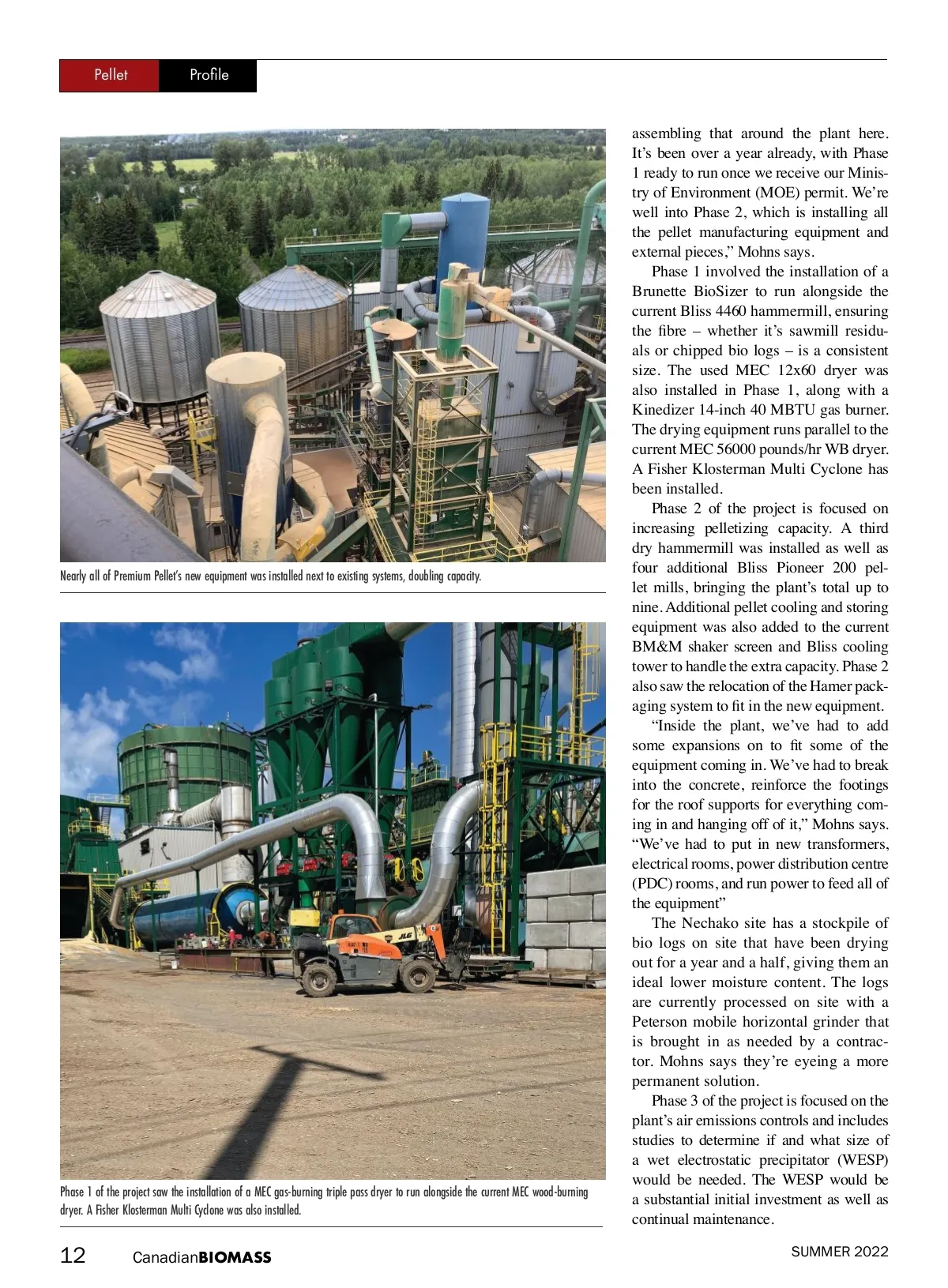
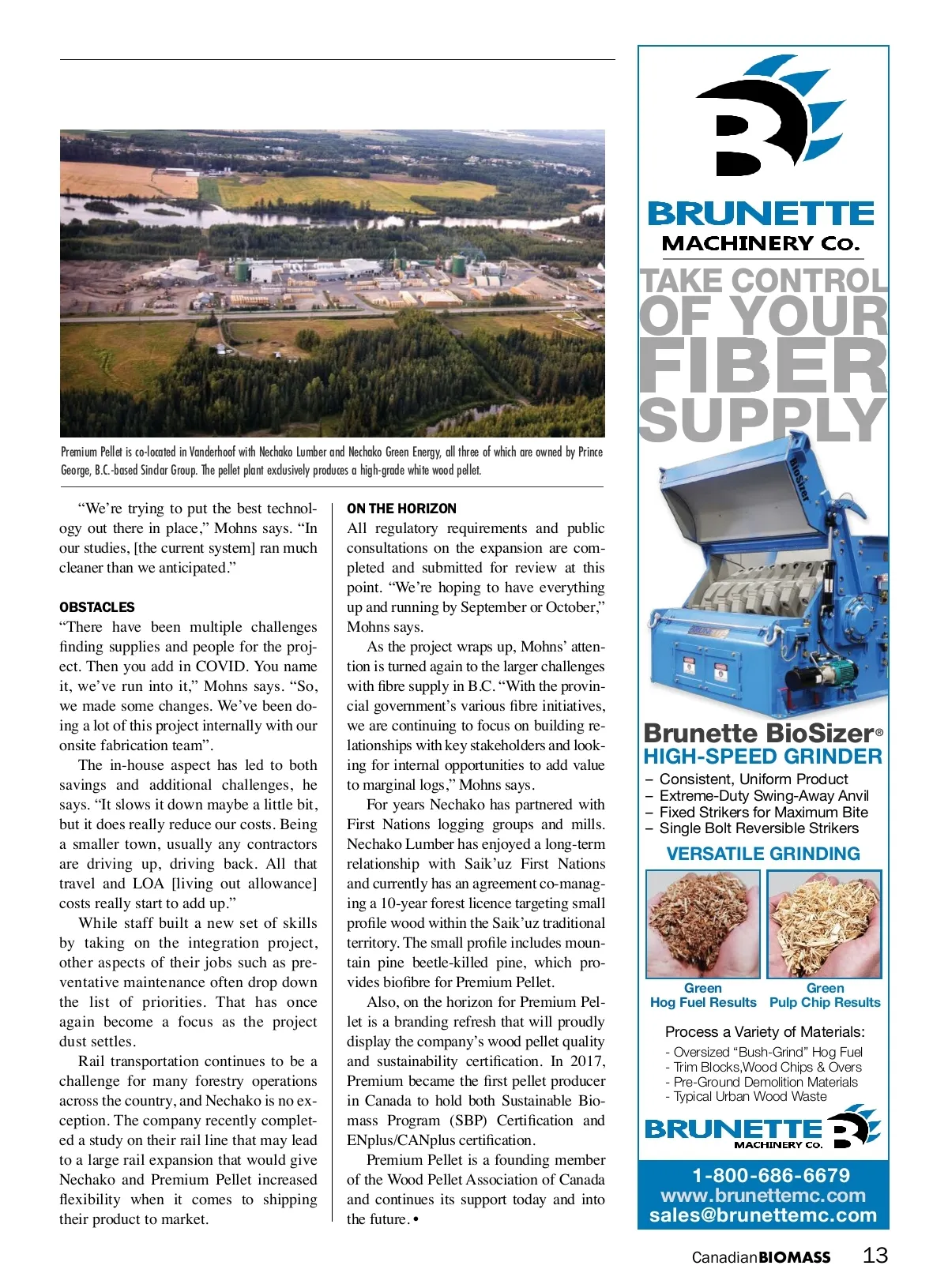
Pellet Profile assembling that around the plant here. It’s been over a year already, with Phase 1 ready to run once we receive our Minis-try of Environment (MOE) permit. We’re well into Phase 2, which is installing all the pellet manufacturing equipment and external pieces,” Mohns says. Phase 1 involved the installation of a Brunette BioSizer to run alongside the current Bliss 4460 hammermill, ensuring the fibre – whether it’s sawmill residu -als or chipped bio logs – is a consistent size. The used MEC 12x60 dryer was also installed in Phase 1, along with a Kinedizer 14-inch 40 MBTU gas burner. The drying equipment runs parallel to the current MEC 56000 pounds/hr WB dryer. A Fisher Klosterman Multi Cyclone has been installed. Phase 2 of the project is focused on increasing pelletizing capacity. A third dry hammermill was installed as well as four additional Bliss Pioneer 200 pel -let mills, bringing the plant’s total up to nine. Additional pellet cooling and storing equipment was also added to the current BM&M shaker screen and Bliss cooling tower to handle the extra capacity. Phase 2 also saw the relocation of the Hamer pack-aging system to fit in the new equipment. “Inside the plant, we’ve had to add some expansions on to fit some of the equipment coming in. We’ve had to break into the concrete, reinforce the footings for the roof supports for everything com-ing in and hanging off of it,” Mohns says. “We’ve had to put in new transformers, electrical rooms, power distribution centre (PDC) rooms, and run power to feed all of the equipment” The Nechako site has a stockpile of bio logs on site that have been drying out for a year and a half, giving them an ideal lower moisture content. The logs are currently processed on site with a Peterson mobile horizontal grinder that is brought in as needed by a contrac-tor. Mohns says they’re eyeing a more permanent solution. Phase 3 of the project is focused on the plant’s air emissions controls and includes studies to determine if and what size of a wet electrostatic precipitator (WESP) would be needed. The WESP would be a substantial initial investment as well as continual maintenance. SUMMER 2022 Nearly all of Premium Pellet’s new equipment was installed next to existing systems, doubling capacity. Phase 1 of the project saw the installation of a MEC gas-burning triple pass dryer to run alongside the current MEC wood-burning dryer. A Fisher Klosterman Multi Cyclone was also installed. 12 Canadian BIOMASS
Canadian Biomass Summer 2022: Page 12