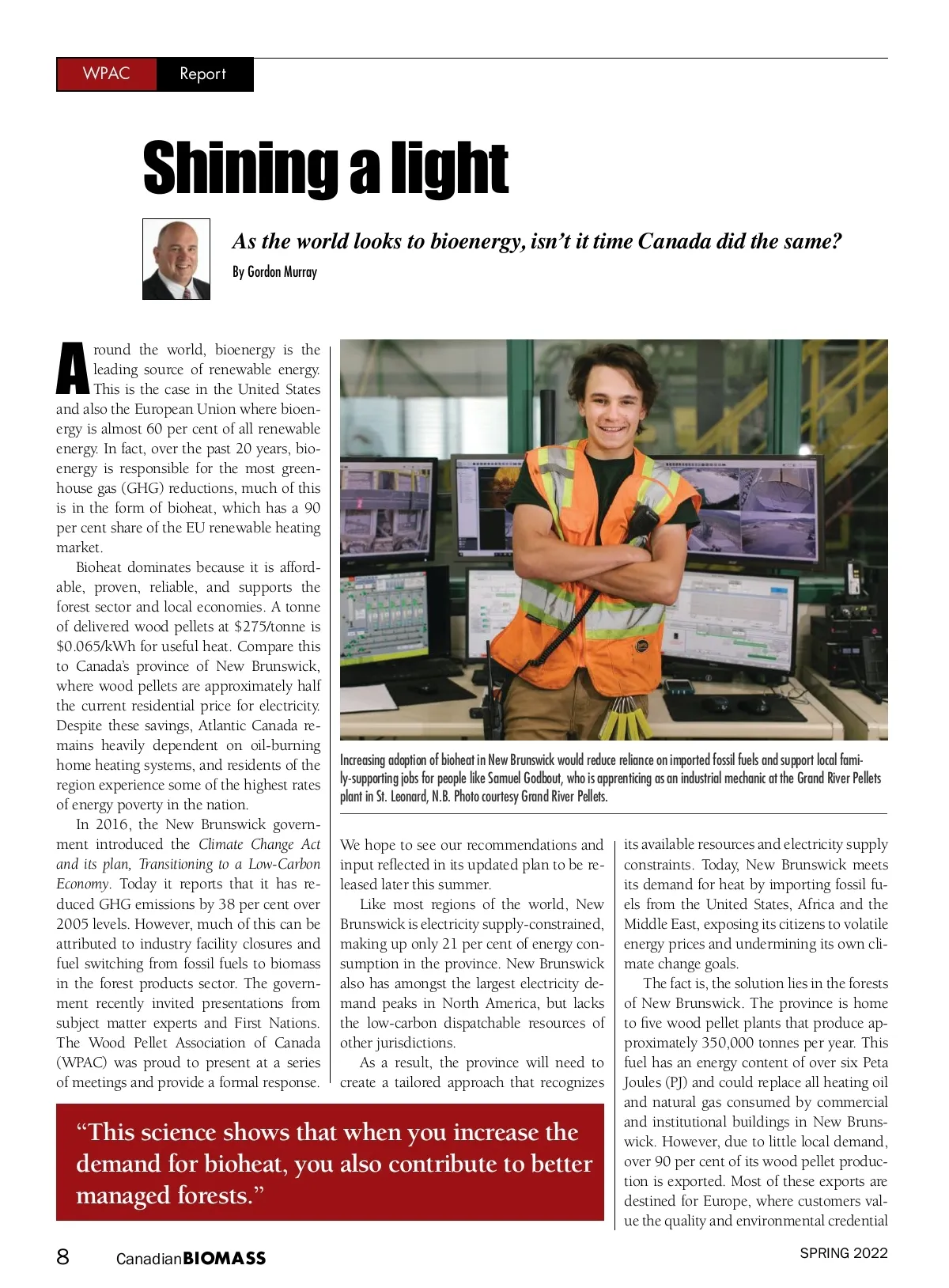
WPAC Report Shining a light As the world looks to bioenergy, isn’t it time Canada did the same? By Gordon Murray A round the world, bioenergy is the leading source of renewable energy. This is the case in the United States and also the European Union where bioen-ergy is almost 60 per cent of all renewable energy. In fact, over the past 20 years, bio-energy is responsible for the most green-house gas (GHG) reductions, much of this is in the form of bioheat, which has a 90 per cent share of the EU renewable heating market. Bioheat dominates because it is afford-able, proven, reliable, and supports the forest sector and local economies. A tonne of delivered wood pellets at $275/tonne is $0.065/kWh for useful heat. Compare this to Canada’s province of New Brunswick, where wood pellets are approximately half the current residential price for electricity. Despite these savings, Atlantic Canada re-mains heavily dependent on oil-burning home heating systems, and residents of the region experience some of the highest rates of energy poverty in the nation. In 2016, the New Brunswick govern-ment introduced the Climate Change Act and its plan, Transitioning to a Low-Carbon Economy . Today it reports that it has re-duced GHG emissions by 38 per cent over 2005 levels. However, much of this can be attributed to industry facility closures and fuel switching from fossil fuels to biomass in the forest products sector. The govern-ment recently invited presentations from subject matter experts and First Nations. The Wood Pellet Association of Canada (WPAC) was proud to present at a series of meetings and provide a formal response. Increasing adoption of bioheat in New Brunswick would reduce reliance on imported fossil fuels and support local fami-ly-supporting jobs for people like Samuel Godbout, who is apprenticing as an industrial mechanic at the Grand River Pellets plant in St. Leonard, N.B. Photo courtesy Grand River Pellets. We hope to see our recommendations and input reflected in its updated plan to be re-leased later this summer. Like most regions of the world, New Brunswick is electricity supply-constrained, making up only 21 per cent of energy con-sumption in the province. New Brunswick also has amongst the largest electricity de-mand peaks in North America, but lacks the low-carbon dispatchable resources of other jurisdictions. As a result, the province will need to create a tailored approach that recognizes “This science shows that when you increase the demand for bioheat, you also contribute to better managed forests.” 8 Canadian BIOMASS its available resources and electricity supply constraints. Today, New Brunswick meets its demand for heat by importing fossil fu-els from the United States, Africa and the Middle East, exposing its citizens to volatile energy prices and undermining its own cli-mate change goals. The fact is, the solution lies in the forests of New Brunswick. The province is home to five wood pellet plants that produce ap-proximately 350,000 tonnes per year. This fuel has an energy content of over six Peta Joules (PJ) and could replace all heating oil and natural gas consumed by commercial and institutional buildings in New Bruns-wick. However, due to little local demand, over 90 per cent of its wood pellet produc-tion is exported. Most of these exports are destined for Europe, where customers val-ue the quality and environmental credential SPRING 2022
Canadian Biomass Spring 2022: Page 8