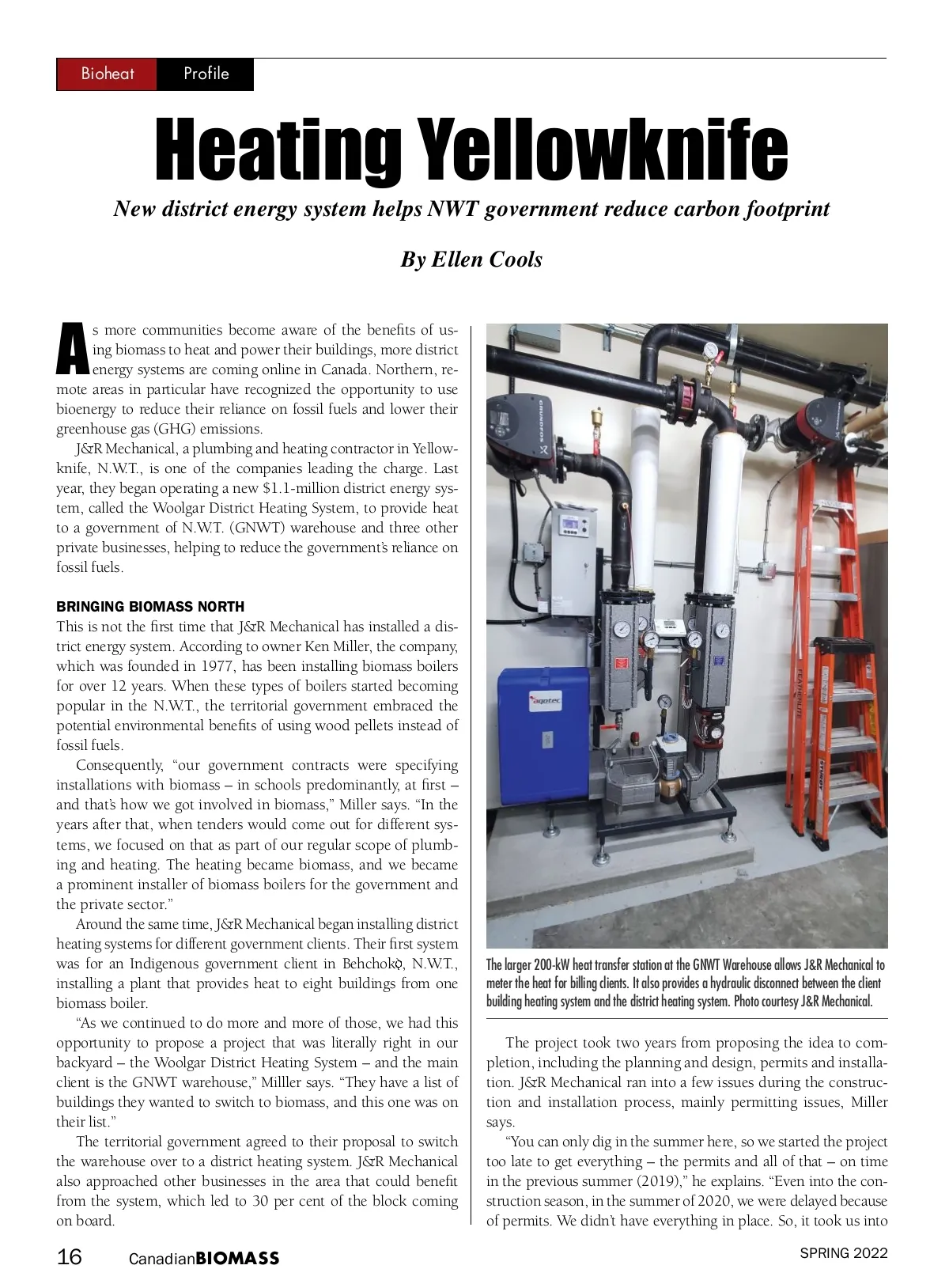
the winter, which caused some issues for us and left us with some seasonal deficiencies.” But, the system officially came online in March 2021, and has since been providing heat to the three businesses, the GNWT warehouse and a GNWT data centre that is connected to the ware-house. FROM WOOD PELLETS TO HEAT and fairly high efficiencies. It’s worked out well.” REDUCING FOSSIL FUEL RELIANCE The system itself is fairly simple, with two main components: a container with a 390-kW Viessmann Vitoflex 300-UF boiler, sup-plied by Enderby, B.C.-based Fink Machine, and a silo to store the wood pellets that the boiler burns. Fink Machine assembled the boiler in a containerized plant, which was then shipped to J&R Mechanical, who installed it and connected it to their own systems. Meanwhile, the wood pellets came from a pellet plant in Alberta. According to Miller, the system is very similar to any other hy-dronic heating system: “you heat water and you transfer the heat to buildings through various different types of heat exchangers, whether it be baseboard radiation or unit heaters, radiant in-floor heaters, radiant panel heating. “The process of burning wood pellets to create the heat source is the only real difference,” he continues. “We unload and load them, redistribute them to different silos in the community where these pellets are then extracted by augers or different devices to feed the boiler, based on the demand for heat.” The boiler produces heat, water vapour, carbon dioxide and ash. The heat from the water vapour is transferred to each build-ing’s space heating system through underground pipes, Miller ex-plains. Yellowknife, of course, is an extremely cold area in the winter, which means the system has to be able to operate in a harsh cli-mate. So far, there have been no issues with the boiler, Miller says. “The average design temperature here is to -45 C; we’ve seen the boiler operate just perfectly in those temperatures,” he says. “It’s operating as it was designed to operate, with low maintenance The system has also had a big impact on the N.W.T. government’s fossil fuel use, as it has cut oil use for the warehouse by 92 per cent – from 60,000 litres per year to just 4,800 litres. The system has also reduced the warehouse’s GHG emissions by 145 tonnes of carbon equivalent. The project, which cost $1.1 million, was a big capital invest-ment for J&R Mechanical. The N.W.T. government gave J&R Me-chanical a $274,000 grant for the project, but the company footed the rest of the bill. However, Miller says their business plan calls for paying off that investment in four to five years. So far, the feedback from the community and the territorial government has been very positive, Miller says. He believes there are opportunities for other northern communities to develop sim-ilar district energy systems to reduce their reliance on fossil fuels. “I think everyone is looking at them as a better solution – look-ing at biomass boilers to heat buildings – so I think it has been kind of proven that this is a good way to go,” he says. Nevertheless, there are a few barriers to overcome when install-ing a system like this. One such challenge is understanding the potential impact on a community’s infrastructure. “We bury pipes in the ground, and that can be very disrup-tive,” Miller explains. “There’s other stuff in the ground that you don’t see – power lines, water and sewer pipes, telephone lines and things like that, depending on where you’re trying to install it. So, engineering design can be a bigger challenge.” However, the benefits far outweigh the costs, and J&R Me-chanical is looking at possibly expanding the Woolgar District Heating System. “If our client base grows – and it potentially will with some new developments next year or the year after – we possibly will have to expand the size of the heating plant to accommodate,” he says. For now, though, the company is planning to add one or two more buildings to the system and continue running it as is. • Fink Machine Inc. , is very excited to announce that we have added Schmid Energy Solutions boilers to our current product portfolio. Fink’s success is based on Service and we are looking to continue that by adding Schmid boilers to its line of high quality products. E Canada’s leading supplier of commercial and small industrial heating systems E ASME and CSA certified E 100 kW – 12 MW (0.3 MMBTU – 36 MMBTU) E Over 160 energy efficient systems installed Fink District Heating System Box 308, 124 Old Vernon St. Enderby, B.C. V0E 1V0 Ph. 250.838.0077 | Fax. 250.838.0068 | www.FinkMachine.com Canadian BIOMASS CB_Fink_Spring22_MLD.indd 1 2022-04-14 1:48 PM 17
Canadian Biomass Spring 2022: Page 17