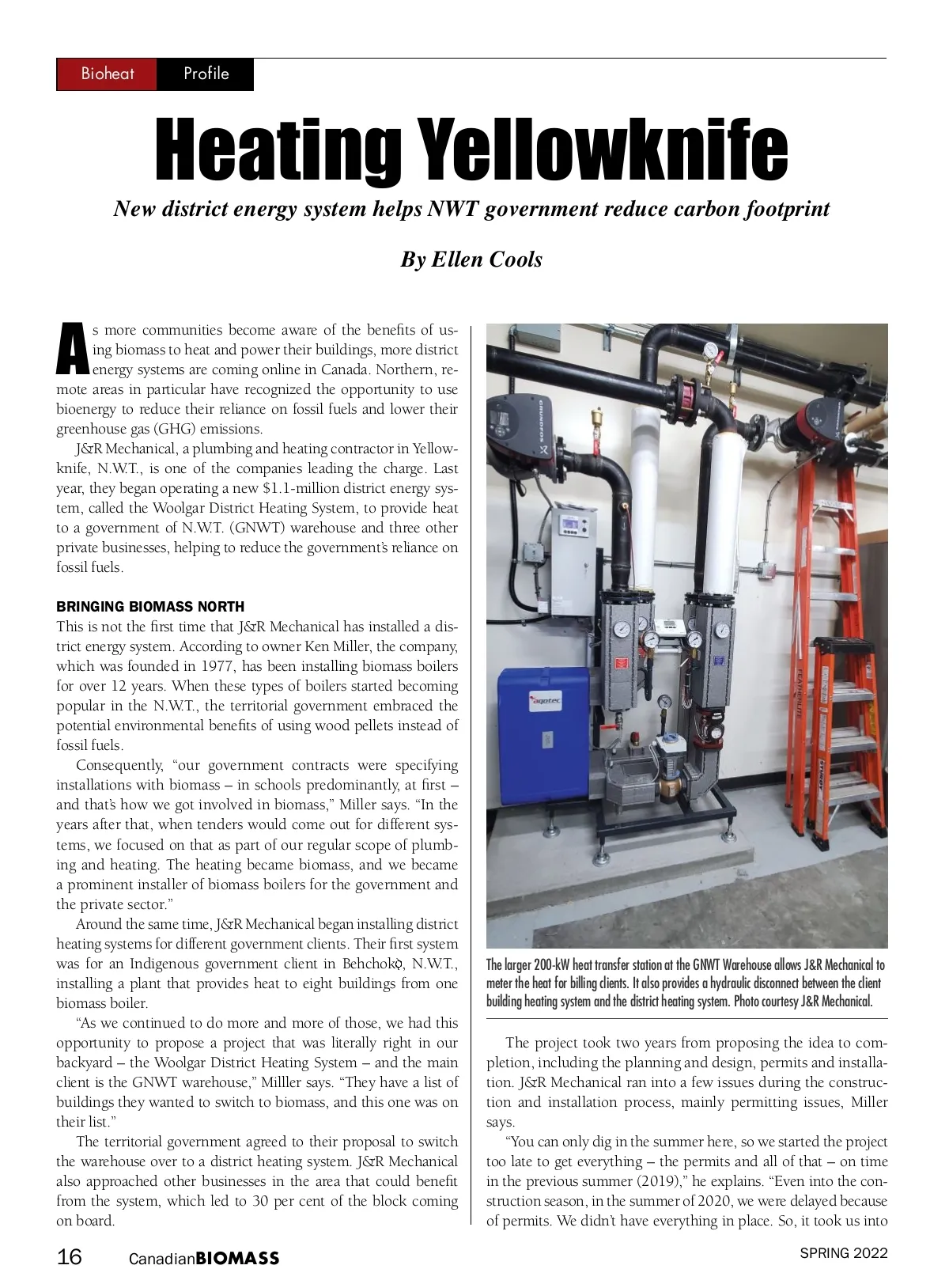
Bioheat Profile New district energy system helps NWT government reduce carbon footprint By Ellen Cools Heating Yellowknife A s more communities become aware of the benefits of us-ing biomass to heat and power their buildings, more district energy systems are coming online in Canada. Northern, re-mote areas in particular have recognized the opportunity to use bioenergy to reduce their reliance on fossil fuels and lower their greenhouse gas (GHG) emissions. J&R Mechanical, a plumbing and heating contractor in Yellow-knife, N.W.T., is one of the companies leading the charge. Last year, they began operating a new $1.1-million district energy sys-tem, called the Woolgar District Heating System, to provide heat to a government of N.W.T. (GNWT) warehouse and three other private businesses, helping to reduce the government’s reliance on fossil fuels. BRINGING BIOMASS NORTH This is not the first time that J&R Mechanical has installed a dis-trict energy system. According to owner Ken Miller, the company, which was founded in 1977, has been installing biomass boilers for over 12 years. When these types of boilers started becoming popular in the N.W.T., the territorial government embraced the potential environmental benefits of using wood pellets instead of fossil fuels. Consequently, “our government contracts were specifying installations with biomass – in schools predominantly, at first – and that’s how we got involved in biomass,” Miller says. “In the years after that, when tenders would come out for different sys-tems, we focused on that as part of our regular scope of plumb-ing and heating. The heating became biomass, and we became a prominent installer of biomass boilers for the government and the private sector.” Around the same time, J&R Mechanical began installing district heating systems for different government clients. Their first system was for an Indigenous government client in Behchok , N.W.T., installing a plant that provides heat to eight buildings from one biomass boiler. “As we continued to do more and more of those, we had this opportunity to propose a project that was literally right in our backyard – the Woolgar District Heating System – and the main client is the GNWT warehouse,” Milller says. “They have a list of buildings they wanted to switch to biomass, and this one was on their list.” The territorial government agreed to their proposal to switch the warehouse over to a district heating system. J&R Mechanical also approached other businesses in the area that could benefit from the system, which led to 30 per cent of the block coming on board. The larger 200-kW heat transfer station at the GNWT Warehouse allows J&R Mechanical to meter the heat for billing clients. It also provides a hydraulic disconnect between the client building heating system and the district heating system. Photo courtesy J&R Mechanical. The project took two years from proposing the idea to com-pletion, including the planning and design, permits and installa-tion. J&R Mechanical ran into a few issues during the construc-tion and installation process, mainly permitting issues, Miller says. “You can only dig in the summer here, so we started the project too late to get everything – the permits and all of that – on time in the previous summer (2019),” he explains. “Even into the con-struction season, in the summer of 2020, we were delayed because of permits. We didn’t have everything in place. So, it took us into SPRING 2022 16 Canadian BIOMASS
Canadian Biomass Spring 2022: Page 16