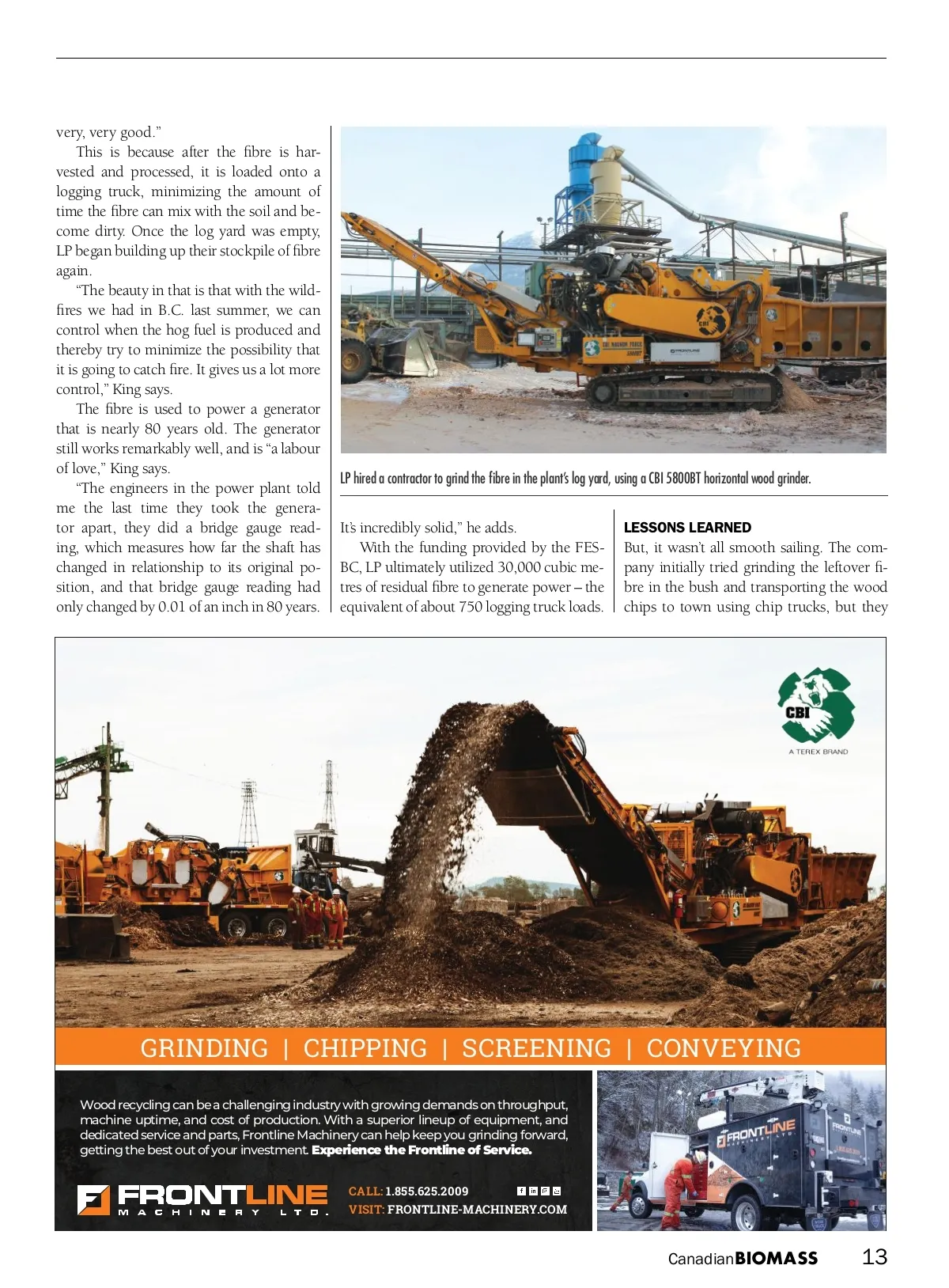
very, very good.” This is because after the fibre is har-vested and processed, it is loaded onto a logging truck, minimizing the amount of time the fibre can mix with the soil and be-come dirty. Once the log yard was empty, LP began building up their stockpile of fibre again. “The beauty in that is that with the wild-fires we had in B.C. last summer, we can control when the hog fuel is produced and thereby try to minimize the possibility that it is going to catch fire. It gives us a lot more control,” King says. The fibre is used to power a generator that is nearly 80 years old. The generator still works remarkably well, and is “a labour of love,” King says. “The engineers in the power plant told me the last time they took the genera-tor apart, they did a bridge gauge read-ing, which measures how far the shaft has changed in relationship to its original po-sition, and that bridge gauge reading had only changed by 0.01 of an inch in 80 years. LP hired a contractor to grind the fibre in the plant’s log yard, using a CBI 5800BT horizontal wood grinder. It’s incredibly solid,” he adds. With the funding provided by the FES-BC, LP ultimately utilized 30,000 cubic me-tres of residual fibre to generate power – the equivalent of about 750 logging truck loads. LESSONS LEARNED But, it wasn’t all smooth sailing. The com-pany initially tried grinding the leftover fi-bre in the bush and transporting the wood chips to town using chip trucks, but they GRINDING | CHIPPING | SCREENING | CONVEYING Wood recycling can be a challenging industry with growing demands on throughput, machine uptime, and cost of production. With a superior lineup of equipment, and dedicated service and parts, Frontline Machinery can help keep you grinding forward, getting the best out of your investment. Experience the Frontline of Service. CALL: 1.855.625.2009 VISIT: FRONTLINE-MACHINERY.COM CB_Frontline_Spring22_CSA.indd 1 Canadian BIOMASS 2022-04-29 7:30 AM 13
Canadian Biomass Spring 2022: Page 13