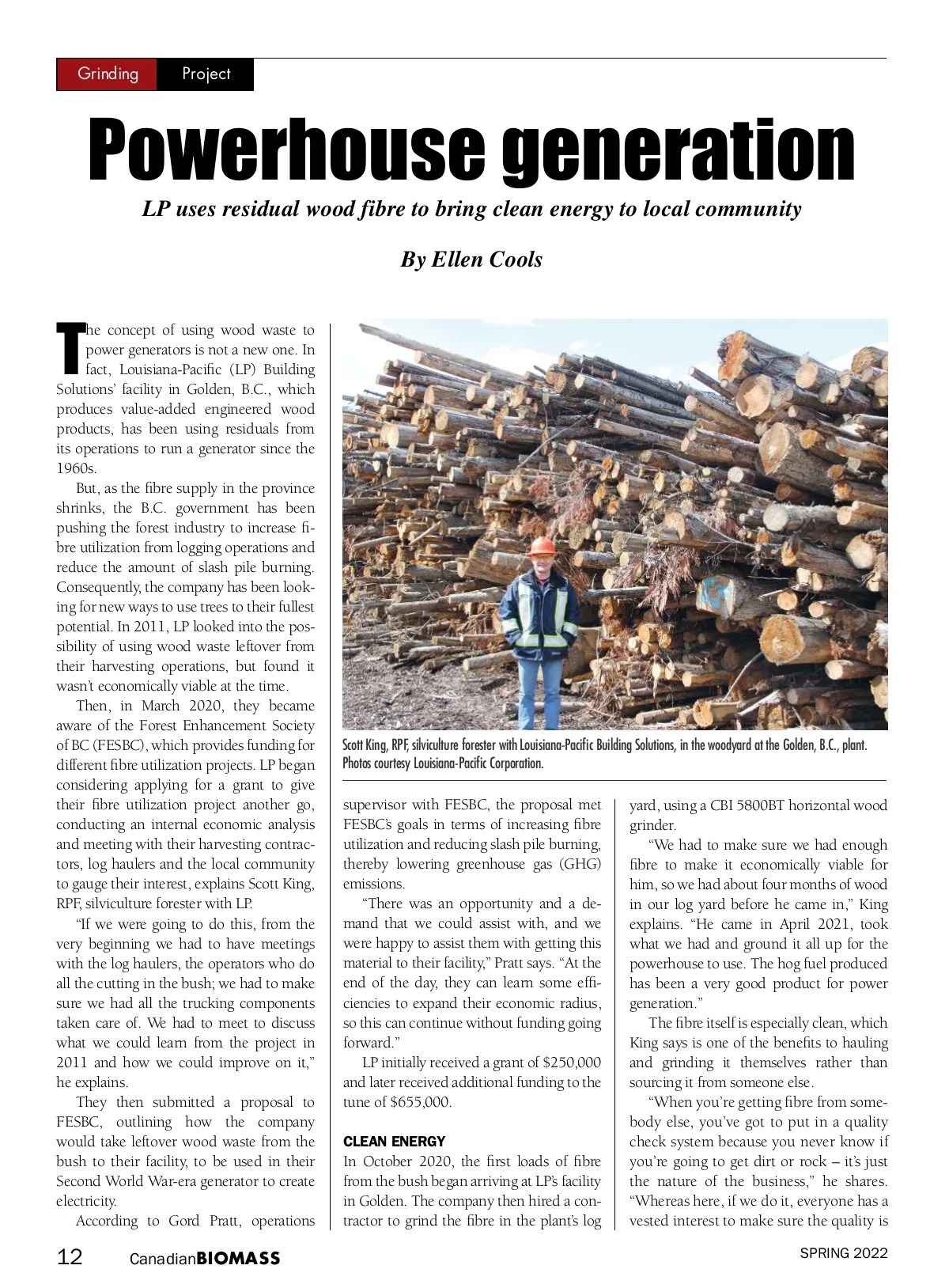
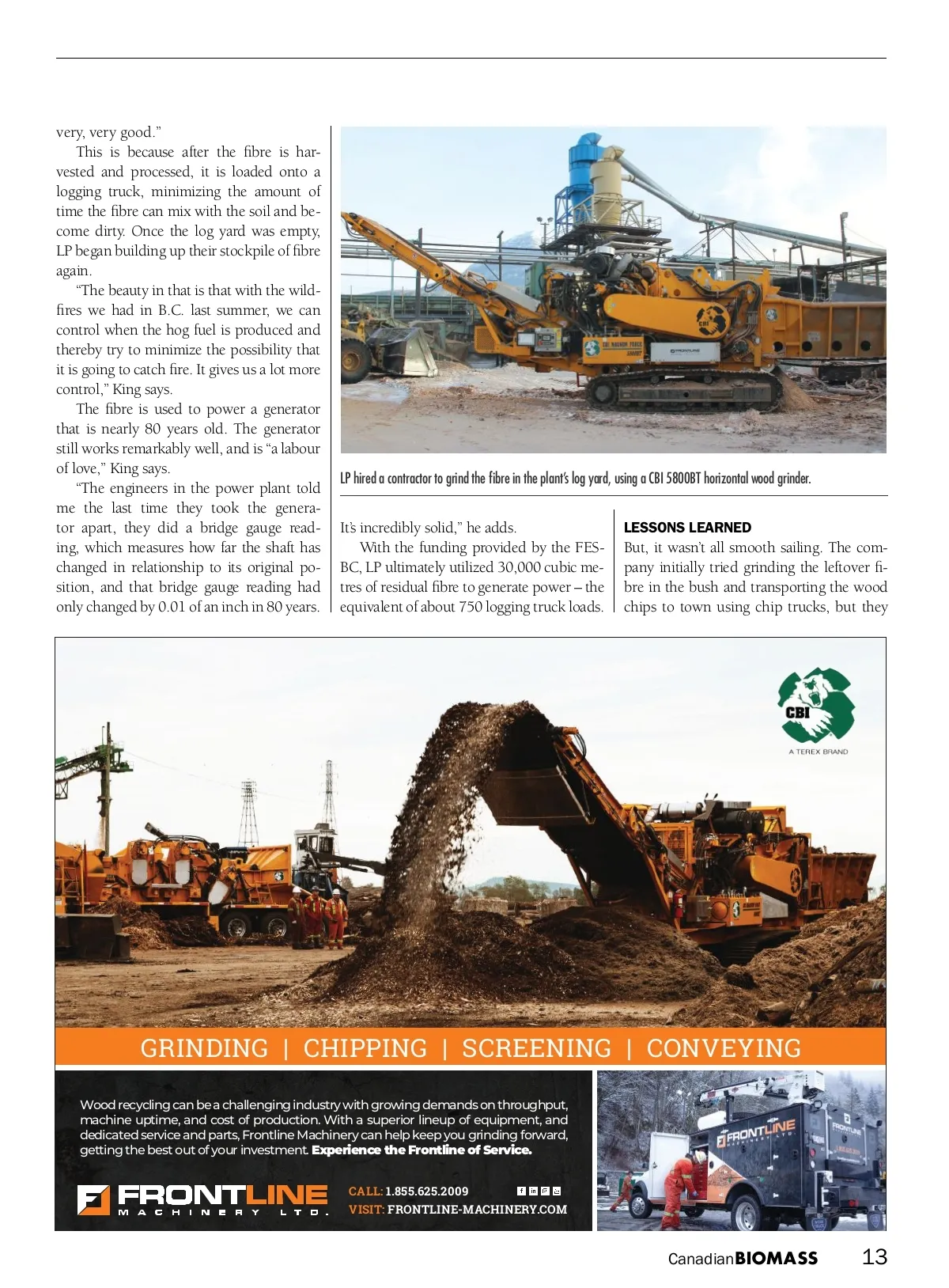
Grinding Project Powerhouse generation LP uses residual wood fibre to bring clean energy to local community By Ellen Cools T he concept of using wood waste to power generators is not a new one. In fact, Louisiana-Pacific (LP) Building Solutions’ facility in Golden, B.C., which produces value-added engineered wood products, has been using residuals from its operations to run a generator since the 1960s. But, as the fibre supply in the province shrinks, the B.C. government has been pushing the forest industry to increase fi-bre utilization from logging operations and reduce the amount of slash pile burning. Consequently, the company has been look-ing for new ways to use trees to their fullest potential. In 2011, LP looked into the pos-sibility of using wood waste leftover from their harvesting operations, but found it wasn’t economically viable at the time. Then, in March 2020, they became aware of the Forest Enhancement Society of BC (FESBC), which provides funding for different fibre utilization projects. LP began considering applying for a grant to give their fibre utilization project another go, conducting an internal economic analysis and meeting with their harvesting contrac-tors, log haulers and the local community to gauge their interest, explains Scott King, RPF , silviculture forester with LP. “If we were going to do this, from the very beginning we had to have meetings with the log haulers, the operators who do all the cutting in the bush; we had to make sure we had all the trucking components taken care of. We had to meet to discuss what we could learn from the project in 2011 and how we could improve on it,” he explains. They then submitted a proposal to FESBC, outlining how the company would take leftover wood waste from the bush to their facility, to be used in their Second World War-era generator to create electricity. According to Gord Pratt, operations Scott King, RPF, silviculture forester with Louisiana-Pacific Building Solutions, in the woodyard at the Golden, B.C., plant. Photos courtesy Louisiana-Pacific Corporation. supervisor with FESBC, the proposal met FESBC’s goals in terms of increasing fibre utilization and reducing slash pile burning, thereby lowering greenhouse gas (GHG) emissions. “There was an opportunity and a de-mand that we could assist with, and we were happy to assist them with getting this material to their facility,” Pratt says. “At the end of the day, they can learn some effi-ciencies to expand their economic radius, so this can continue without funding going forward.” LP initially received a grant of $250,000 and later received additional funding to the tune of $655,000. CLEAN ENERGY In October 2020, the first loads of fibre from the bush began arriving at LP’s facility in Golden. The company then hired a con-tractor to grind the fibre in the plant’s log yard, using a CBI 5800BT horizontal wood grinder. “We had to make sure we had enough fibre to make it economically viable for him, so we had about four months of wood in our log yard before he came in,” King explains. “He came in April 2021, took what we had and ground it all up for the powerhouse to use. The hog fuel produced has been a very good product for power generation.” The fibre itself is especially clean, which King says is one of the benefits to hauling and grinding it themselves rather than sourcing it from someone else. “When you’re getting fibre from some-body else, you’ve got to put in a quality check system because you never know if you’re going to get dirt or rock – it’s just the nature of the business,” he shares. “Whereas here, if we do it, everyone has a vested interest to make sure the quality is SPRING 2022 12 Canadian BIOMASS
Canadian Biomass Spring 2022: Page 12