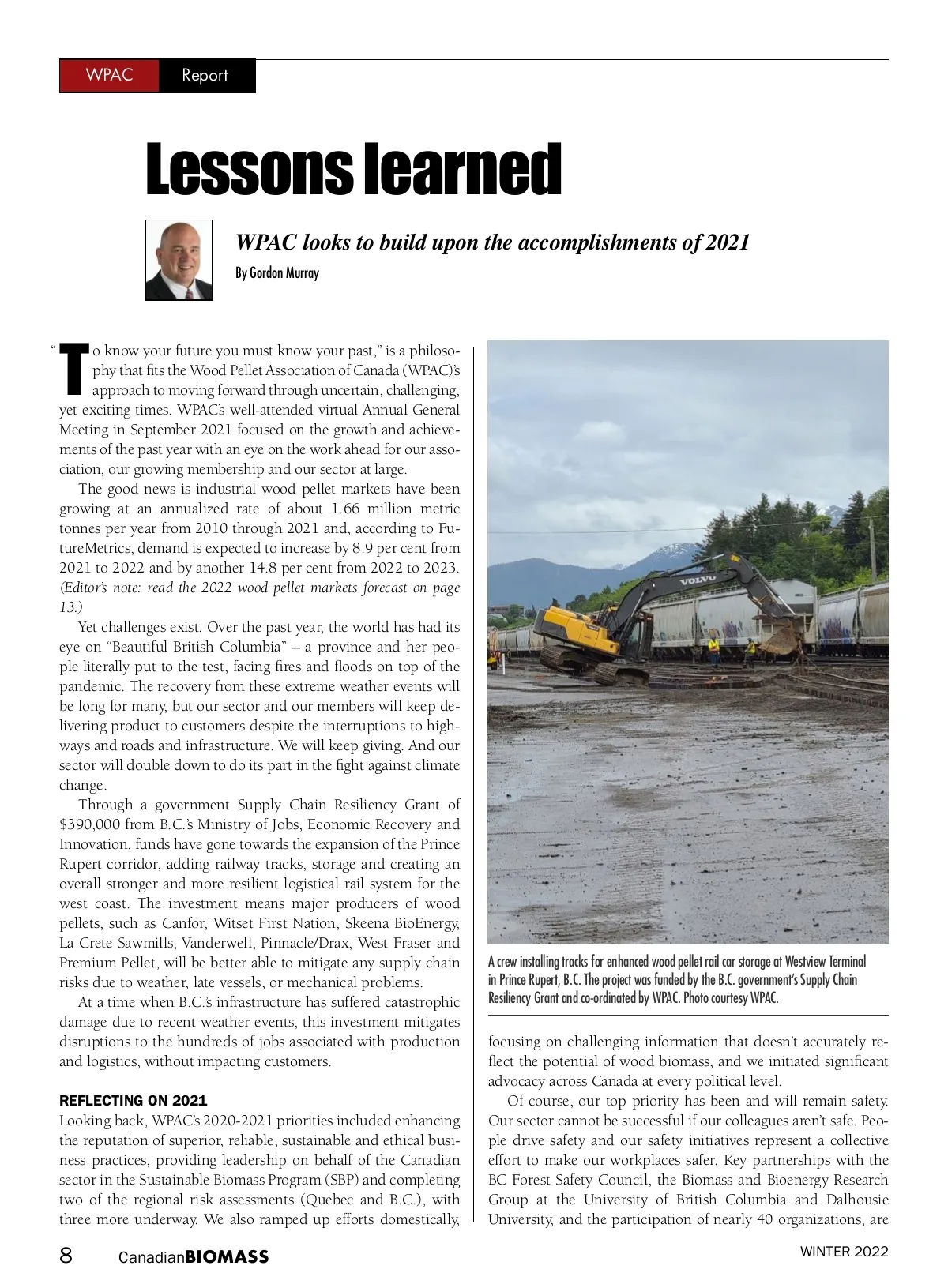
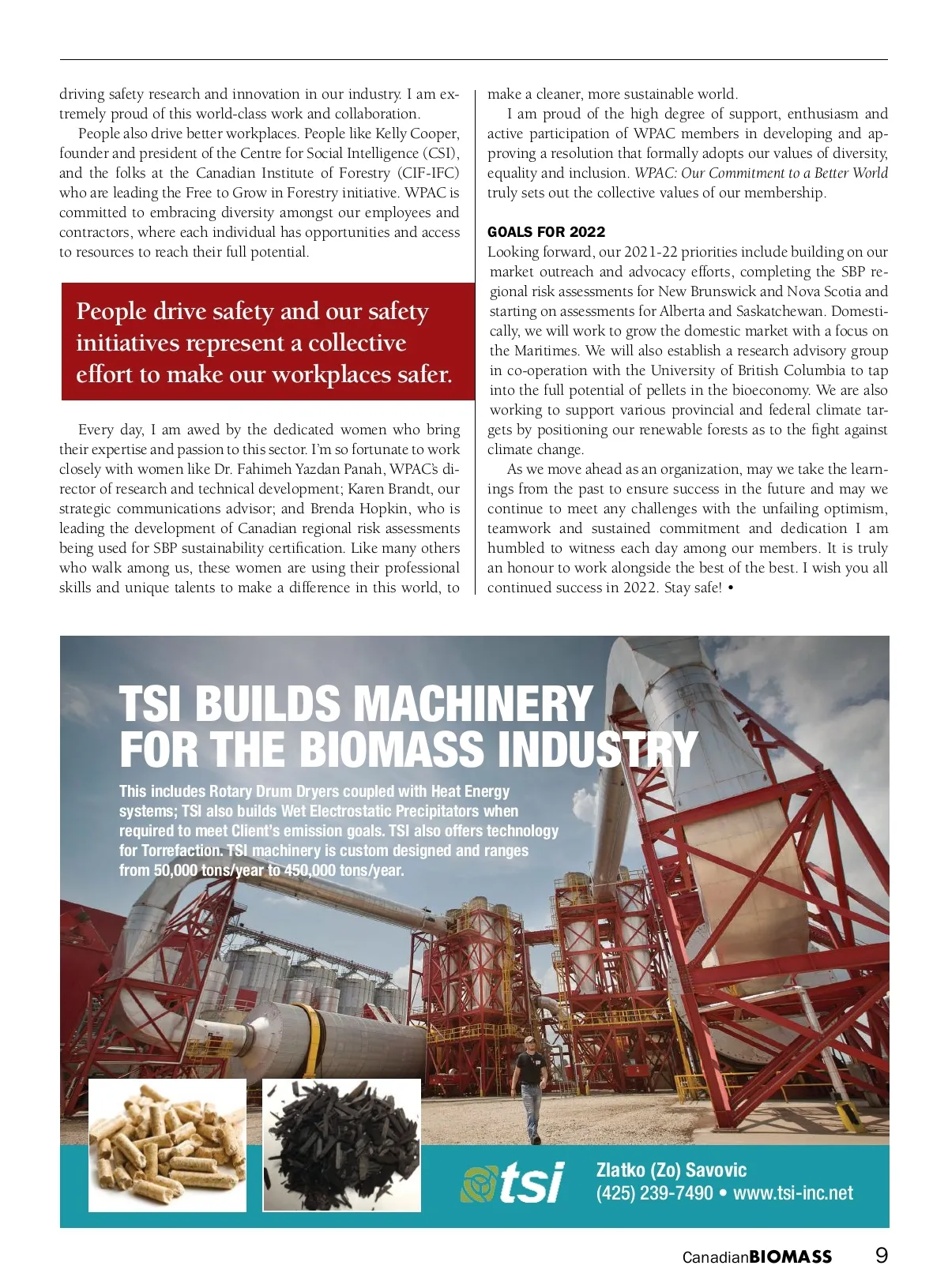
WPAC Report Lessons learned WPAC looks to build upon the accomplishments of 2021 By Gordon Murray “ o know your future you must know your past,” is a philoso-phy that fits the Wood Pellet Association of Canada (WPAC)’s approach to moving forward through uncertain, challenging, yet exciting times. WPAC’s well-attended virtual Annual General Meeting in September 2021 focused on the growth and achieve-ments of the past year with an eye on the work ahead for our asso-ciation, our growing membership and our sector at large. The good news is industrial wood pellet markets have been growing at an annualized rate of about 1.66 million metric tonnes per year from 2010 through 2021 and, according to Fu-tureMetrics, demand is expected to increase by 8.9 per cent from 2021 to 2022 and by another 14.8 per cent from 2022 to 2023. (Editor’s note: read the 2022 wood pellet markets forecast on page 13.) Yet challenges exist. Over the past year, the world has had its eye on “Beautiful British Columbia” – a province and her peo-ple literally put to the test, facing fires and floods on top of the pandemic. The recovery from these extreme weather events will be long for many, but our sector and our members will keep de-livering product to customers despite the interruptions to high-ways and roads and infrastructure. We will keep giving. And our sector will double down to do its part in the fight against climate change. Through a government Supply Chain Resiliency Grant of $390,000 from B.C.’s Ministry of Jobs, Economic Recovery and Innovation, funds have gone towards the expansion of the Prince Rupert corridor, adding railway tracks, storage and creating an overall stronger and more resilient logistical rail system for the west coast. The investment means major producers of wood pellets, such as Canfor, Witset First Nation, Skeena BioEnergy, La Crete Sawmills, Vanderwell, Pinnacle/Drax, West Fraser and Premium Pellet, will be better able to mitigate any supply chain risks due to weather, late vessels, or mechanical problems. At a time when B.C.’s infrastructure has suffered catastrophic damage due to recent weather events, this investment mitigates disruptions to the hundreds of jobs associated with production and logistics, without impacting customers. REFLECTING ON 2021 T A crew installing tracks for enhanced wood pellet rail car storage at Westview Terminal in Prince Rupert, B.C. The project was funded by the B.C. government’s Supply Chain Resiliency Grant and co-ordinated by WPAC. Photo courtesy WPAC. Looking back, WPAC’s 2020-2021 priorities included enhancing the reputation of superior, reliable, sustainable and ethical busi-ness practices, providing leadership on behalf of the Canadian sector in the Sustainable Biomass Program (SBP) and completing two of the regional risk assessments (Quebec and B.C.), with three more underway. We also ramped up efforts domestically, focusing on challenging information that doesn’t accurately re-flect the potential of wood biomass, and we initiated significant advocacy across Canada at every political level. Of course, our top priority has been and will remain safety. Our sector cannot be successful if our colleagues aren’t safe. Peo-ple drive safety and our safety initiatives represent a collective effort to make our workplaces safer. Key partnerships with the BC Forest Safety Council, the Biomass and Bioenergy Research Group at the University of British Columbia and Dalhousie University, and the participation of nearly 40 organizations, are WINTER 2022 8 Canadian BIOMASS
Canadian Biomass Winter 2022: Page 8